Rancho San Joaquin, Irvine
Updated · 4,208 residents
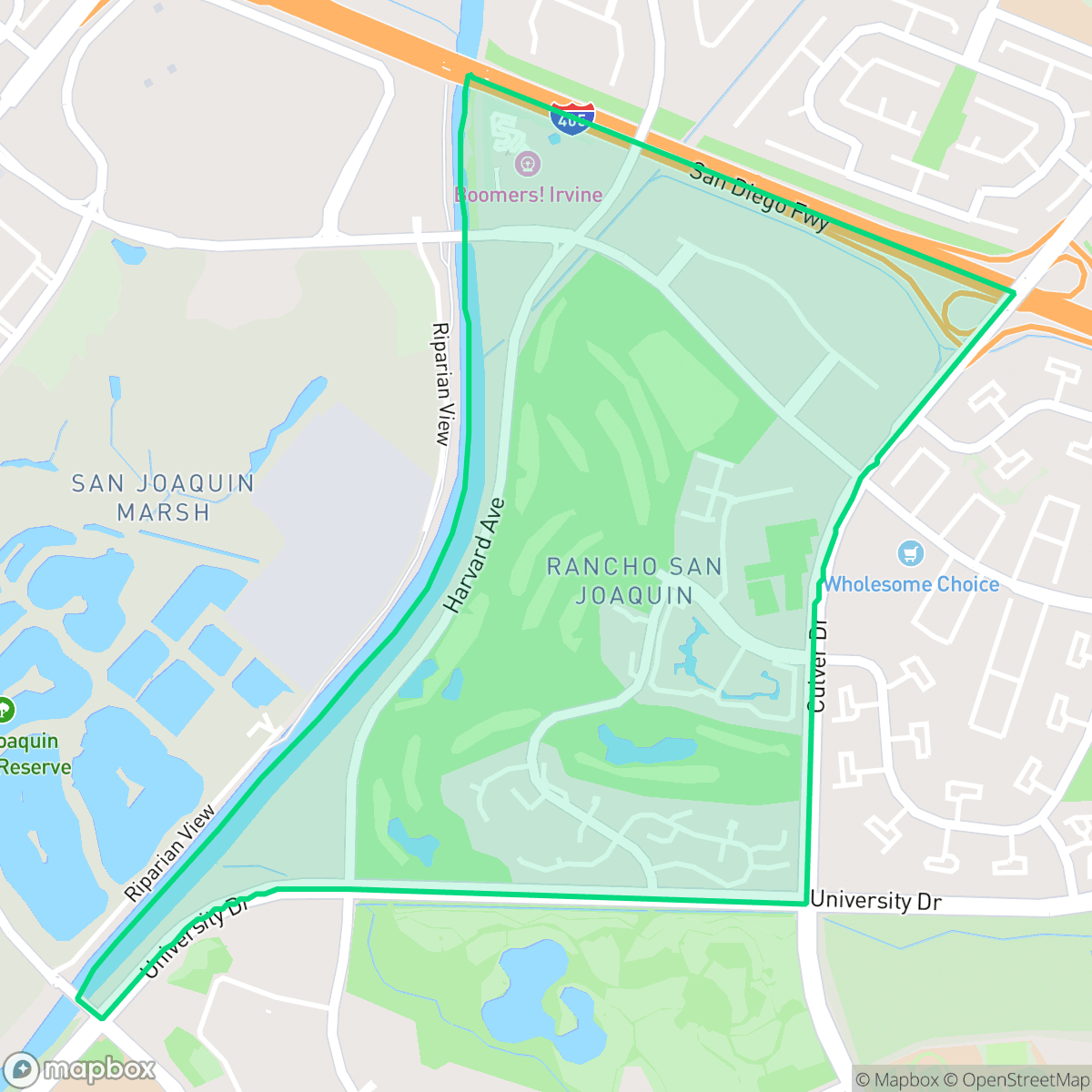
Rancho San Joaquin is a master-planned community in Irvine defined by its integration with a public golf course and a collection of multi-family townhomes. The area offers a quiet, suburban atmosphere with high visual appeal, though residents should expect limited privacy due to the density of the housing. It is served by the highly-rated Irvine Unified School District, making it a stable environment for families and professionals.
Key Highlights
About Rancho San Joaquin
Developed in the 1970s by the Irvine Company, the master-planned village of Rancho San Joaquin is uniquely integrated with Irvine's first public golf course. The neighborhood’s distinctive design features townhomes and condominiums with large plate glass windows and open decks oriented toward the fairways, intentionally omitting detached single-family homes. This modern community directly connects to the area's deep agricultural past; it is home to the Irvine Historical Museum, housed in the oldest remaining building on the Irvine Ranch. Built circa 1877 by James Irvine I as a bunkhouse and cooking wing for the original 1868 San Joaquin Ranch House, the historic structure later served as a golfers' cantina before being dedicated to preserving local history.
This neighborhood functions as a quiet, recreational-focused enclave that prioritizes open green space and manicured surroundings. The landscape is dominated by residential complexes that share walls, creating a dense suburban environment that maintains a strong visual appeal through its proximity to the golf course. While the area lacks the high walkability found in other parts of the city due to surrounding arterial roads, it provides a serene setting for those who value access to tennis courts, swimming pools, and extensive walking paths.
Prospective residents should note that the neighborhood experiences moderate noise levels primarily from road traffic, and the proximity of neighbors results in lower levels of personal privacy. According to iHuus data, the area is free from industrial hazards, contributing to a safe and purely residential atmosphere. It is particularly well-suited for individuals who prioritize proximity to high-performing schools within the Irvine Unified School District and a lifestyle centered around outdoor recreation rather than urban nightlife.
Neighborhood Scores Across 15 Qualities
Residential spacing varies between closely packed apartment complexes and standard suburban homes with small separations. This level of privacy is slightly higher than the Irvine city average according to iHuus data.
Extensive sidewalk networks and clear pedestrian crossings facilitate easy movement on foot, though larger arterial roads can occasionally interrupt the continuity of paths. While extremely accessible, the area is slightly less walkable than the broader Irvine average due to these occasional roadway separations.
Upscale amenities such as tennis courts, community pools, and golf course frontage contribute to a landscape that is more visually polished than the Irvine average. Well-maintained yards and large, multi-car homes define the aesthetic of this area according to iHuus data.
Abundant greenbelts, wide grass verges, and proximity to large natural basins provide excellent opportunities for pet exercise. According to iHuus data, these connected open spaces and buffered sidewalks offer a higher level of dog friendliness than the Irvine average.
Open spaces and water basins are interspersed with dense residential clusters and university facilities. This landscape reflects the typical suburban density found throughout Irvine.
Residential streets and green spaces provide a steady but subdued rhythm of activity, mirroring the general level of liveliness found across Irvine. While certain pockets offer walkable access to local cafes and services, much of the area remains car-dependent with limited commercial density.
Frequent noise from nearby freeways and transit corridors makes this area significantly louder than the Irvine average. According to iHuus data, residents can expect consistent auditory disturbances from heavy vehicle and rail traffic.
Air quality levels fluctuate between acceptable and unhealthy ranges, presenting occasional concerns for sensitive groups. According to iHuus data, the air quality in this area is slightly below the Irvine city average.
Industrial activity is non-existent in this area, as the neighborhood is composed entirely of residential, recreational, and light commercial zones. This absence of heavy manufacturing or warehouses makes the area even more insulated from industrial hazards than the Irvine average, according to iHuus data.
Most residents have access to health insurance, though coverage rates are slightly lower than the Irvine average according to iHuus data.
Political leanings in this area are more liberal than the Irvine average, according to iHuus data.
A balanced demographic spread of young adults, families, and older residents characterizes this area. According to iHuus data, the age distribution is slightly more varied than the Irvine city average.
Flood risk in this area is higher than the Irvine average, though a precise assessment is currently unavailable because official federal studies have not been completed for this specific zone.
Significant fire hazards exist within this area, which represents a higher level of danger than the typical Irvine neighborhood according to iHuus data.
Address-Level Insights for Rancho San Joaquin


iHuus Neighborhood Intelligence Insights
Get address-level neighborhood insights for Rancho San Joaquin
- Street-level scores — see how individual blocks compare, not just neighborhood averages
- Micro-zone boundaries — identify quiet pockets, flood boundaries, and walkable clusters before you visit
- 15 dimensions in full — walkability, noise, air quality, school quality, insurance coverage, population age profile, urban/rural index, and more
- Boundary risk alerts — know if your address sits near a block boundary where scores drop, the kind of detail no listing will ever mention
- School insights — individual school ratings and insights, not just district-level data
- Compare before you commit — side-by-side data across neighborhoods, down to block precision
No credit card required
Compare with Any Neighborhood
| Dimension | Rancho San Joaquin | Business District |
|---|---|---|
| 🚶 Walkabilityavg 9.44 | ||
| 🔊 Acoustic Comfortavg 2.83 | ||
| 🤫 Privacy Indexavg 4.53 | ||
| 🎨 Visual Appealavg 7.36 | ||
| 🐕 Dog Friendlinessavg 7.98 | ||
| 🗺️ Urban-Rural Indexavg 6.69 | ||
| ✨ Neighborhood Vibeavg 4.63 | ||
| 🏥 Health Insurance Coverageavg 8.7 | ||
| 🌿 Air Qualityavg 6.22 | ||
| 🏭 Industrial Proximityavg 9.32 | ||
| 🌊 Flood Safetyavg 3.93 | ||
| 🗳️ Ideological Leanavg 7.23 | ||
| 👥 Population Age Profileavg 4.73 | ||
| 🔥 Fire Safetyavg 0.41 | ||
| 🏫 School Quality |
Rancho San Joaquin Rankings
School Districts Serving Rancho San Joaquin
School Insights for Rancho San Joaquin
Below average outcomes; significant attendance and academic challenges.
School Insights
See what's really behind every school rating near Rancho San Joaquin
- Individual school ratings — each school's own score with outcome context, not just a district average
- Enrollment & class size data — student-to-teacher ratio and how it compares to the state average
- Full demographics breakdown — ethnicity and gender composition for every school in the enrollment zone
- Every school in the district — all schools within the enrollment boundary ranked by rating, not just the closest one
- Grade levels & benchmarks — elementary through high school, with below/above state-average flags
No credit card required