Portola Springs, Irvine
Updated · 2,830 residents
Portola Springs is a master-planned residential community in Irvine characterized by high walkability and proximity to extensive open space. While the area offers a serene, low-density suburban environment, residents experience limited access to local businesses and elevated noise levels from nearby highway traffic.
Key Highlights
About Portola Springs
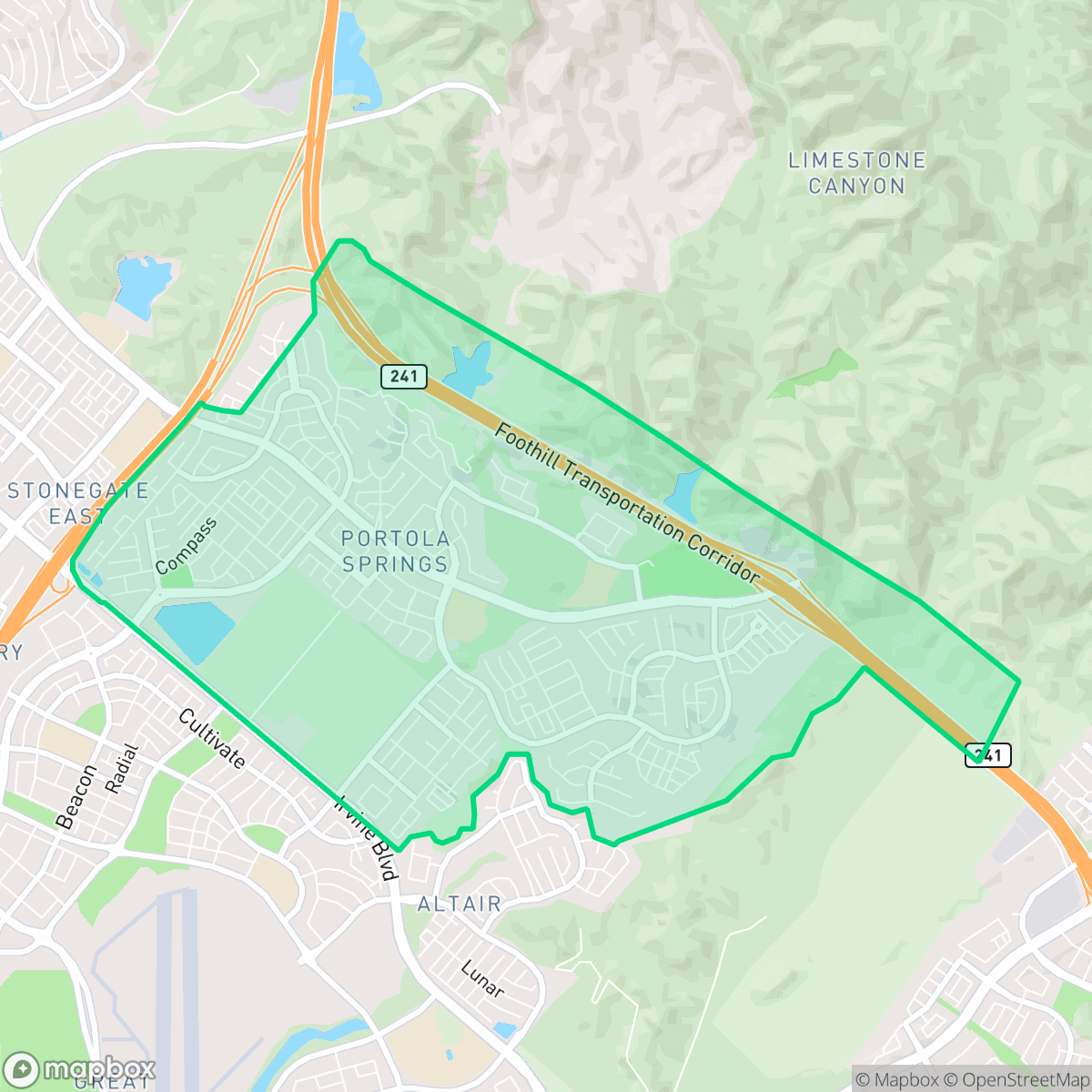
The Portola Springs neighborhood in Irvine, California, sits on land with deep historical significance. For nearly 10,000 years, the rolling hills were inhabited by the Acjachemen (Juaneño) people, who used the sacred, spring-fed site—known as 'U∫rónvanga—for tool manufacturing and solstice celebrations. In July 1769, Spanish explorer Gaspar de Portolà’s expedition camped here near freshwater springs, naming the site El Aguage del Padre Gómez (later called Tomato Springs). When the Irvine Company began developing the master-planned residential community in 2006, they collaborated with Native American leaders to preserve 124 acres of the historic landscape. Today, the Portola Springs Community Park features a Native American garden, interpretive panels, and a community center displaying local archaeological artifacts and fossils unearthed from the hillsides.
The neighborhood functions as a quiet residential enclave defined by its integration with the surrounding hilly landscape. It features a high degree of walkability and access to green space, though it maintains a low-density character with limited commercial development. The area is served by the Irvine Unified School District, with top-rated schools such as Loma Ridge Elementary and Portola Springs Elementary providing consistent educational opportunities for local families.
Living in this area involves specific trade-offs regarding acoustic comfort and regional safety. Residents may notice road traffic noise and should be aware of the higher risk profile for fire events in the surrounding hills. The community is best suited for those prioritizing academic access and a quiet suburban lifestyle over immediate proximity to urban amenities, as the current infrastructure emphasizes residential living and recreational pathways rather than commercial convenience.
Neighborhood Scores Across 15 Qualities
Residential spacing provides a moderate level of separation between homes, though this is slightly lower than the Irvine average. According to iHuus data, neighbors are situated with some buffer, but density remains relatively consistent throughout the area.
Extensive sidewalks and pedestrian-priority zones make navigating the area on foot easy. According to iHuus data, walkability levels remain slightly below the Irvine city average.
Large homes and frequent upscale amenities characterize the area, though the overall visual appeal sits slightly below the Irvine city average according to iHuus data.
Interconnected green spaces and wide, traffic-safe paths provide an environment that is slightly more pet-friendly than the Irvine average, according to iHuus data.
Low-density residential areas transition directly into large tracts of undeveloped hilly open space, providing a more semi-rural feel than the typical Irvine suburb. According to iHuus data, this neighborhood features more frequent access to open land and woodland compared to the city average.
Serene, low-density surroundings offer a peaceful environment with significant open space, though local business density is below the Irvine average. Most daily amenities and dining options require a car, as the area is primarily composed of quiet residential blocks and limited commercial destinations.
Persistent noise from nearby airport runways and heavy transit infrastructure makes this area significantly louder than the Irvine average. Residents can expect frequent acoustic disruptions throughout the day.
Air quality remains mostly clean with only rare instances of elevated readings, performing better than the Irvine average according to iHuus data.
Industrial presence is minimal within the neighborhood, though a nearby Superfund site could potentially impact soil or groundwater quality. This area contains significantly less industrial activity than the Irvine average, consisting mostly of quiet streets and open green spaces.
Health insurance access remains robust for residents, though it sits slightly below the Irvine city average according to iHuus data.
Political leanings in this area lean liberal, sitting slightly more progressive than the Irvine city average according to iHuus data.
Residents live alongside a diverse mix of young adults, families, and older individuals. According to iHuus data, the age distribution is slightly more concentrated in specific age groups than the broader Irvine area.
Properties in this area are located within a designated floodplain, which implies a higher risk of flooding and the likely necessity of flood insurance. According to iHuus data, this risk level is higher than the average for Irvine.
Extreme fire hazards are present in this area, representing a significantly higher risk than the Irvine average. Residents should remain vigilant regarding wildfire precautions and emergency preparedness.
Address-Level Insights for Portola Springs


iHuus Neighborhood Intelligence Insights
Get address-level neighborhood insights for Portola Springs
- Street-level scores — see how individual blocks compare, not just neighborhood averages
- Micro-zone boundaries — identify quiet pockets, flood boundaries, and walkable clusters before you visit
- 15 dimensions in full — walkability, noise, air quality, school quality, insurance coverage, population age profile, urban/rural index, and more
- Boundary risk alerts — know if your address sits near a block boundary where scores drop, the kind of detail no listing will ever mention
- School insights — individual school ratings and insights, not just district-level data
- Compare before you commit — side-by-side data across neighborhoods, down to block precision
No credit card required
Compare with Any Neighborhood
| Dimension | Portola Springs | Business District |
|---|---|---|
| 🚶 Walkabilityavg 9.44 | ||
| 🔊 Acoustic Comfortavg 2.83 | ||
| 🤫 Privacy Indexavg 4.53 | ||
| 🎨 Visual Appealavg 7.36 | ||
| 🐕 Dog Friendlinessavg 7.98 | ||
| 🗺️ Urban-Rural Indexavg 6.69 | ||
| ✨ Neighborhood Vibeavg 4.63 | ||
| 🏥 Health Insurance Coverageavg 8.7 | ||
| 🌿 Air Qualityavg 6.22 | ||
| 🏭 Industrial Proximityavg 9.32 | ||
| 🌊 Flood Safetyavg 3.93 | ||
| 🗳️ Ideological Leanavg 7.23 | ||
| 👥 Population Age Profileavg 4.73 | ||
| 🔥 Fire Safetyavg 0.41 | ||
| 🏫 School Quality |
Portola Springs Rankings
School Districts Serving Portola Springs
School Insights for Portola Springs
Below average outcomes; significant attendance and academic challenges.
School Insights
See what's really behind every school rating near Portola Springs
- Individual school ratings — each school's own score with outcome context, not just a district average
- Enrollment & class size data — student-to-teacher ratio and how it compares to the state average
- Full demographics breakdown — ethnicity and gender composition for every school in the enrollment zone
- Every school in the district — all schools within the enrollment boundary ranked by rating, not just the closest one
- Grade levels & benchmarks — elementary through high school, with below/above state-average flags
No credit card required