Lower Peters Canyon, Irvine
Updated · 22,363 residents
Lower Peters Canyon is a master-planned community in Irvine characterized by high-density residential layouts and exceptional walkability. While residents benefit from proximity to diverse local dining and expansive green spaces like David Sills Lower Peters Canyon Park, the area experiences significant noise levels due to its location near major highway corridors.
Key Highlights
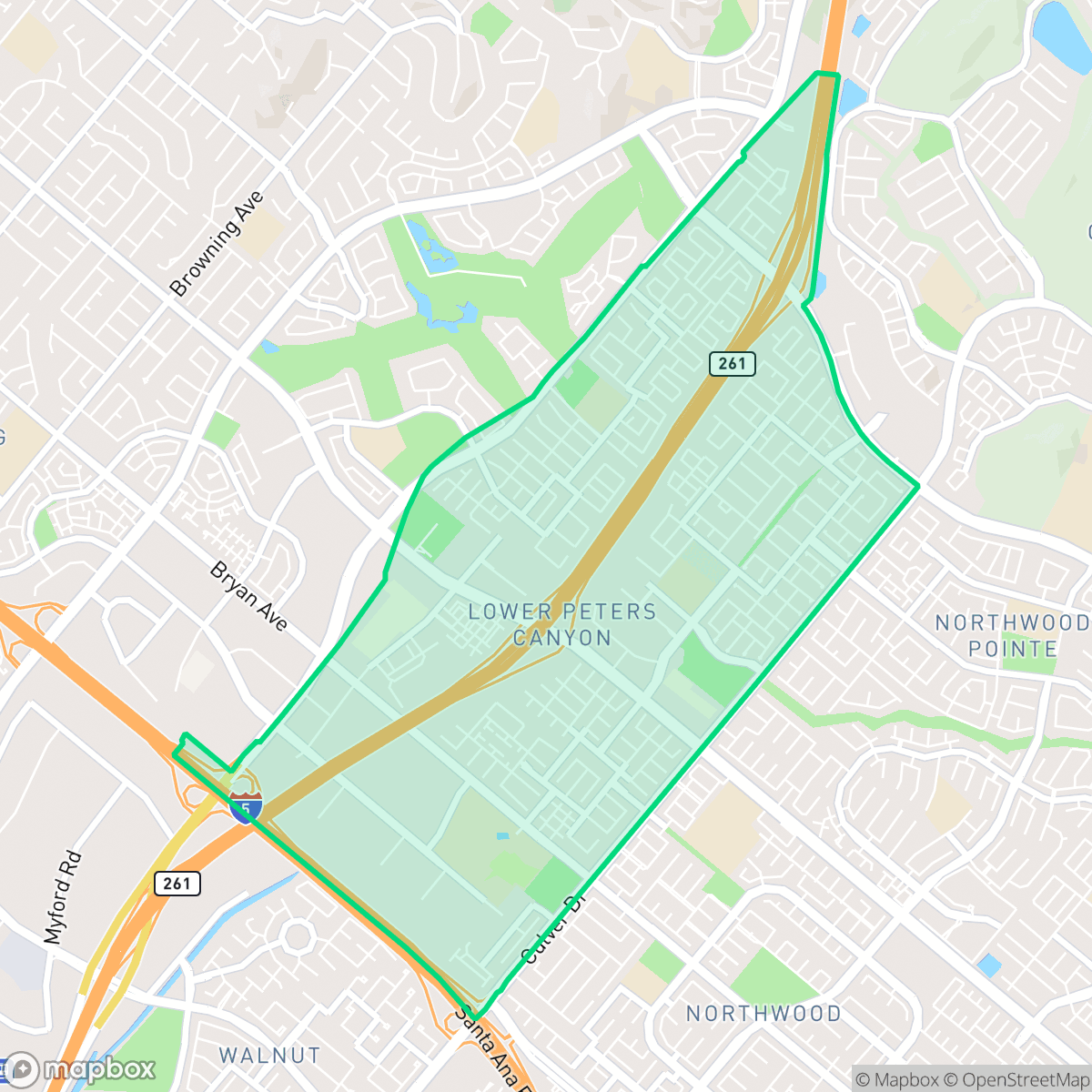
About Lower Peters Canyon
Lower Peters Canyon in Irvine, California, has a rich history transitioning from Spanish ranchos to a modern residential community. Originally part of the 1846 Rancho Lomas de Santiago land grant, the area was known as Cañón de las Ranas (Canyon of the Frogs). In 1897, James Irvine purchased the land and leased it to farmers, including James Peters, who dry-farmed barley and beans. In 1899, the Santiago Golf Club opened Orange County’s first golf course here, featuring oil-soaked sand greens. The Irvine Company built the lower reservoir in 1940 to support agricultural orange orchards; during World War II, this site hosted a U.S. Army training camp known as Camp Commander. In the late 1990s and early 2000s, these agricultural lands were rezoned, transforming the area into a master-planned neighborhood adjacent to the preserved Peters Canyon Regional Park.
The area features a mix of multi-story townhomes, apartment complexes, and single-family tracts, creating a dense suburban environment with high integration between residential clusters, commercial retail centers, and professional office parks. It is highly regarded for its connectivity, featuring a comprehensive network of sidewalks and pedestrian paths that link residents to schools and everyday amenities. According to iHuus data, the neighborhood provides a consistent rhythm of suburban life supported by well-maintained community infrastructure and professional landscaping.
Potential residents should note that the neighborhood is notably loud, with road traffic contributing to elevated noise levels. While the area provides excellent air quality and high health insurance coverage, the high-density development results in limited privacy between neighbors. It is best suited for professionals and families who prioritize school quality and accessibility over quietude and expansive private yards.
Neighborhood Scores Across 15 Qualities
Shared walls and narrow gaps between homes are common in certain sections of the neighborhood. According to iHuus data, the level of privacy and spacing between neighbors is slightly lower than the Irvine average.
Extensive sidewalk networks and dedicated pedestrian bridges provide seamless connectivity throughout the area. According to iHuus data, the pedestrian infrastructure is nearly identical to the broader Irvine average.
Manicured landscaping, large homes, and frequent private pools characterize the local landscape. This area maintains a level of visual appeal that is consistent with the Irvine city average.
Extensive greenbelts, wide parkways, and connected walking paths provide ample space for pets. While highly accessible, the area is slightly below the Irvine average for dog friendliness.
Frequent open land and scattered homes amid woodland characterize this area. This level of open space is slightly below the Irvine average.
A mix of quiet residential streets and occasional lively dining pockets provides a steady rhythm that is slightly more active than the Irvine average. While many social hubs and restaurants are accessible via local paths, the area remains primarily car-dependent due to the suburban layout.
Constant noise from nearby transit infrastructure makes this area significantly louder than the Irvine average. Residents should expect frequent acoustic disruptions due to the proximity of heavy rail or flight paths.
Air quality in this area remains mostly clean with rare instances of elevated readings. According to iHuus data, the air quality is notably better than the Irvine city average.
Industrial activity and large warehouses are entirely absent from this area. According to iHuus data, the neighborhood remains exclusively residential and recreational with no detectable industrial hazards or heavy logistics hubs.
Health insurance accessibility is exceptionally high in this area, surpassing the Irvine city average. According to iHuus data, nearly all residents are covered by a health plan.
Political views in this area lean liberal, which is consistent with the broader Irvine community according to iHuus data.
Residents live alongside a diverse mix of young adults, families, and older individuals. This age distribution is consistent with the broader Irvine area according to iHuus data.
Properties in this area are situated within a designated floodplain, which may necessitate flood insurance. According to iHuus data, the risk level in Lower Peters Canyon is slightly higher than the average for Irvine.
Address-Level Insights for Lower Peters Canyon


iHuus Neighborhood Intelligence Insights
Get address-level neighborhood insights for Lower Peters Canyon
- Street-level scores — see how individual blocks compare, not just neighborhood averages
- Micro-zone boundaries — identify quiet pockets, flood boundaries, and walkable clusters before you visit
- 15 dimensions in full — walkability, noise, air quality, school quality, insurance coverage, population age profile, urban/rural index, and more
- Boundary risk alerts — know if your address sits near a block boundary where scores drop, the kind of detail no listing will ever mention
- School insights — individual school ratings and insights, not just district-level data
- Compare before you commit — side-by-side data across neighborhoods, down to block precision
No credit card required
Compare with Any Neighborhood
| Dimension | Lower Peters Canyon | Business District |
|---|---|---|
| 🚶 Walkabilityavg 9.44 | ||
| 🔊 Acoustic Comfortavg 2.83 | ||
| 🤫 Privacy Indexavg 4.53 | ||
| 🎨 Visual Appealavg 7.36 | ||
| 🐕 Dog Friendlinessavg 7.98 | ||
| 🗺️ Urban-Rural Indexavg 6.69 | ||
| ✨ Neighborhood Vibeavg 4.63 | ||
| 🏥 Health Insurance Coverageavg 8.7 | ||
| 🌿 Air Qualityavg 6.22 | ||
| 🏭 Industrial Proximityavg 9.32 | ||
| 🌊 Flood Safetyavg 3.93 | ||
| 🗳️ Ideological Leanavg 7.23 | ||
| 👥 Population Age Profileavg 4.73 | ||
| 🔥 Fire Safetyavg 0.41 | ||
| 🏫 School Quality |
Lower Peters Canyon Rankings
School Districts Serving Lower Peters Canyon
School Insights for Lower Peters Canyon
Below average outcomes; significant attendance and academic challenges.
School Insights
See what's really behind every school rating near Lower Peters Canyon
- Individual school ratings — each school's own score with outcome context, not just a district average
- Enrollment & class size data — student-to-teacher ratio and how it compares to the state average
- Full demographics breakdown — ethnicity and gender composition for every school in the enrollment zone
- Every school in the district — all schools within the enrollment boundary ranked by rating, not just the closest one
- Grade levels & benchmarks — elementary through high school, with below/above state-average flags
No credit card required