Business District, Irvine
Updated · 10,134 residents
The Business District is a high-density, mixed-use hub located near John Wayne Airport, known for its modern apartment complexes and diverse dining destinations like Diamond Jamboree. While the area offers high walkability and proximity to major employment centers, residents should expect notable noise from surrounding road traffic.
Key Highlights
About Business District
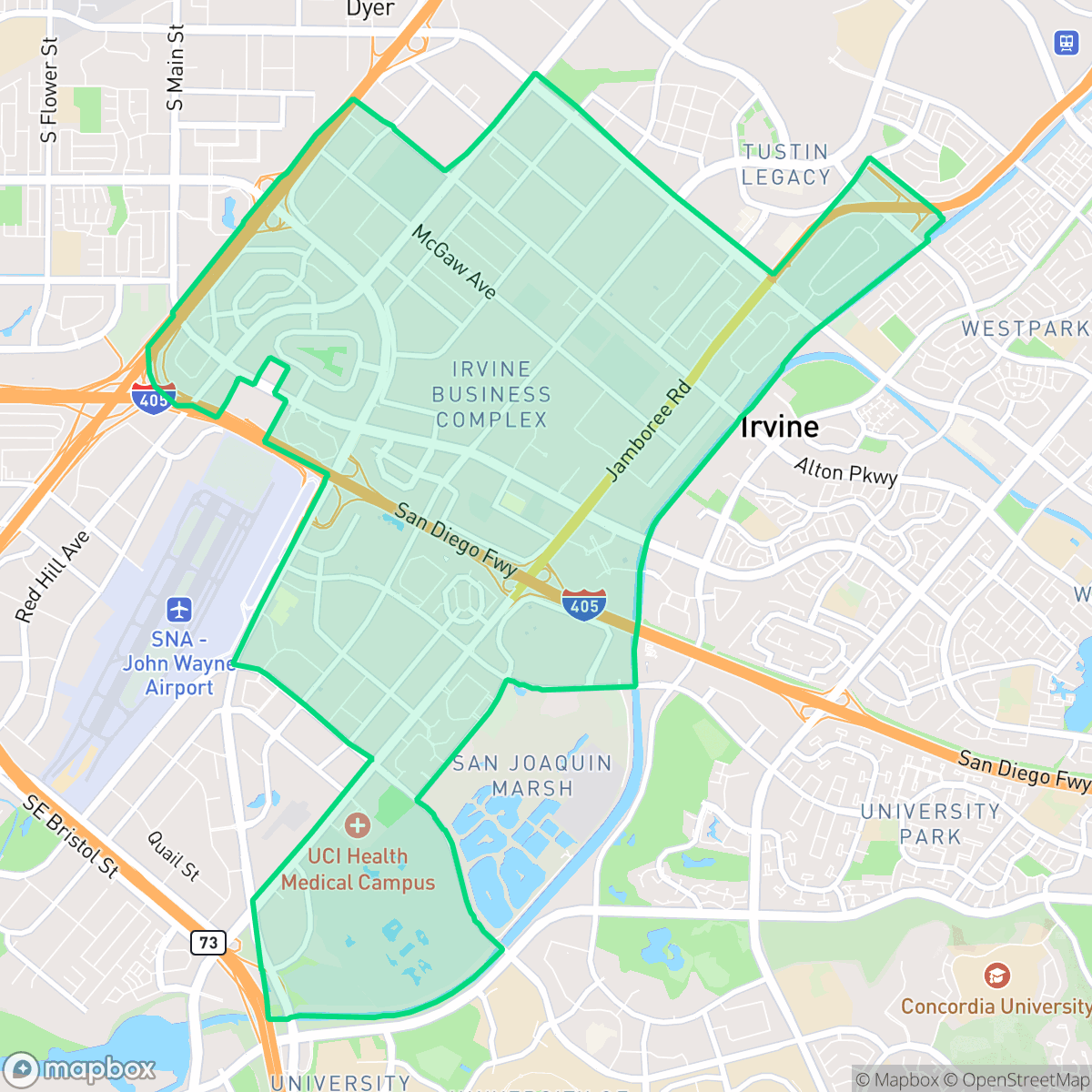
The Business District of Irvine, California, primarily known as the Irvine Business Complex (IBC), is a 2,700-acre neighborhood on the city's western edge near John Wayne Airport. Originally developed in the 1970s exclusively as an industrial and commercial center, the area evolved rapidly as high-rise office towers were built to support Orange County’s growing technology and business sectors. In the mid-1980s, the city introduced residential zoning to the district, which was further structured by the 2010 IBC Vision Plan to transform the industrial hub into a high-density, pedestrian-friendly, mixed-use community. Today, the neighborhood is a bustling live-work-play area featuring modern mid-rise and high-rise architecture, major employment centers, and popular local commercial landmarks like the Diamond Jamboree shopping center and The District.
This area functions as a central node for commerce and residential life in Irvine. It features a dense landscape of mid-rise and high-rise apartment buildings integrated with campus-style office parks. The neighborhood is characterized by an energetic atmosphere that blends industrial utility with modern lifestyle amenities, including popular shopping centers like The District. According to iHuus data, the area maintains a high level of walkability, allowing residents to access daily services and dining options without needing to rely on a vehicle for every errand.
Prospective residents should weigh the benefits of urban convenience against specific environmental factors. The proximity to major thoroughfares and industrial zones results in elevated noise levels from road traffic, and the high-density design means shared walls are common. However, the neighborhood remains an attractive option for professionals and commuters who prioritize access to major transit routes and a vibrant, diverse culinary scene. While the area faces specific challenges regarding fire and flood safety, it provides a stable environment with high health insurance coverage for its population.
Neighborhood Scores Across 15 Qualities
Residential spacing is consistent with the city average, featuring a mix of multi-family complexes and tightly clustered housing. Some areas contain shared walls and narrow gaps between structures, as noted in iHuus data.
Extensive sidewalks, dedicated pedestrian paths, and clearly marked crossings make navigating the area on foot easy. While still slightly below the Irvine average, the neighborhood offers a very high level of connectivity for walkers according to iHuus data.
Manicured landscaping and upscale amenities characterize the area, though the visual landscape is slightly less lush than the Irvine city average. The district features a mix of well-maintained residential tracts and larger, functional commercial developments.
Extensive greenbelts, large parks, and connected trail systems provide ample space for pet activity. While highly accessible for pet owners, the neighborhood level of dog friendliness is slightly below the Irvine average.
A blend of commercial office parks and manicured green belts characterizes this area, making it slightly more built-up than the city average. While large-scale industrial structures and airport infrastructure are present, significant open spaces and nature preserves are also interspersed throughout the district.
Diverse dining and social hubs provide more activity than the city average, though much of this energy is concentrated around car-dependent commercial corridors. While some blocks offer lively amenities, other pockets remain quiet and industrial in nature.
Frequent noise from nearby freeway and transit corridors characterizes this area. Levels of acoustic disturbance are slightly higher than the Irvine average, according to iHuus data.
Air quality levels fluctuate between acceptable and unhealthy, presenting occasional concerns for sensitive groups. This area experiences lower air quality than the Irvine average, according to iHuus data.
Industrial presence is relatively low here, consisting mostly of light commercial activity and office use. This area lacks the heavy manufacturing and large-scale logistics hubs found more frequently elsewhere in Irvine.
Most residents in this area maintain health insurance, though coverage rates are slightly lower than the Irvine city average according to iHuus data.
Political leanings in this area are more liberal than the Irvine average. According to iHuus data, the district contains a liberal majority with a modest opposing presence.
Residents live alongside a varied demographic of young professionals, families, and seniors. According to iHuus data, the age distribution is slightly more concentrated toward specific age brackets compared to the broader Irvine area.
Significant flood risk exists here as the area sits within a designated floodplain; this risk level is notably higher than the Irvine city average according to iHuus data.
Extreme fire hazards are present in this area, representing a significantly higher risk level than the Irvine city average according to iHuus data.
Address-Level Insights for Business District


iHuus Neighborhood Intelligence Insights
Get address-level neighborhood insights for Business District
- Street-level scores — see how individual blocks compare, not just neighborhood averages
- Micro-zone boundaries — identify quiet pockets, flood boundaries, and walkable clusters before you visit
- 15 dimensions in full — walkability, noise, air quality, school quality, insurance coverage, population age profile, urban/rural index, and more
- Boundary risk alerts — know if your address sits near a block boundary where scores drop, the kind of detail no listing will ever mention
- School insights — individual school ratings and insights, not just district-level data
- Compare before you commit — side-by-side data across neighborhoods, down to block precision
No credit card required
Compare with Any Neighborhood
| Dimension | Business District | East Industrial Complex |
|---|---|---|
| 🚶 Walkabilityavg 9.44 | ||
| 🔊 Acoustic Comfortavg 2.83 | ||
| 🤫 Privacy Indexavg 4.53 | ||
| 🎨 Visual Appealavg 7.36 | ||
| 🐕 Dog Friendlinessavg 7.98 | ||
| 🗺️ Urban-Rural Indexavg 6.69 | ||
| ✨ Neighborhood Vibeavg 4.63 | ||
| 🏥 Health Insurance Coverageavg 8.7 | ||
| 🌿 Air Qualityavg 6.22 | ||
| 🏭 Industrial Proximityavg 9.32 | ||
| 🌊 Flood Safetyavg 3.93 | ||
| 🗳️ Ideological Leanavg 7.23 | ||
| 👥 Population Age Profileavg 4.73 | ||
| 🔥 Fire Safetyavg 0.41 | ||
| 🏫 School Quality |
Business District Rankings
School Districts Serving Business District
School Insights for Business District
Below average outcomes; significant attendance and academic challenges.
School Insights
See what's really behind every school rating near Business District
- Individual school ratings — each school's own score with outcome context, not just a district average
- Enrollment & class size data — student-to-teacher ratio and how it compares to the state average
- Full demographics breakdown — ethnicity and gender composition for every school in the enrollment zone
- Every school in the district — all schools within the enrollment boundary ranked by rating, not just the closest one
- Grade levels & benchmarks — elementary through high school, with below/above state-average flags
No credit card required