University Avenue, Davis
Updated · 187 residents
University Avenue is a historic, highly walkable enclave situated between the UC Davis campus and the city's downtown core. Residents benefit from exceptional access to local amenities and pet-friendly spaces, though the area experiences moderate noise levels from nearby traffic.
Key Highlights
About University Avenue
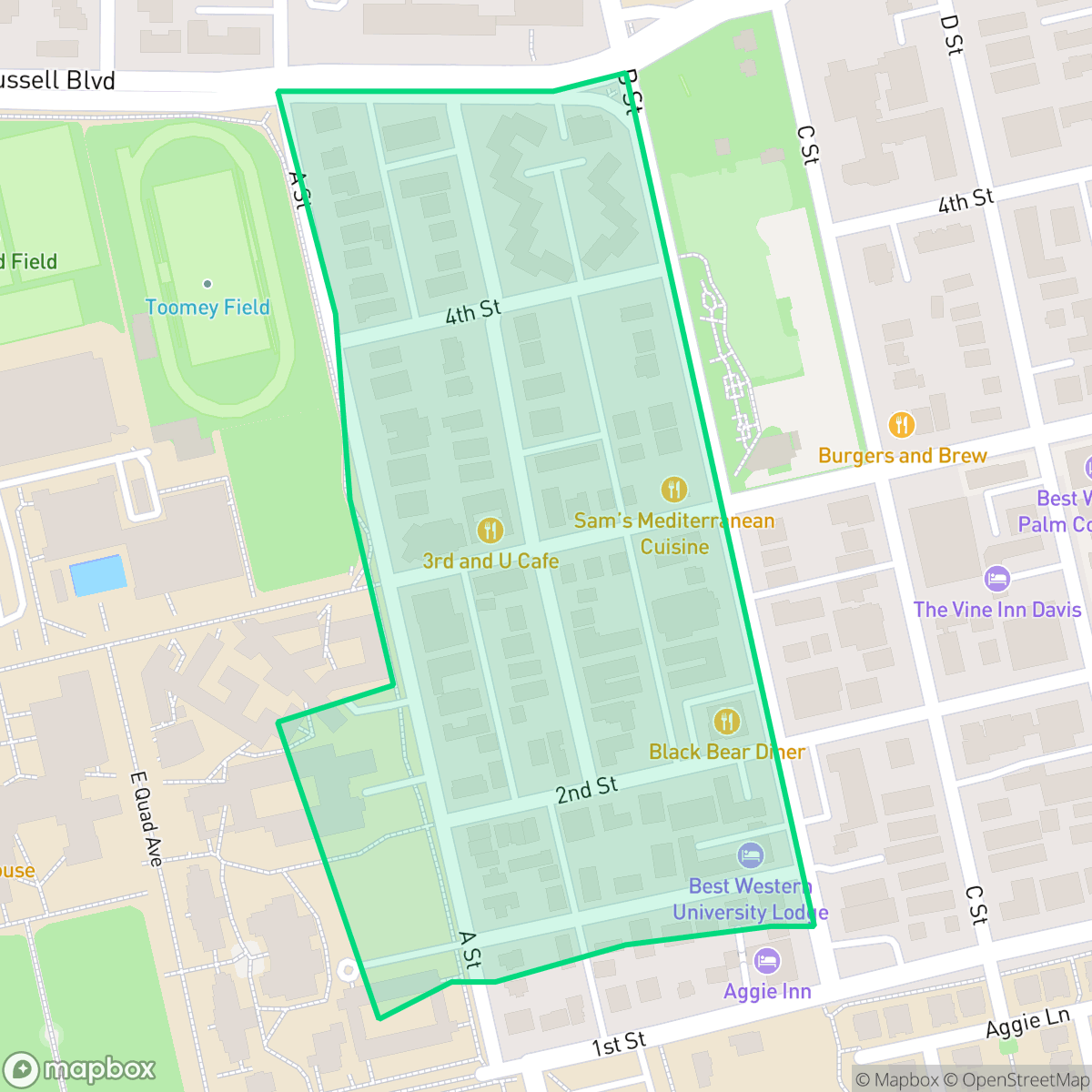
The University Avenue/Rice Lane neighborhood in Davis, California, is a historic residential enclave bounded by the UC Davis campus to the west, Central Park and B Street to the east, and the downtown commercial core. Developed primarily during the late 1920s and 1930s—including parcels within the McDonald Subdivision—the neighborhood is characterized by its Craftsman bungalows and vernacular architecture. Serving as a transition zone between the university and downtown, it historically housed early university faculty, such as UC agricultural engineer Stanley W. McBirney. In 2001, the City of Davis recognized the neighborhood's distinct historical and physical character by designating it as part of the Traditional Residential Neighborhood Conservation District, protecting its low-intensity residential streetscape and historic building stock.
The neighborhood serves as a vibrant transition zone, blending established residential charm with immediate access to the academic and commercial life of Davis. With a perfect walkability score, the area supports a lifestyle where daily errands, dining, and cultural visits to venues like the Gorman Museum are easily managed on foot. The streetscape is defined by a dense, traditional atmosphere that fosters a strong sense of community, while its proximity to Central Park provides essential green space for residents and their pets.
Living in this area involves navigating specific trade-offs, particularly regarding noise levels and environmental factors. While the neighborhood is highly desirable for its location, the acoustic environment is influenced by road traffic, and prospective residents should be aware of nearby historical industrial sites that require ongoing monitoring for soil quality. It is an ideal setting for those who prioritize connectivity and a pedestrian-oriented lifestyle over absolute quiet or suburban seclusion, appealing particularly to individuals who value being at the heart of the city's activity.
Neighborhood Scores Across 15 Qualities
Residential lots feature mixed spacing with some buffer between neighbors. According to iHuus data, this level of density is slightly higher than the Davis city average.
Pedestrian infrastructure is exceptional in this area, featuring a complete sidewalk grid and dedicated paths near parks. According to iHuus data, the level of walkability here is even higher than the typical Davis average.
Uniform rooflines and tidy yards characterize this area, though the visual landscape is less lush than the Davis average. Most properties feature standard suburban architecture with some private backyard pools visible in certain sections.
Abundant green verges, parks, and large sports fields provide ample space for pets. According to iHuus data, the neighborhood offers slightly more accessible walking areas than the Davis average.
A dense suburban layout features a combination of single-family homes, apartments, and commercial blocks. This area is slightly less rural than the Davis average, offering more concentrated development than the surrounding outskirts.
A noticeable concentration of local dining and cultural sites creates a more active atmosphere than the typical Davis neighborhood. According to iHuus data, the area features a steady stream of social activity driven by nearby parks and diverse eateries.
Ongoing street noise from a busy thoroughfare is common here. According to iHuus data, acoustic levels are slightly higher than the Davis average.
Air quality is consistently good with rare instances of elevated readings. This level of cleanliness is typical for the Davis area according to iHuus data.
This area is composed entirely of residential, commercial, and educational zones with no detected warehouses or hazardous industrial facilities. According to iHuus data, this neighborhood has a much lower presence of industrial structures than the Davis average, though a nearby Superfund site may pose potential environmental considerations regarding soil or waste contaminants.
Health insurance coverage among residents is consistent with the Davis city average. According to iHuus data, most members of this community have access to comprehensive health coverage.
Voting patterns and census indicators reflect a deeply liberal political leaning that is slightly more pronounced than the Davis city average, according to iHuus data.
Residents consist primarily of young adults, with a slightly lower proportion of families and older adults compared to the Davis average according to iHuus data.
Significant flood risk exists here as the area is situated within a 100-year floodplain. According to iHuus data, this level of risk is considerably higher than the average for Davis.
Address-Level Insights for University Avenue


iHuus Neighborhood Intelligence Insights
Get address-level neighborhood insights for University Avenue
- Street-level scores — see how individual blocks compare, not just neighborhood averages
- Micro-zone boundaries — identify quiet pockets, flood boundaries, and walkable clusters before you visit
- 15 dimensions in full — walkability, noise, air quality, school quality, insurance coverage, population age profile, urban/rural index, and more
- Boundary risk alerts — know if your address sits near a block boundary where scores drop, the kind of detail no listing will ever mention
- School insights — individual school ratings and insights, not just district-level data
- Compare before you commit — side-by-side data across neighborhoods, down to block precision
No credit card required
Compare with Any Neighborhood
| Dimension | University Avenue | Adams Terrace |
|---|---|---|
| 🚶 Walkabilityavg 9.47 | ||
| 🔊 Acoustic Comfortavg 4.41 | ||
| 🤫 Privacy Indexavg 5.8 | ||
| 🎨 Visual Appealavg 7.21 | ||
| 🐕 Dog Friendlinessavg 8.49 | ||
| 🗺️ Urban-Rural Indexavg 6.91 | ||
| ✨ Neighborhood Vibeavg 5.48 | ||
| 🏥 Health Insurance Coverageavg 8.51 | ||
| 🌿 Air Qualityavg 8 | ||
| 🏭 Industrial Proximityavg 7.1 | ||
| 🌊 Flood Safetyavg 5.58 | ||
| 🗳️ Ideological Leanavg 9.76 | ||
| 👥 Population Age Profileavg 4.21 | ||
| 🔥 Fire Safety | ||
| 🏫 School Quality |
University Avenue Rankings
School Districts Serving University Avenue
School Insights for University Avenue
Below average outcomes; significant attendance and academic challenges.
School Insights
See what's really behind every school rating near University Avenue
- Individual school ratings — each school's own score with outcome context, not just a district average
- Enrollment & class size data — student-to-teacher ratio and how it compares to the state average
- Full demographics breakdown — ethnicity and gender composition for every school in the enrollment zone
- Every school in the district — all schools within the enrollment boundary ranked by rating, not just the closest one
- Grade levels & benchmarks — elementary through high school, with below/above state-average flags
No credit card required