Olive Drive, Davis
Updated · 444 residents
Olive Drive is a compact, highly walkable enclave in Davis known for its bohemian character and central access to local dining and social hubs. While it offers a convenient lifestyle for residents, the area is notably loud due to its immediate proximity to major road and rail traffic.
Key Highlights
About Olive Drive
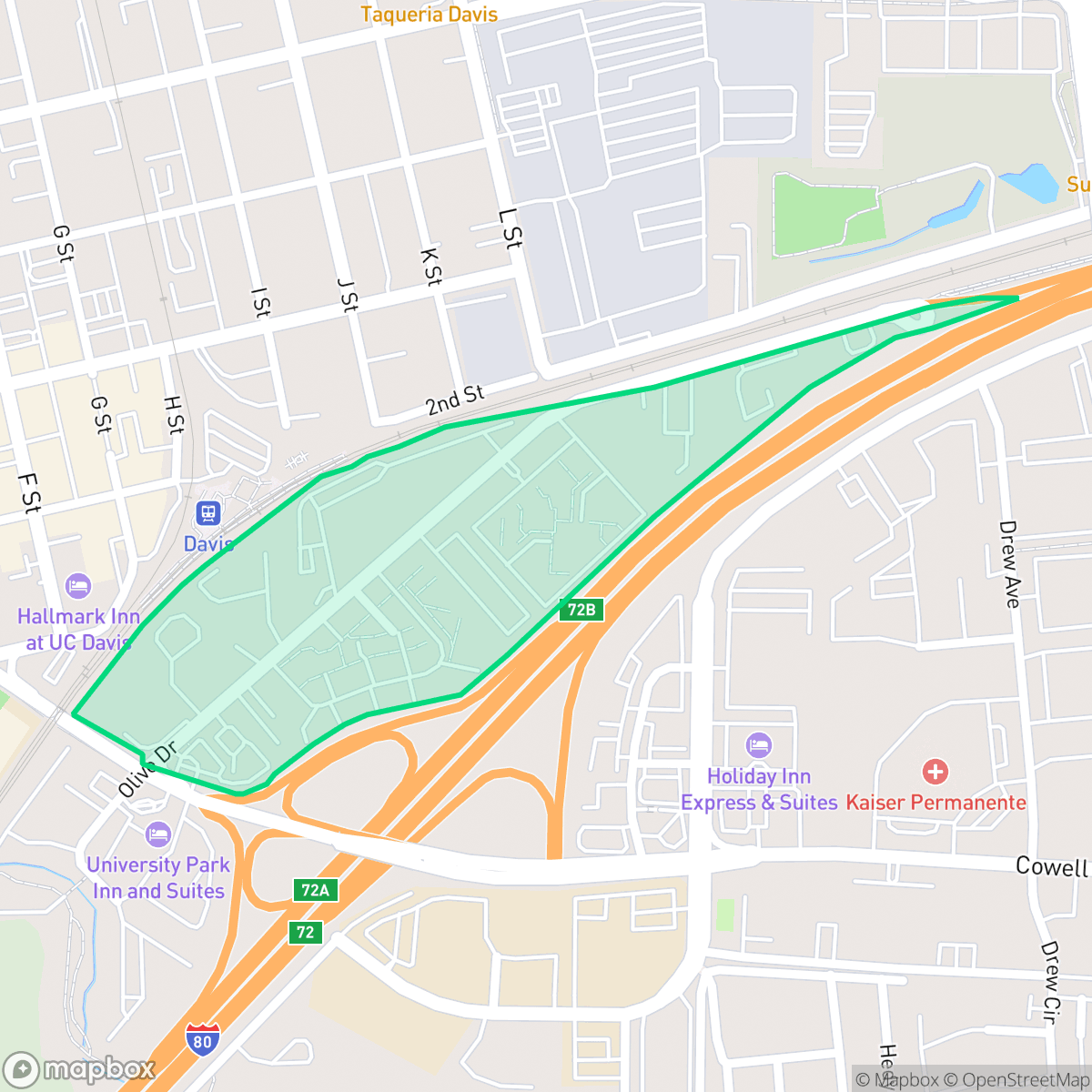
Nestled between the railroad tracks and Interstate 80, the Olive Drive neighborhood in Davis, California, originated in the late 1920s as a key segment of the historic Lincoln Highway. Shaded by landmark cork oaks and fruit-bearing olive trees, the neighborhood is defined by its distinct small-town feel and bohemian character. Its central landmark is Slatter’s Court, established in the 1920s as a roadside gas station, campsite, and motor court for transcontinental travelers. Over the decades, the court's cabins and community spaces evolved into an eclectic, affordable housing enclave for local artists, musicians, and students. Today, Olive Drive remains a unique, non-conformist pocket of Davis, where the former Lincoln Highway gas station still stands as a local barber shop.
The neighborhood functions as a vibrant, mixed-use corridor that blends residential blocks with accessible commercial services. Residents enjoy immediate access to a variety of dining options, including local sushi and Mexican restaurants, alongside popular social destinations like the John Natsoulas Gallery and Dutch Bros. Coffee. The area maintains a high level of connectivity, with a grid layout that ensures most daily errands can be completed on foot. According to iHuus data, the community benefits from high health insurance coverage rates and a stable academic environment supported by the Davis Joint Unified School District. Prospective residents should account for the high ambient noise levels resulting from the nearby interstate and railroad tracks. While the location offers excellent walkability, it faces specific challenges regarding flood and fire safety. It is best suited for individuals who prioritize a central location and transit access over a quiet residential environment.
Neighborhood Scores Across 15 Qualities
Housing density is moderate with some buffering between neighbors; this level of spacing is slightly higher than the Davis city average according to iHuus data.
Frequent crosswalks and a structured grid layout with wide sidewalks on both sides make navigating the area on foot easy. This level of pedestrian accessibility is very similar to the rest of the city.
Housing consists of modest lot sizes and uniform architecture. This visual character is less varied than the typical scenery found throughout Davis, according to iHuus data.
Nearby park areas and tree-lined verges offer decent walking space, though overall access to dedicated pet amenities is lower than the Davis average according to iHuus data.
Open land and scattered homes characterize this area, though it feels slightly more developed than the Davis average. According to iHuus data, the landscape features a mix of low-rise commercial buildings, apartment blocks, and dense residential pockets.
Diverse dining options and local social hubs provide a steady activity level that matches the city average. According to iHuus data, the area balances high-energy blocks near major transit corridors with quieter pockets of green space and dog parks.
Frequent noise from nearby transit corridors, including a railroad and busy roadway, makes this area significantly louder than the Davis average. According to iHuus data, residents can expect persistent acoustic disruptions throughout the day.
Air quality is consistently good with rare instances of elevated readings, matching the typical levels found across Davis.
Commercial and light industrial units are integrated with residential areas, resulting in more industrial proximity than the Davis average. This area includes proximity to an EPA Superfund site where environmental contaminants may affect the soil and air quality, according to iHuus data.
Health insurance access is widespread among residents, appearing significantly higher than the Davis average according to iHuus data.
Voting patterns and census indicators in Olive Drive reflect a deeply liberal leaning, consistent with the broader Davis area.
Young adults make up the majority of the population here, creating a demographic that is notably younger than the Davis city average. According to iHuus data, there is a modest presence of families and older residents, but the area leans heavily toward a student or early-career age profile.
Property within this area is located in a designated floodplain, which indicates a much higher risk of flooding than the Davis average. According to iHuus data, residents may find that flood insurance is a typical requirement for properties here.
Address-Level Insights for Olive Drive


iHuus Neighborhood Intelligence Insights
Get address-level neighborhood insights for Olive Drive
- Street-level scores — see how individual blocks compare, not just neighborhood averages
- Micro-zone boundaries — identify quiet pockets, flood boundaries, and walkable clusters before you visit
- 15 dimensions in full — walkability, noise, air quality, school quality, insurance coverage, population age profile, urban/rural index, and more
- Boundary risk alerts — know if your address sits near a block boundary where scores drop, the kind of detail no listing will ever mention
- School insights — individual school ratings and insights, not just district-level data
- Compare before you commit — side-by-side data across neighborhoods, down to block precision
No credit card required
Compare with Any Neighborhood
| Dimension | Olive Drive | Adams Terrace |
|---|---|---|
| 🚶 Walkabilityavg 9.47 | ||
| 🔊 Acoustic Comfortavg 4.41 | ||
| 🤫 Privacy Indexavg 5.8 | ||
| 🎨 Visual Appealavg 7.21 | ||
| 🐕 Dog Friendlinessavg 8.49 | ||
| 🗺️ Urban-Rural Indexavg 6.91 | ||
| ✨ Neighborhood Vibeavg 5.48 | ||
| 🏥 Health Insurance Coverageavg 8.51 | ||
| 🌿 Air Qualityavg 8 | ||
| 🏭 Industrial Proximityavg 7.1 | ||
| 🌊 Flood Safetyavg 5.58 | ||
| 🗳️ Ideological Leanavg 9.76 | ||
| 👥 Population Age Profileavg 4.21 | ||
| 🔥 Fire Safety | ||
| 🏫 School Quality |
Olive Drive Rankings
School Districts Serving Olive Drive
School Insights for Olive Drive
Below average outcomes; significant attendance and academic challenges.
School Insights
See what's really behind every school rating near Olive Drive
- Individual school ratings — each school's own score with outcome context, not just a district average
- Enrollment & class size data — student-to-teacher ratio and how it compares to the state average
- Full demographics breakdown — ethnicity and gender composition for every school in the enrollment zone
- Every school in the district — all schools within the enrollment boundary ranked by rating, not just the closest one
- Grade levels & benchmarks — elementary through high school, with below/above state-average flags
No credit card required