Old East Davis, Davis
Updated · 435 residents
Old East Davis is a highly walkable historic district defined by its grid layout and immediate proximity to downtown amenities. While the area offers excellent access to local dining and services, residents experience significant noise from nearby railroad tracks and road traffic.
Key Highlights
About Old East Davis
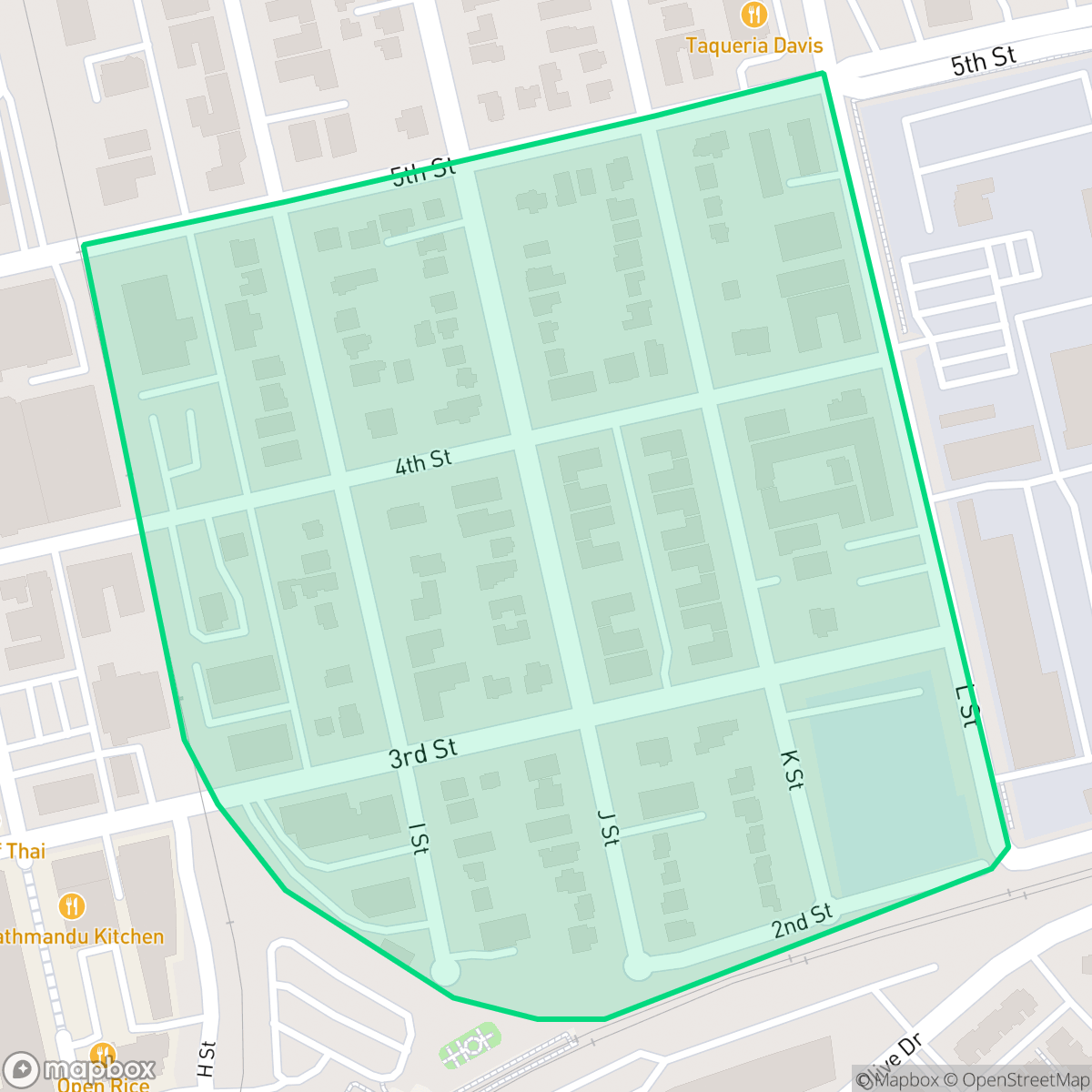
Old East Davis is a historic neighborhood and designated conservation district in Davis, California, bounded by the railroad tracks, L Street, 2nd Street, and 5th Street. Originally part of the 1868 "Davisville" townsite, the neighborhood is situated east and north of the tracks. Its first residence, the Drummond House, was built in 1876 by William S. Williams. Today, the neighborhood preserves its unique architectural character under the city's Traditional Residential Neighborhood Design Guidelines. It features eight homes on the historic registry, six traditional homes, and three landmark trees. Notably, Old East Davis has served as a sanctuary for vintage homes relocated from the downtown core to protect them from demolition while facilitating compatible urban densification. The Old East Davis Neighborhood Association, founded in 1987, actively preserves these historical assets.
The neighborhood functions as a dense, transit-oriented enclave that balances historical preservation with modern convenience. Residents benefit from exceptional walkability, allowing for easy access to nearby social hubs like the John Natsoulas Gallery and various dining options. According to iHuus data, the area maintains a high level of ideological alignment and strong health insurance coverage, reflecting a stable and community-focused population base.
Prospective residents should weigh the architectural charm against specific livability trade-offs. The acoustic environment is notably challenging due to the proximity of active rail lines and major roads, which results in elevated noise levels. Additionally, the area faces specific environmental considerations, including its location within an extended zone of an EPA Superfund site. This neighborhood is best suited for those who prioritize walkability and proximity to the city center over absolute quiet or expansive outdoor space.
Neighborhood Scores Across 15 Qualities
Residential spacing offers a moderate level of separation between neighbors, which is slightly higher than the Davis average. Houses are situated relatively close together, though small yards and fences provide a modest buffer between properties.
Pedestrian access is exceptional here due to a comprehensive sidewalk network and frequent crosswalks that connect residential zones to local parks. This level of connectivity and ease of movement is even higher than the Davis city average, according to iHuus data.
Typical suburban layouts feature modest yards and boxy rooflines. According to iHuus data, the visual variety in this area is lower than the Davis average.
Connected greenbelts and visible parklands on the western edge provide ample space for pets. While walking options are plentiful due to street trees and wide paths, the area is slightly less dog-friendly than the Davis city average.
Residential areas feature a blend of single-family homes and apartment blocks interspersed with pockets of open land. This layout is slightly less rural than the typical Davis landscape, according to iHuus data.
Diverse dining options and social hubs provide a slightly more active atmosphere than the Davis average. Residents can find a mix of high-energy commercial blocks and quieter, green suburban spaces near local parks.
Steady traffic sounds from nearby busy streets are common here, resulting in acoustic levels slightly below the Davis average according to iHuus data.
Air quality is consistently good with infrequent periods of elevated readings. This level of cleanliness is consistent with the average found throughout Davis.
Light industrial and commercial units exist alongside residential development, resulting in more industrial proximity than the Davis average. According to iHuus data, some areas are located near an EPA Superfund site where potential soil and groundwater contaminants may affect the environment.
Health insurance access is nearly universal among residents, significantly surpassing the Davis city average according to iHuus data.
Voting patterns and census indicators show a deeply liberal political leaning that is slightly more pronounced than the Davis average, according to iHuus data.
Residents live alongside a balanced mix of young adults, families, and older individuals. This demographic variety is slightly lower than the average seen across Davis, according to iHuus data.
Flood risk levels in this area remain uncertain because official detailed studies have not been completed. According to iHuus data, the potential for flooding is higher than the Davis average.
Address-Level Insights for Old East Davis


iHuus Neighborhood Intelligence Insights
Get address-level neighborhood insights for Old East Davis
- Street-level scores — see how individual blocks compare, not just neighborhood averages
- Micro-zone boundaries — identify quiet pockets, flood boundaries, and walkable clusters before you visit
- 15 dimensions in full — walkability, noise, air quality, school quality, insurance coverage, population age profile, urban/rural index, and more
- Boundary risk alerts — know if your address sits near a block boundary where scores drop, the kind of detail no listing will ever mention
- School insights — individual school ratings and insights, not just district-level data
- Compare before you commit — side-by-side data across neighborhoods, down to block precision
No credit card required
Compare with Any Neighborhood
| Dimension | Old East Davis | Adams Terrace |
|---|---|---|
| 🚶 Walkabilityavg 9.47 | ||
| 🔊 Acoustic Comfortavg 4.41 | ||
| 🤫 Privacy Indexavg 5.8 | ||
| 🎨 Visual Appealavg 7.21 | ||
| 🐕 Dog Friendlinessavg 8.49 | ||
| 🗺️ Urban-Rural Indexavg 6.91 | ||
| ✨ Neighborhood Vibeavg 5.48 | ||
| 🏥 Health Insurance Coverageavg 8.51 | ||
| 🌿 Air Qualityavg 8 | ||
| 🏭 Industrial Proximityavg 7.1 | ||
| 🌊 Flood Safetyavg 5.58 | ||
| 🗳️ Ideological Leanavg 9.76 | ||
| 👥 Population Age Profileavg 4.21 | ||
| 🔥 Fire Safety | ||
| 🏫 School Quality |
Old East Davis Rankings
School Districts Serving Old East Davis
School Insights for Old East Davis
Below average outcomes; significant attendance and academic challenges.
School Insights
See what's really behind every school rating near Old East Davis
- Individual school ratings — each school's own score with outcome context, not just a district average
- Enrollment & class size data — student-to-teacher ratio and how it compares to the state average
- Full demographics breakdown — ethnicity and gender composition for every school in the enrollment zone
- Every school in the district — all schools within the enrollment boundary ranked by rating, not just the closest one
- Grade levels & benchmarks — elementary through high school, with below/above state-average flags
No credit card required