Old Davis North, Davis
Updated · 633 residents
Old Davis North is an exceptionally walkable neighborhood defined by its historic character and central location near the city's civic center. Residents enjoy easy access to local parks and amenities, though the area experiences moderate noise levels from nearby road traffic and the railway.
Key Highlights
About Old Davis North
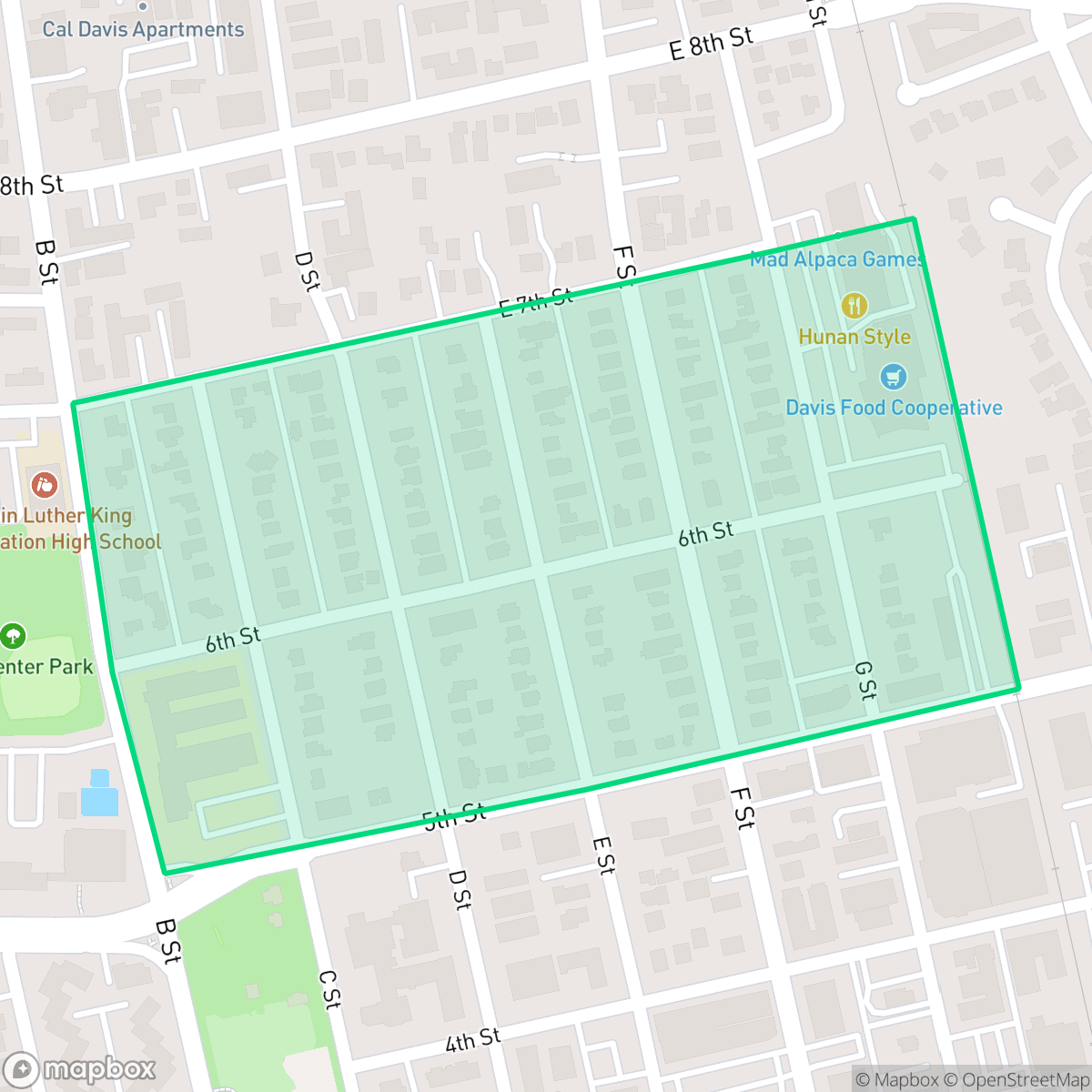
Old Davis North, historically established in 1913 as the Bowers Addition, is one of the most architecturally distinct neighborhoods in Davis, California. Developed by C.W. Bowers, the area bounded by Fifth, Seventh, B, and G Streets was built out between the 1910s and 1940s. Its residential stock comprises approximately 140 pre-1950 homes, split between craftsman bungalows from the 1910s and 1920s—such as the unaltered 1913 Liggett House—and cottages from the 1930s and 1940s. The neighborhood is also notable for preserving historical structures relocated from downtown, including the 1903 Queen Anne style Anderson-Hamel House, built by Davis’s first mayor, John B. Anderson. Today, Old Davis North is protected under the city's Conservation District guidelines to maintain its tree-lined streets and historic character.
The neighborhood functions as a dense, suburban-style community that blends residential streets with commercial and educational blocks. Its layout is highly conducive to pedestrian activity, featuring a complete grid of sidewalks and paths that connect to landmarks like Civic Center Park and the Davis Community Church. With no industrial proximity, the area maintains a consistent, community-focused atmosphere that is entirely residential and commercial in nature. According to iHuus data, the neighborhood provides a lively environment where green spaces and streetscapes are evenly balanced, making it a preferred location for those who prioritize accessibility and local engagement.
Living in this area involves certain trade-offs, particularly regarding acoustic comfort, as ambient noise levels average around 59 decibels due to road and rail activity. Prospective residents should also note the neighborhood's location within the Davis Joint Unified School District, which is recognized for strong academic performance despite ongoing fiscal adjustments. It is best suited for individuals or families who value a walkable, historic setting and are comfortable with the typical noise profile of an active, centrally located urban neighborhood.
Neighborhood Scores Across 15 Qualities
Housing density is moderate with varying distances between neighbors; some properties offer a buffer, while multi-family units feature shared common areas. This level of spacing is slightly higher than the Davis average, according to iHuus data.
A complete grid of sidewalks and frequent crosswalks make navigating the area on foot easy. Pedestrian-priority paths and wide walkways are more comprehensive here than in most other parts of Davis.
Uniform rooflines and modest lot sizes define this area, which offers less visual variety than the typical Davis neighborhood. According to iHuus data, the landscape consists primarily of standard tract housing with tidy but small yards.
Abundant green verges, parks, and large sports fields provide ample space for pets. While these features offer several walking options, the overall accessibility for dog owners is slightly lower than the Davis city average.
Open land and scattered homes amid fields or woodland characterize this area, which feels slightly less urban than the Davis average according to iHuus data.
Local dining options and social spaces provide a higher level of activity than the Davis average. Residents have access to a diverse range of amenities, including various eateries and community parks, near major transit corridors.
Frequent sounds from nearby railroad tracks and major thoroughfares create a noisy environment. According to iHuus data, acoustic comfort in this area is lower than the Davis average.
Air quality remains consistently high with rare instances of elevated readings. This level of cleanliness is typical for the Davis area according to iHuus data.
Largely residential and educational in nature, this area lacks significant industrial presence and remains quieter than the Davis average. Some parts of the neighborhood sit near an EPA Superfund site, which may involve historical soil and waste considerations according to iHuus data.
Health insurance access is exceptionally high among residents, sitting well above the Davis average according to iHuus data.
Voting patterns and census indicators show a predominantly liberal community, which is slightly more pronounced than the city average according to iHuus data.
A balanced mix of young adults, families, and older residents defines the community demographic. This population spread is slightly lower than the Davis city average, according to iHuus data.
Address-Level Insights for Old Davis North


iHuus Neighborhood Intelligence Insights
Get address-level neighborhood insights for Old Davis North
- Street-level scores — see how individual blocks compare, not just neighborhood averages
- Micro-zone boundaries — identify quiet pockets, flood boundaries, and walkable clusters before you visit
- 15 dimensions in full — walkability, noise, air quality, school quality, insurance coverage, population age profile, urban/rural index, and more
- Boundary risk alerts — know if your address sits near a block boundary where scores drop, the kind of detail no listing will ever mention
- School insights — individual school ratings and insights, not just district-level data
- Compare before you commit — side-by-side data across neighborhoods, down to block precision
No credit card required
Compare with Any Neighborhood
| Dimension | Old Davis North | Adams Terrace |
|---|---|---|
| 🚶 Walkabilityavg 9.47 | ||
| 🔊 Acoustic Comfortavg 4.41 | ||
| 🤫 Privacy Indexavg 5.8 | ||
| 🎨 Visual Appealavg 7.21 | ||
| 🐕 Dog Friendlinessavg 8.49 | ||
| 🗺️ Urban-Rural Indexavg 6.91 | ||
| ✨ Neighborhood Vibeavg 5.48 | ||
| 🏥 Health Insurance Coverageavg 8.51 | ||
| 🌿 Air Qualityavg 8 | ||
| 🏭 Industrial Proximityavg 7.1 | ||
| 🌊 Flood Safetyavg 5.58 | ||
| 🗳️ Ideological Leanavg 9.76 | ||
| 👥 Population Age Profileavg 4.21 | ||
| 🔥 Fire Safety | ||
| 🏫 School Quality |
Old Davis North Rankings
School Districts Serving Old Davis North
School Insights for Old Davis North
Below average outcomes; significant attendance and academic challenges.
School Insights
See what's really behind every school rating near Old Davis North
- Individual school ratings — each school's own score with outcome context, not just a district average
- Enrollment & class size data — student-to-teacher ratio and how it compares to the state average
- Full demographics breakdown — ethnicity and gender composition for every school in the enrollment zone
- Every school in the district — all schools within the enrollment boundary ranked by rating, not just the closest one
- Grade levels & benchmarks — elementary through high school, with below/above state-average flags
No credit card required