Interland-Univ. Research Park, Davis
Updated · 708 residents
Interland-University Research Park is a dense, academic-focused neighborhood in southeast Davis characterized by a mix of professional office space and residential housing. Residents experience notable road traffic noise and limited privacy, though the area provides convenient access to local green spaces and essential amenities.
Key Highlights
About Interland-Univ. Research Park
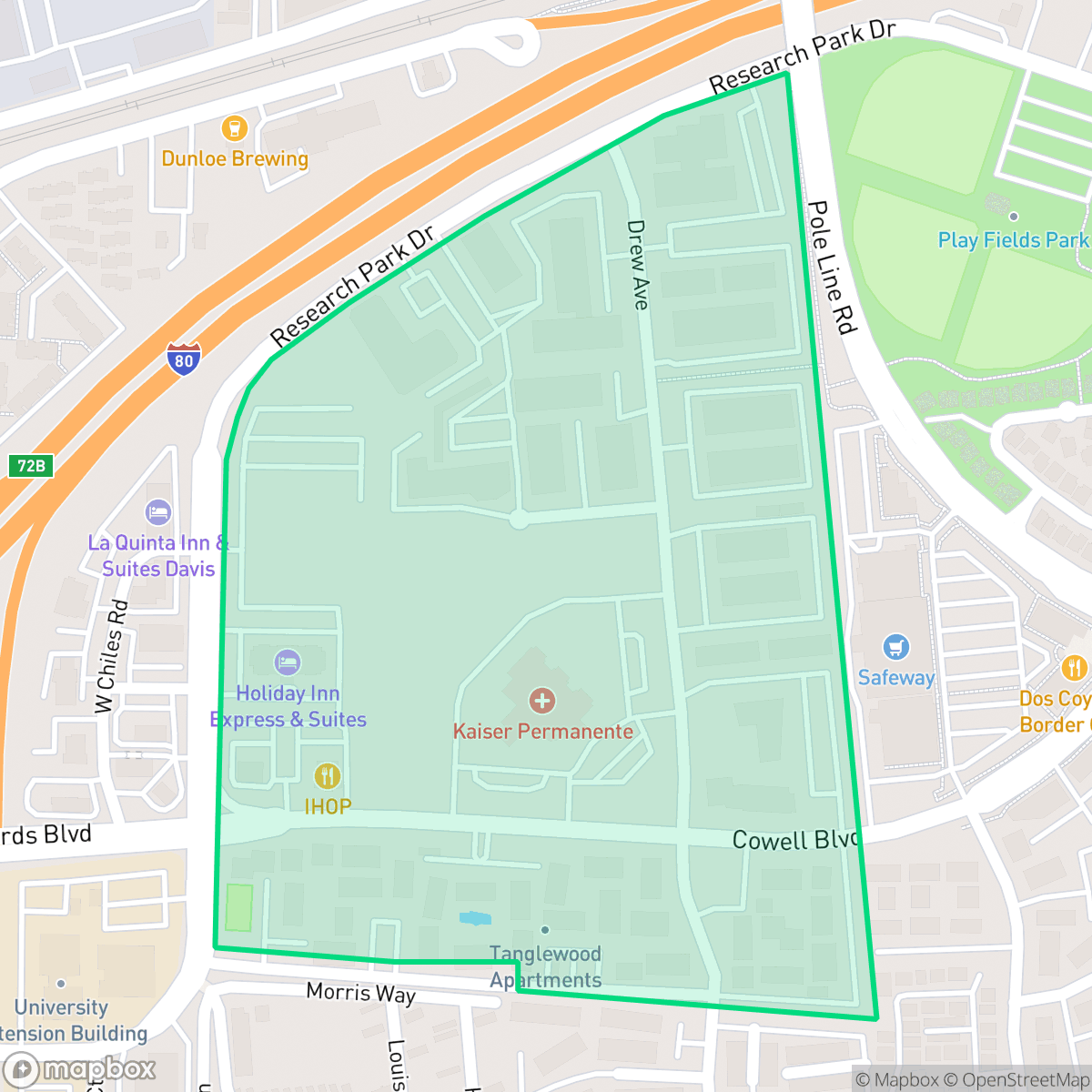
Developed starting in 1990 by the real estate firm Interland, the Interland-University Research Park in southeast Davis was established as the city's premier hub for agricultural biotechnology and life sciences. Situated near the intersection of Drew Avenue and Richards Boulevard, the 33-acre campus comprises over 300,000 square feet of office and laboratory space across 17 buildings. It historically served as the only major business park in Davis equipped with specialized wet labs, attracting pioneering biotech companies such as Novo Nordisk, Novozymes Biotech, AgraQuest, and Marrone Bio Innovations. The park also hosts "Area 52," a prominent technology incubator on Research Park Drive. Today, the surrounding neighborhood integrates this commercial innovation hub with dense, student-friendly residential developments, maintaining a youthful, academic energy due to its close proximity to the University of California, Davis.
The area functions as a transitional zone where professional biotech laboratories meet high-density residential housing. It serves as a hub for academic energy, benefiting from its strategic location near the University of California, Davis, and a robust network of sidewalks that facilitate local movement. The neighborhood maintains a functional, suburban aesthetic with standard amenities like casual dining options located along major traffic arteries.
Prospective residents should be aware of the significant acoustic impact from nearby road traffic, which is a defining feature of the local environment. While the presence of green buffers and recreational trails supports outdoor activity and pet ownership, the area presents specific challenges regarding flood and fire safety. It is best suited for students, researchers, or professionals who prioritize proximity to the university and local employment hubs over absolute quiet or luxury surroundings.
Neighborhood Scores Across 15 Qualities
Residential spacing varies significantly across the area, with some mobile home clusters situated closely together while office developments provide larger buffers. This level of privacy is slightly higher than the average for Davis.
Sidewalks and interior paths connect residential areas to nearby office parks and commercial zones, though connectivity is slightly lower than the city average. Safe crossings are available for pedestrians navigating the neighborhood.
Residential scenery consists of standard tract housing and dense apartment complexes with modest yards. This visual character is less varied than the average for Davis.
Abundant green buffers and recreational trails bordering residential zones offer excellent space for pet owners. This area is slightly below the city average for dog friendliness due to the lack of widespread urban parks.
Agricultural fields and woodland areas border office parks and high-density housing, creating a transitional landscape that is slightly less rural than the Davis average according to iHuus data.
A mix of light industrial spaces and suburban greenery provides a moderately active atmosphere that is slightly more lively than the Davis average. Local amenities like Toad Hollow Dog Park and nearby dining options offer pockets of activity alongside quieter residential and commercial blocks.
Frequent noise from nearby freeway and railroad activity makes this area significantly louder than the Davis average, according to iHuus data.
Air quality remains consistently good with rare instances of elevated readings. This level of air purity is typical for the Davis area according to iHuus data.
Residential areas blend with light industrial and commercial zones, resulting in more industrial activity than the Davis average. According to iHuus data, proximity to a nearby EPA Superfund site may present potential environmental considerations regarding soil and groundwater.
Health insurance coverage in this area is lower than the Davis average, according to iHuus data.
Voting patterns and census indicators reflect a deeply liberal political leaning, which is consistent with the broader Davis area according to iHuus data.
A high concentration of young adults defines the area, with a noticeably lower proportion of families and older residents compared to the Davis average. According to iHuus data, the population profile is significantly more skewed toward a younger demographic.
Significant flood risk exists within this area because it is located inside a mapped floodplain; according to iHuus data, this risk level is considerably higher than the Davis average.
Address-Level Insights for Interland-Univ. Research Park


iHuus Neighborhood Intelligence Insights
Get address-level neighborhood insights for Interland-Univ. Research Park
- Street-level scores — see how individual blocks compare, not just neighborhood averages
- Micro-zone boundaries — identify quiet pockets, flood boundaries, and walkable clusters before you visit
- 15 dimensions in full — walkability, noise, air quality, school quality, insurance coverage, population age profile, urban/rural index, and more
- Boundary risk alerts — know if your address sits near a block boundary where scores drop, the kind of detail no listing will ever mention
- School insights — individual school ratings and insights, not just district-level data
- Compare before you commit — side-by-side data across neighborhoods, down to block precision
No credit card required
Compare with Any Neighborhood
| Dimension | Interland-Univ. Research Park | Adams Terrace |
|---|---|---|
| 🚶 Walkabilityavg 9.47 | ||
| 🔊 Acoustic Comfortavg 4.41 | ||
| 🤫 Privacy Indexavg 5.8 | ||
| 🎨 Visual Appealavg 7.21 | ||
| 🐕 Dog Friendlinessavg 8.49 | ||
| 🗺️ Urban-Rural Indexavg 6.91 | ||
| ✨ Neighborhood Vibeavg 5.48 | ||
| 🏥 Health Insurance Coverageavg 8.51 | ||
| 🌿 Air Qualityavg 8 | ||
| 🏭 Industrial Proximityavg 7.1 | ||
| 🌊 Flood Safetyavg 5.58 | ||
| 🗳️ Ideological Leanavg 9.76 | ||
| 👥 Population Age Profileavg 4.21 | ||
| 🔥 Fire Safety | ||
| 🏫 School Quality |
Interland-Univ. Research Park Rankings
School Districts Serving Interland-Univ. Research Park
School Insights for Interland-Univ. Research Park
Below average outcomes; significant attendance and academic challenges.
School Insights
See what's really behind every school rating near Interland-Univ. Research Park
- Individual school ratings — each school's own score with outcome context, not just a district average
- Enrollment & class size data — student-to-teacher ratio and how it compares to the state average
- Full demographics breakdown — ethnicity and gender composition for every school in the enrollment zone
- Every school in the district — all schools within the enrollment boundary ranked by rating, not just the closest one
- Grade levels & benchmarks — elementary through high school, with below/above state-average flags
No credit card required