Downtown Core, Davis
Updated · 860 residents
The Downtown Core serves as the vibrant commercial heart of Davis, offering unparalleled pedestrian access to local dining, galleries, and cultural landmarks. While the area provides a highly walkable lifestyle, residents should anticipate significant ambient noise from nearby road traffic and railroad activity.
Key Highlights
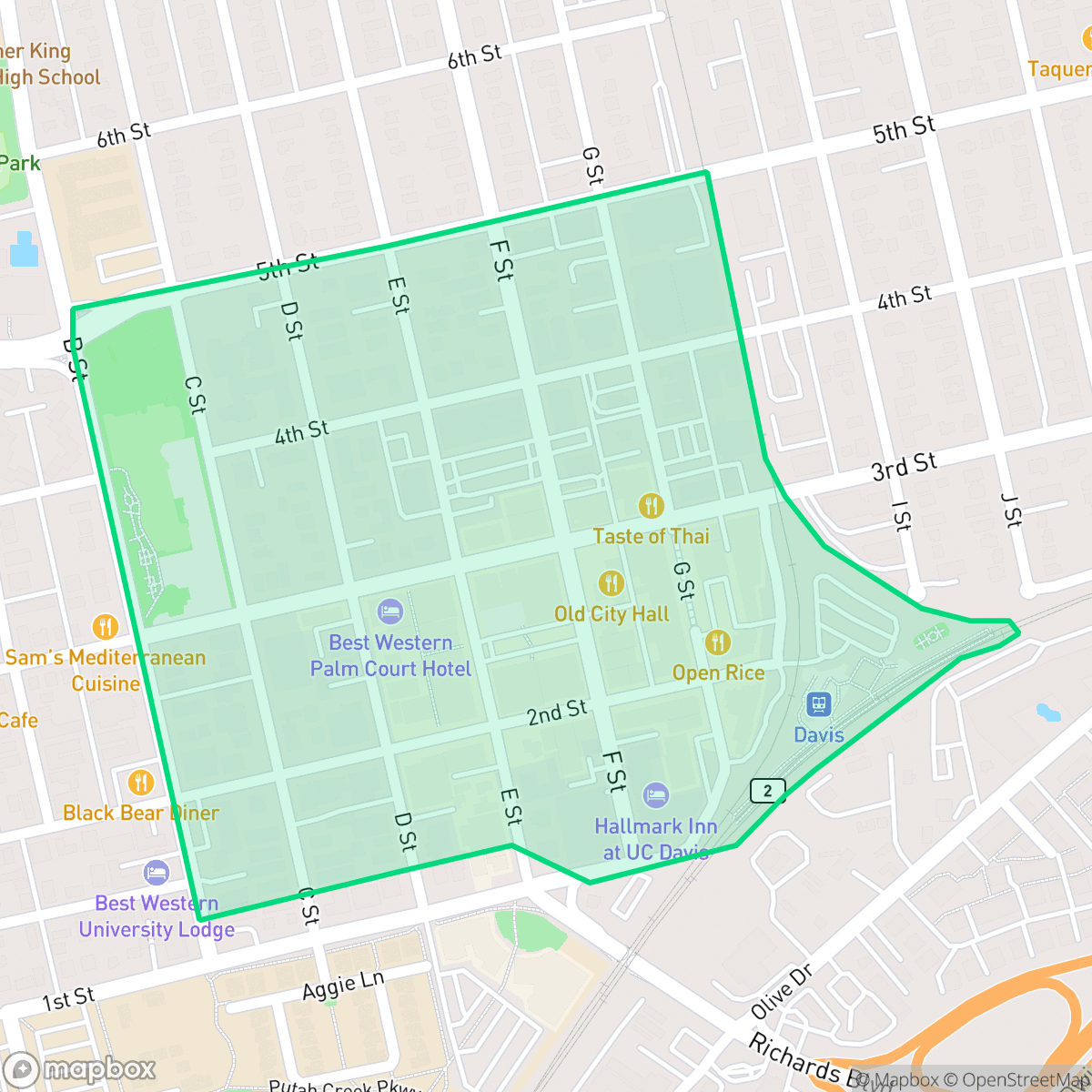
About Downtown Core
The Downtown Core of Davis, California, grew around the Southern Pacific Railroad Depot, established in 1868 and replaced in 1913 by a Mission Revival-style station. The neighborhood features diverse architectural landmarks, including the 1875 Stick-Style Italianate Dresbach-Hunt-Boyer Mansion—built for William Dresbach, the postmaster who named the town—the 1914 Prairie School-influenced Anderson Bank Building, and the 1950 Streamline Moderne Varsity Theatre. Rather than allowing suburban shopping malls, Davis deliberately preserved its compact downtown grid in the late 20th century to foster a pedestrian- and bicycle-friendly commercial hub. Today, the neighborhood's cultural identity is anchored by Central Park, the historic Hattie Weber Museum, and the U.S. Bicycling Hall of Fame.
This neighborhood functions as the primary hub for commerce and social activity in Davis. It features a dense, grid-based layout that prioritizes bicycle and foot traffic over personal vehicles, connecting residents to diverse dining options and local social venues like the John Natsoulas Gallery. According to iHuus data, the area maintains a high level of health insurance coverage and remains deeply integrated into the city's academic and social fabric. The presence of green spaces like Central Park provides a necessary respite within the bustling commercial landscape.
Living in this central district involves distinct trade-offs, particularly regarding acoustic comfort. The proximity to major transit corridors results in elevated noise levels, which prospective residents should weigh against the convenience of a central location. The area is best suited for individuals who prioritize immediate access to urban amenities over quiet, secluded residential environments. While the housing stock includes a mix of apartment blocks and single-family homes, the density creates a social, high-energy atmosphere that appeals to those seeking an active lifestyle.
Neighborhood Scores Across 15 Qualities
Residential spacing provides a moderate level of separation between neighbors, which is slightly higher than the Davis average. Homes and multi-family units feature mixed density with some buffer zones between structures.
Pedestrian access is excellent due to a complete grid of sidewalks and frequent crosswalks. This area offers superior connectivity for walking compared to the rest of Davis.
Residential layouts feature consistent rooflines and modest lot sizes with limited greenery. This area presents a more functional, less landscaped visual profile compared to the city average, according to iHuus data.
Abundant green verges and nearby park areas provide ample space for pet owners, though overall dog friendliness is slightly lower than the Davis city average.
Urban density is slightly lower than the city average, characterized by a mix of low-rise commercial blocks, apartment buildings, and single-family residential areas. According to iHuus data, the area lacks the frequent open fields found in more rural parts of Davis.
Concentrated clusters of dining, galleries, and parks create an energy level notably higher than the Davis average. Residents can find various social hubs and local eateries distributed across active blocks, according to iHuus data.
Frequent disturbances from nearby railroad tracks and heavy traffic are common in this area. According to iHuus data, acoustic comfort is lower than the Davis city average.
Air quality is consistently good with rare instances of elevated readings, matching the average levels found across Davis.
Minimal industrial activity characterizes this area, which is primarily comprised of residential, commercial, and educational spaces. While the vicinity is notably free of heavy industry compared to the city average, iHuus data indicates proximity to an EPA Superfund site with potential for soil and soil gas contaminants.
Health insurance access is widespread among residents, remaining slightly above the Davis city average according to iHuus data.
Voting patterns and census indicators show a predominantly liberal political landscape, which is slightly more pronounced here than in the rest of Davis.
Residents primarily consist of young adults, creating a demographic that is notably younger than the Davis city average. This concentration of young people is balanced by a smaller presence of families and older adults.
Located within a designated floodplain, this area carries a significantly higher risk of flooding than the rest of Davis. Residents may find that flood insurance is typically required for properties in this zone according to iHuus data.
Address-Level Insights for Downtown Core


iHuus Neighborhood Intelligence Insights
Get address-level neighborhood insights for Downtown Core
- Street-level scores — see how individual blocks compare, not just neighborhood averages
- Micro-zone boundaries — identify quiet pockets, flood boundaries, and walkable clusters before you visit
- 15 dimensions in full — walkability, noise, air quality, school quality, insurance coverage, population age profile, urban/rural index, and more
- Boundary risk alerts — know if your address sits near a block boundary where scores drop, the kind of detail no listing will ever mention
- School insights — individual school ratings and insights, not just district-level data
- Compare before you commit — side-by-side data across neighborhoods, down to block precision
No credit card required
Compare with Any Neighborhood
| Dimension | Downtown Core | Adams Terrace |
|---|---|---|
| 🚶 Walkabilityavg 9.47 | ||
| 🔊 Acoustic Comfortavg 4.41 | ||
| 🤫 Privacy Indexavg 5.8 | ||
| 🎨 Visual Appealavg 7.21 | ||
| 🐕 Dog Friendlinessavg 8.49 | ||
| 🗺️ Urban-Rural Indexavg 6.91 | ||
| ✨ Neighborhood Vibeavg 5.48 | ||
| 🏥 Health Insurance Coverageavg 8.51 | ||
| 🌿 Air Qualityavg 8 | ||
| 🏭 Industrial Proximityavg 7.1 | ||
| 🌊 Flood Safetyavg 5.58 | ||
| 🗳️ Ideological Leanavg 9.76 | ||
| 👥 Population Age Profileavg 4.21 | ||
| 🔥 Fire Safety | ||
| 🏫 School Quality |
Downtown Core Rankings
School Districts Serving Downtown Core
School Insights for Downtown Core
Below average outcomes; significant attendance and academic challenges.
School Insights
See what's really behind every school rating near Downtown Core
- Individual school ratings — each school's own score with outcome context, not just a district average
- Enrollment & class size data — student-to-teacher ratio and how it compares to the state average
- Full demographics breakdown — ethnicity and gender composition for every school in the enrollment zone
- Every school in the district — all schools within the enrollment boundary ranked by rating, not just the closest one
- Grade levels & benchmarks — elementary through high school, with below/above state-average flags
No credit card required