South Corona, Corona
Updated · 45,923 residents
South Corona is defined by its Mediterranean architecture and proximity to the Cleveland National Forest. It features a highly walkable suburban layout with consistent sidewalk networks and well-manicured, affluent residential tracts.
Key Highlights
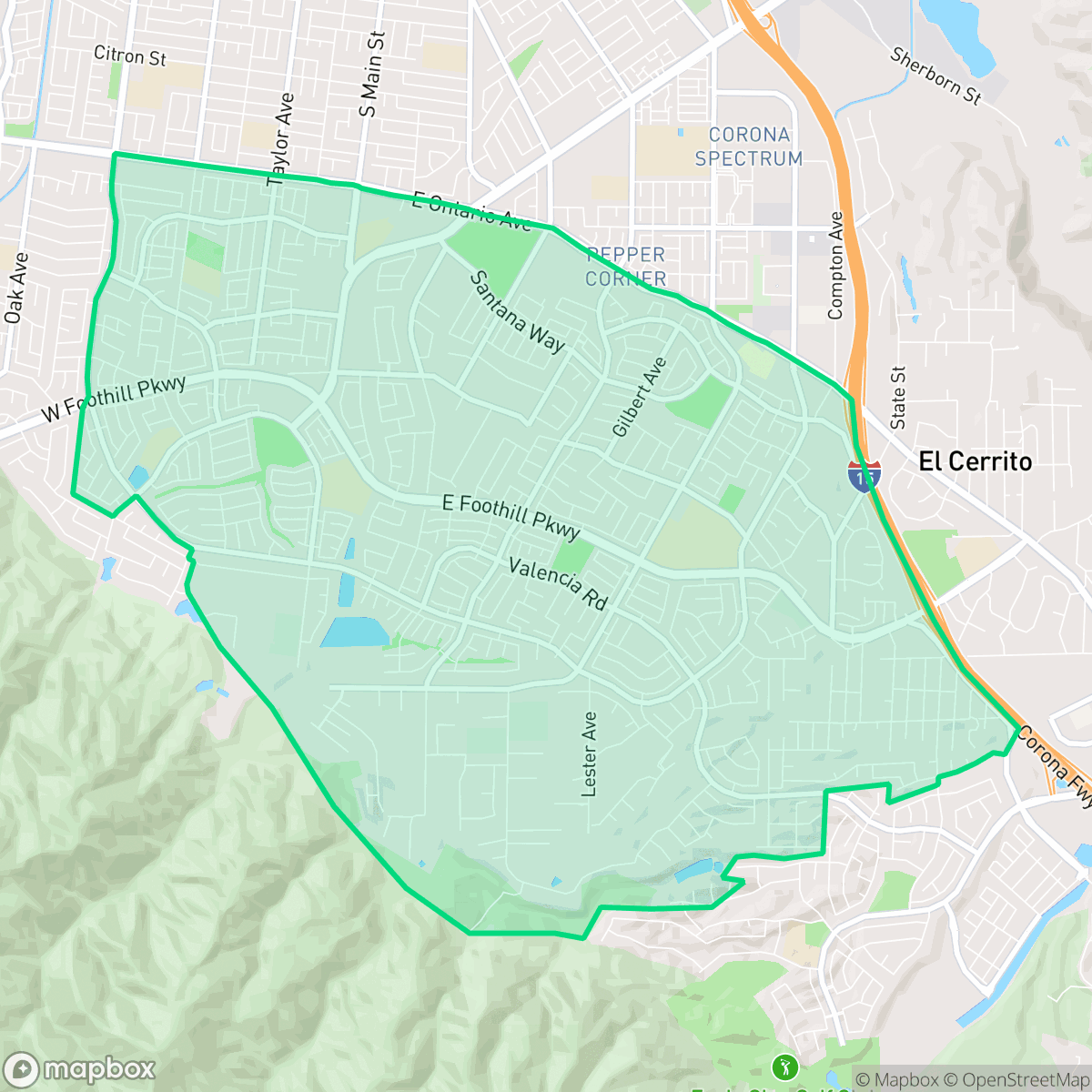
About South Corona
South Corona, situated at the foothills of the Cleveland National Forest, has a history rooted in the region's late-19th-century "Citrus Boom". Originally covered by vast lemon and orange groves, the area was once dominated by agricultural operations like the Corona Foothill Lemon Company. In 1988, a city general plan amendment initiated the gradual conversion of these agricultural lands into master-planned residential communities, leading to the development of neighborhoods like Eagle Glen and Dos Lagos in the late 1990s and 2000s. A key landmark is The Shops at Dos Lagos, a lifestyle center built over two former mining pits of the historic Temescal Tin Mines along the historic Butterfield Stage Coach Route. Today, the neighborhood is known for its Mediterranean and Spanish-style architecture and scenic parks like Mountain Gate Park.
The neighborhood is characterized by large, affluent single-family homes that often feature private backyard swimming pools and multi-car driveways. Residents benefit from a highly walkable environment, supported by a comprehensive network of sidewalks and safe pedestrian crossings throughout the residential grid. The area is served by the Corona-Norco Unified School District, which maintains a strong reputation for academic performance and provides access to several top-rated schools, including Dwight D. Eisenhower Elementary and Santiago High.
While the area offers a serene suburban atmosphere, it maintains a lower level of commercial activity, making it a quieter residential destination rather than a bustling urban center. Prospective residents should note the high-density suburban layout, which results in close property lines and limited private space between homes. Additionally, the region faces inherent environmental risks related to fire and flood, and while the neighborhood is exceptionally walkable for local transit, most major shopping and employment hubs remain car-dependent.
Neighborhood Scores Across 15 Qualities
Homes are typically detached with varying setbacks, offering more separation between neighbors than the city average. While some modern developments feature closely spaced houses, many properties benefit from buffer zones such as canyon edges or golf course borders.
Extensive sidewalk networks and well-defined pedestrian crossings are present on both residential and arterial roads. This level of connectivity for walkers is significantly higher than the average found throughout Corona.
Large homes with manicured landscapes and a high density of private backyard pools characterize this area. According to iHuus data, the visual quality of the neighborhood is notably higher than the city average.
Abundant greenbelts, wide sidewalk verges, and large public parks provide excellent opportunities for pet owners. According to iHuus data, these features make the area more dog friendly than the average Corona neighborhood.
Residential layouts consist primarily of dense suburban tract housing with minimal undeveloped open space. This level of development is consistent with the city average for Corona.
Suburban streets and green spaces provide a serene atmosphere with a steady but sparse rhythm of local services. While some walkable paths exist near parks and dining, the area is slightly less active than the broader Corona area.
Steady traffic hum from nearby busy streets is present, though acoustic comfort remains slightly higher than the average for Corona. According to iHuus data, residents may experience consistent ambient noise during peak commuting hours.
Air quality remains consistently high with minimal health concerns for residents. This level of cleanliness is slightly above the city average according to iHuus data.
Industrial activity is virtually non-existent in this area, providing a cleaner environment than the Corona average. Residents can expect an exclusively residential and institutional landscape without the presence of warehouses, factories, or heavy industrial hazards.
Health insurance accessibility is notably higher in this area than the average for Corona. According to iHuus data, most residents in South Corona have access to comprehensive health coverage.
Conservative values represent the majority in this area, with a notably more conservative political leaning than the broader Corona area according to iHuus data.
A balanced mix of young adults, families, and older residents characterizes this area. According to iHuus data, the age distribution in South Corona is consistent with the broader Corona area.
Properties in this area are located within a designated floodplain, which may necessitate the purchase of flood insurance. This level of risk is consistent with the broader Corona area according to iHuus data.
Fire hazards in this area are severe; residents should be aware that the risk level is slightly higher than the average for Corona. Maximum protection measures and rigorous safety precautions are necessary due to the extreme nature of the local fire threat.
Address-Level Insights for South Corona


iHuus Neighborhood Intelligence Insights
Get address-level neighborhood insights for South Corona
- Street-level scores — see how individual blocks compare, not just neighborhood averages
- Micro-zone boundaries — identify quiet pockets, flood boundaries, and walkable clusters before you visit
- 15 dimensions in full — walkability, noise, air quality, school quality, insurance coverage, population age profile, urban/rural index, and more
- Boundary risk alerts — know if your address sits near a block boundary where scores drop, the kind of detail no listing will ever mention
- School insights — individual school ratings and insights, not just district-level data
- Compare before you commit — side-by-side data across neighborhoods, down to block precision
No credit card required
Compare with Any Neighborhood
| Dimension | South Corona | Brentridge |
|---|---|---|
| 🚶 Walkabilityavg 8.38 | ||
| 🔊 Acoustic Comfortavg 4.43 | ||
| 🤫 Privacy Indexavg 5.19 | ||
| 🎨 Visual Appealavg 7.22 | ||
| 🐕 Dog Friendlinessavg 6.49 | ||
| 🗺️ Urban-Rural Indexavg 6.84 | ||
| ✨ Neighborhood Vibeavg 4.72 | ||
| 🏥 Health Insurance Coverageavg 6.35 | ||
| 🌿 Air Qualityavg 8.72 | ||
| 🏭 Industrial Proximityavg 8.05 | ||
| 🌊 Flood Safetyavg 1.55 | ||
| 🗳️ Ideological Leanavg 4.94 | ||
| 👥 Population Age Profileavg 4.7 | ||
| 🔥 Fire Safetyavg 0.5 | ||
| 🏫 School Quality |
South Corona Rankings
School Districts Serving South Corona
School Insights for South Corona
Below average outcomes; significant attendance and academic challenges.
School Insights
See what's really behind every school rating near South Corona
- Individual school ratings — each school's own score with outcome context, not just a district average
- Enrollment & class size data — student-to-teacher ratio and how it compares to the state average
- Full demographics breakdown — ethnicity and gender composition for every school in the enrollment zone
- Every school in the district — all schools within the enrollment boundary ranked by rating, not just the closest one
- Grade levels & benchmarks — elementary through high school, with below/above state-average flags
No credit card required