Sierra del Oro, Corona
Updated · 11,095 residents
Sierra del Oro is a hillside community in western Corona defined by its scenic mountain views and proximity to the Cleveland National Forest. The neighborhood features a highly walkable suburban layout with well-maintained sidewalks, although residents should expect elevated noise levels due to its location near major regional transit corridors.
Key Highlights
About Sierra del Oro
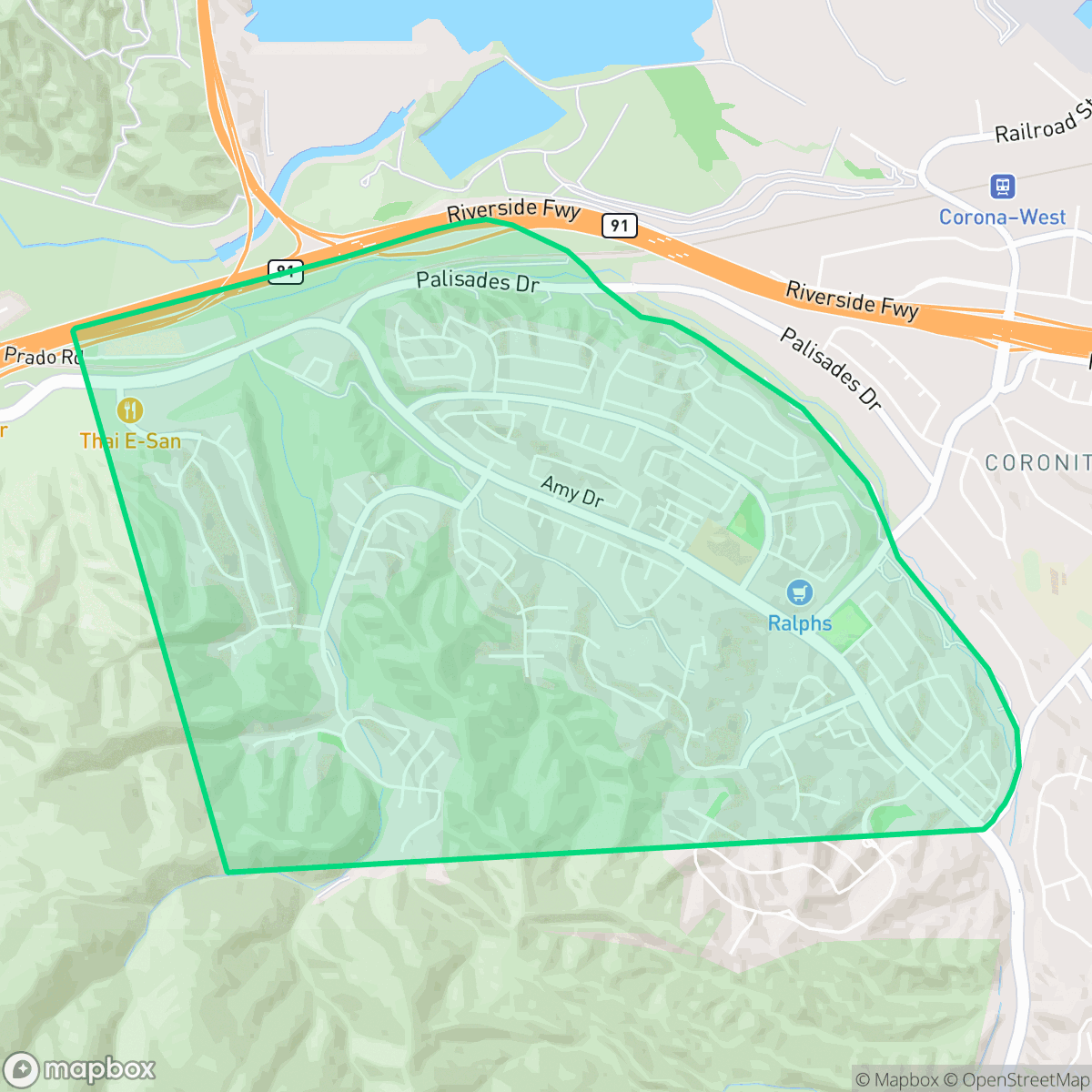
Located on the westernmost edge of Corona, California, the foothill neighborhood of Sierra del Oro sits on land historically used for cattle and horse grazing by descendants of Spanish ranchero Jose Antonio Yorba. In 1985, the City of Corona annexed approximately 1,400 acres of unincorporated Riverside County land to initiate the Sierra del Oro Specific Plan, launching a massive hillside residential development. Built out primarily between the mid-1980s and late 1990s, the master-planned community is defined by its distinct hillside terrain, scenic vistas of the Santa Ana Mountains, and proximity to the Cleveland National Forest. Today, Sierra del Oro is characterized by its tight-knit suburban layout, convenient commuter access to the adjacent Orange County border via the 91 Freeway, and the preservation of local natural riparian habitats like Fresno Canyon.
The area is characterized by affluent, modern single-family homes that often feature private swimming pools and manicured landscaping. Residents benefit from consistent access to outdoor recreation, including an extensive network of canyon trails that provide ample space for dog walking and exercise. According to iHuus data, the community maintains a distinct visual appeal, blending dense suburban residential tracts with the rugged natural terrain of the Santa Ana Mountains.
While the neighborhood offers a high quality of life supported by the top-rated Corona-Norco Unified School District, potential residents should consider certain trade-offs. The proximity to the 91 Freeway and local industrial zones results in higher ambient noise levels, and the hillside location necessitates awareness of fire safety considerations. The area is best suited for commuters and families seeking a balance between suburban convenience and immediate access to natural landscapes.
Neighborhood Scores Across 15 Qualities
Residential spacing varies by pocket, with some areas featuring dense clusters and others offering large buffers against canyons. According to iHuus data, the level of separation between neighbors is slightly higher than the Corona average.
Continuous sidewalks and safe crosswalks make much of the neighborhood accessible for pedestrians; according to iHuus data, walkability remains slightly below the Corona average.
Manicured landscaping, private pools, and large multi-story homes characterize this area. According to iHuus data, the visual quality of the neighborhood is notably higher than the Corona average.
Extensive canyon trail networks and wide sidewalk verges offer ample opportunities for pet exercise. These interconnected green spaces make the area significantly more dog friendly than the rest of Corona.
Open hilly terrain and natural vegetation provide a semi-rural feel that is slightly more pronounced than the typical Corona landscape. According to iHuus data, residential pockets here often border undeveloped canyons and rugged hillsides.
A steady rhythm of residential life and local services defines this area, which matches the city average for liveliness. While some blocks offer accessible dining and park access, other sections remain quiet and car-dependent due to nearby industrial zones and highway proximity.
Frequent noise from nearby freeways and rail lines makes this area louder than the average Corona neighborhood. According to iHuus data, residents may experience regular auditory disturbances from heavy transit corridors.
Air quality is exceptionally high and presents minimal health concerns. According to iHuus data, these conditions are notably better than the average found throughout Corona.
Primarily residential and natural hillside areas provide a peaceful environment, though some residents may experience noise from nearby logistics hubs and heavy traffic near the neighborhood edges. This level of industrial separation is slightly lower than the Corona average due to the proximity of large warehouses and freight-related infrastructure.
Health insurance enrollment in this area is lower than the average seen across Corona. According to iHuus data, a notable portion of the population lacks coverage.
Conservative-leaning values are more prominent here than in the rest of Corona, according to iHuus data.
Residents live alongside a balanced range of young adults, families, and older individuals. This demographic spread is largely consistent with the broader Corona area, according to iHuus data.
Properties in this area are located within a designated floodplain, which represents a higher risk level than the average for Corona. According to iHuus data, residents should expect that flood insurance will likely be a requirement for most homes.
Fire hazard levels in this area are significantly higher than the Corona average, necessitating rigorous wildfire preparedness and maximum protection measures. According to iHuus data, the terrain presents an extreme risk for residents.
Address-Level Insights for Sierra del Oro


iHuus Neighborhood Intelligence Insights
Get address-level neighborhood insights for Sierra del Oro
- Street-level scores — see how individual blocks compare, not just neighborhood averages
- Micro-zone boundaries — identify quiet pockets, flood boundaries, and walkable clusters before you visit
- 15 dimensions in full — walkability, noise, air quality, school quality, insurance coverage, population age profile, urban/rural index, and more
- Boundary risk alerts — know if your address sits near a block boundary where scores drop, the kind of detail no listing will ever mention
- School insights — individual school ratings and insights, not just district-level data
- Compare before you commit — side-by-side data across neighborhoods, down to block precision
No credit card required
Compare with Any Neighborhood
| Dimension | Sierra del Oro | Brentridge |
|---|---|---|
| 🚶 Walkabilityavg 8.38 | ||
| 🔊 Acoustic Comfortavg 4.43 | ||
| 🤫 Privacy Indexavg 5.19 | ||
| 🎨 Visual Appealavg 7.22 | ||
| 🐕 Dog Friendlinessavg 6.49 | ||
| 🗺️ Urban-Rural Indexavg 6.84 | ||
| ✨ Neighborhood Vibeavg 4.72 | ||
| 🏥 Health Insurance Coverageavg 6.35 | ||
| 🌿 Air Qualityavg 8.72 | ||
| 🏭 Industrial Proximityavg 8.05 | ||
| 🌊 Flood Safetyavg 1.55 | ||
| 🗳️ Ideological Leanavg 4.94 | ||
| 👥 Population Age Profileavg 4.7 | ||
| 🔥 Fire Safetyavg 0.5 | ||
| 🏫 School Quality |
Sierra del Oro Rankings
School Districts Serving Sierra del Oro
School Insights for Sierra del Oro
Below average outcomes; significant attendance and academic challenges.
School Insights
See what's really behind every school rating near Sierra del Oro
- Individual school ratings — each school's own score with outcome context, not just a district average
- Enrollment & class size data — student-to-teacher ratio and how it compares to the state average
- Full demographics breakdown — ethnicity and gender composition for every school in the enrollment zone
- Every school in the district — all schools within the enrollment boundary ranked by rating, not just the closest one
- Grade levels & benchmarks — elementary through high school, with below/above state-average flags
No credit card required