Eagle Glen, Corona
Updated · 4,943 residents
Eagle Glen is a master-planned community in South Corona defined by its Mediterranean-style architecture and proximity to the Santa Ana Mountains. Residents benefit from high walkability and abundant greenbelts, though the area remains a quiet, residential enclave with limited local commercial activity.
Key Highlights
About Eagle Glen
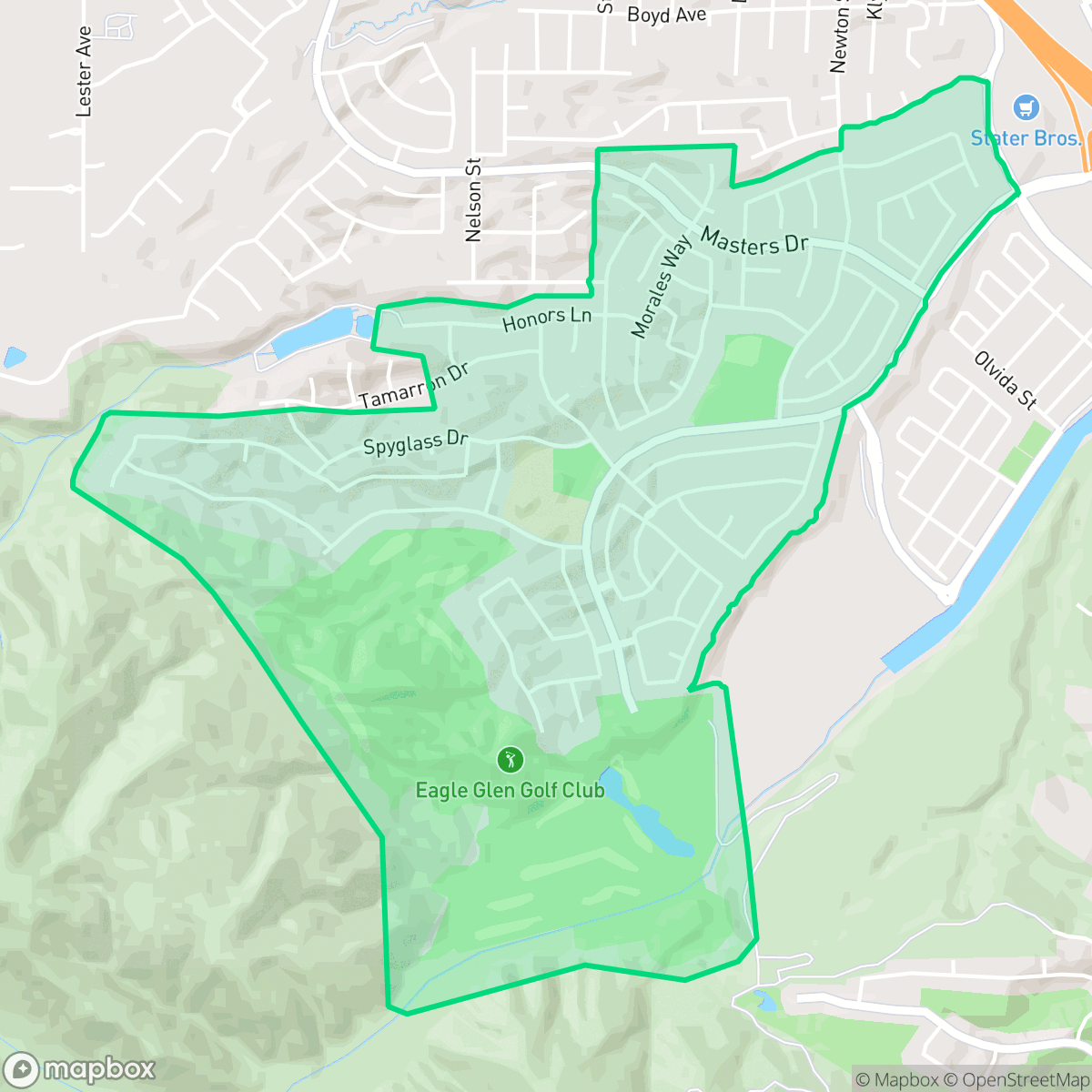
Eagle Glen, located in South Corona, California, was originally planned under the Mission Crest Specific Plan approved in 1992, with a 1997 amendment officially renaming the development to Eagle Glen. Before its suburban transformation, the neighborhood’s western portion was dominated by citrus groves, while the eastern portion consisted of undeveloped hillsides. Developed primarily between 1991 and 2003, the residential area features "California Mediterranean" style homes characterized by stucco exteriors and red tile roofs. At the heart of the community is the Eagle Glen Golf Club, an 18-hole championship course designed by Gary Roger Baird that opened in 1999. Nestled against the Santa Ana Mountains and the Cleveland National Forest, the neighborhood also features Woodrow Wilson Elementary School and local parks.
This neighborhood is characterized by its hilly terrain and expansive, well-maintained residential streets that reflect a classic California Mediterranean aesthetic. The community layout emphasizes connectivity through continuous sidewalks and dedicated pedestrian paths, which provides a high level of walkability for residents. At the center of the local landscape is the championship golf course, which serves as a primary recreational hub and contributes to the area's significant open space.
While the area offers a peaceful environment with virtually no industrial proximity, it functions primarily as a quiet residential retreat rather than a commercial center. According to iHuus data, the neighborhood maintains a low-key vibe with few local businesses, requiring residents to rely on personal vehicles for daily errands and commuting. It is well-suited for families and individuals who prioritize a stable, school-focused environment and access to outdoor recreation over immediate proximity to urban nightlife or retail districts.
Neighborhood Scores Across 15 Qualities
Residential spacing is moderate; while some houses are positioned close to one another, many properties benefit from extra buffers provided by adjacent golf courses or canyons. This level of privacy is slightly higher than the average for Corona, according to iHuus data.
Pedestrian infrastructure is well-developed with continuous sidewalks and dedicated paths, making it slightly more walkable than the rest of Corona. Residents can navigate residential streets safely using established crossings and interconnected walkways.
Large homes with private pools and expansive driveways characterize this area. According to iHuus data, the visual quality of the neighborhood is higher than the average for Corona.
Abundant greenbelts, golf course edges, and park spaces offer excellent walking routes that are well-connected and separated from heavy traffic. According to iHuus data, these accessible outdoor areas make the neighborhood more pet-friendly than the average Corona community.
Open land and large natural canyon buffers provide a sense of openness that is slightly more rural than the typical Corona residential area. According to iHuus data, the neighborhood features a mix of suburban housing interspersed with significant natural landscape features.
Local activity is primarily centered around residential streets and a few scattered dining options. This area offers a calmer pace of life than the rest of Corona, as the landscape is characterized more by open spaces and suburban blocks than by dense commercial hubs.
Local traffic from nearby busy streets creates a consistent level of ambient noise. According to iHuus data, this acoustic environment is slightly more active than the average found throughout Corona.
Air quality remains consistently high with rare instances of elevated readings; this level of air purity is nearly identical to the average found across Corona.
Industrial activity and warehouse facilities are absent from this area, offering a cleaner environment than the Corona average. According to iHuus data, the neighborhood consists entirely of residential and recreational spaces without proximity to hazardous industrial sites.
Health insurance coverage among Eagle Glen residents is notably higher than the average for Corona. According to iHuus data, a majority of the population is covered by a health plan.
Conservative viewpoints represent a clear majority within the community, leaning significantly more towards this political orientation than the broader Corona area according to iHuus data.
Residents live alongside a diverse range of age groups, including young adults, families, and older individuals. According to iHuus data, the demographic distribution in Eagle Glen is consistent with the broader Corona area.
Flood risk in this area is slightly higher than the Corona average. Residents may face elevated or prohibitive insurance costs due to the proximity to high-hazard zones, according to iHuus data.
Significant fire hazards exist in this area, which is notably higher than the Corona average according to iHuus data. Enhanced mitigation measures and heightened awareness of local fire safety protocols are necessary for residents.
Address-Level Insights for Eagle Glen


iHuus Neighborhood Intelligence Insights
Get address-level neighborhood insights for Eagle Glen
- Street-level scores — see how individual blocks compare, not just neighborhood averages
- Micro-zone boundaries — identify quiet pockets, flood boundaries, and walkable clusters before you visit
- 15 dimensions in full — walkability, noise, air quality, school quality, insurance coverage, population age profile, urban/rural index, and more
- Boundary risk alerts — know if your address sits near a block boundary where scores drop, the kind of detail no listing will ever mention
- School insights — individual school ratings and insights, not just district-level data
- Compare before you commit — side-by-side data across neighborhoods, down to block precision
No credit card required
Compare with Any Neighborhood
| Dimension | Eagle Glen | Brentridge |
|---|---|---|
| 🚶 Walkabilityavg 8.38 | ||
| 🔊 Acoustic Comfortavg 4.43 | ||
| 🤫 Privacy Indexavg 5.19 | ||
| 🎨 Visual Appealavg 7.22 | ||
| 🐕 Dog Friendlinessavg 6.49 | ||
| 🗺️ Urban-Rural Indexavg 6.84 | ||
| ✨ Neighborhood Vibeavg 4.72 | ||
| 🏥 Health Insurance Coverageavg 6.35 | ||
| 🌿 Air Qualityavg 8.72 | ||
| 🏭 Industrial Proximityavg 8.05 | ||
| 🌊 Flood Safetyavg 1.55 | ||
| 🗳️ Ideological Leanavg 4.94 | ||
| 👥 Population Age Profileavg 4.7 | ||
| 🔥 Fire Safetyavg 0.5 | ||
| 🏫 School Quality |
Eagle Glen Rankings
School Districts Serving Eagle Glen
School Insights for Eagle Glen
Below average outcomes; significant attendance and academic challenges.
School Insights
See what's really behind every school rating near Eagle Glen
- Individual school ratings — each school's own score with outcome context, not just a district average
- Enrollment & class size data — student-to-teacher ratio and how it compares to the state average
- Full demographics breakdown — ethnicity and gender composition for every school in the enrollment zone
- Every school in the district — all schools within the enrollment boundary ranked by rating, not just the closest one
- Grade levels & benchmarks — elementary through high school, with below/above state-average flags
No credit card required