Downtown, Corona
Updated · 6,166 residents
Downtown Corona serves as the historic heart of the city, offering high walkability and a dense, diverse urban environment. While the area provides convenient access to local commerce, residents should be prepared for a bustling atmosphere characterized by proximity to industrial zones and significant traffic noise.
Key Highlights
About Downtown
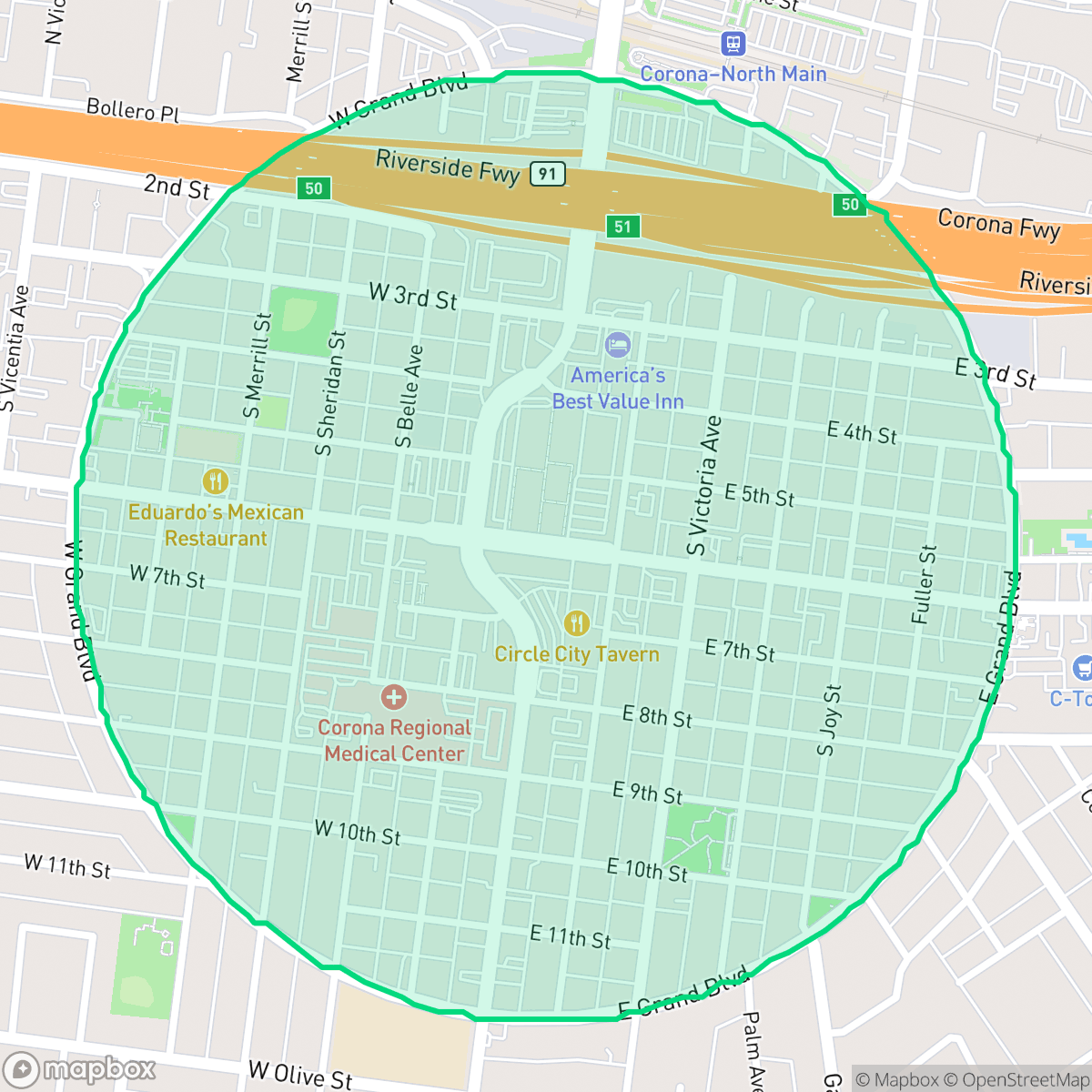
Downtown Corona, known as the heart of the "Circle City," is defined by its unique layout centered around the historic Grand Boulevard, a three-mile circular thoroughfare established in 1886. The district retains significant architectural character from the early 20th century, featuring historic commercial structures along Main Street that reflect the city's origins as a citrus-growing hub. Key landmarks, such as the historic Corona Public Library and the area’s proximity to the original Grand Boulevard, highlight the neighborhood's role in the city's agricultural prosperity. This circular street pattern remains a rare urban design feature in Southern California, distinguishing the downtown core from surrounding suburban developments and preserving its historical identity as the original commercial and social center of the community.
The area functions as a central hub where residential streets meet light industrial and commercial infrastructure. This dense, urban-adjacent setting supports a diverse age demographic and offers a more active social atmosphere than surrounding suburban tracts. Residents benefit from a highly connected street grid that encourages pedestrian activity, making it easy to navigate the immediate vicinity without a vehicle.
Prospective residents should consider specific livability trade-offs, including elevated noise levels from nearby rail lines and freeway traffic. The neighborhood also features tightly packed housing with minimal privacy between properties. While the area is situated within a designated floodplain, it remains a stable choice for those prioritizing access to the highly regarded Corona-Norco Unified School District, which provides top-tier academic resources for families.
Neighborhood Scores Across 15 Qualities
Residential structures are densely clustered with minimal distance between neighbors; this level of density is higher than the average for Corona. According to iHuus data, many homes feature small setbacks and significant proximity to adjacent properties and industrial areas.
Sidewalk networks and clear pedestrian crossings are consistently available, providing a level of connectivity slightly above the Corona average. Most residential streets feature continuous paths for pedestrians, though a major multi-lane freeway does create a physical break in the grid.
Standard tract housing features boxy rooflines and small yards. According to iHuus data, the visual variety in this area is lower than the Corona average due to a high density of uniform residential and commercial surroundings.
Limited public green space and narrow sidewalk verges make for fewer walking options than the Corona average. While some areas feature a central park, much of the neighborhood relies on private yards for outdoor activity.
Built environments feature a dense blend of single-family homes, apartment complexes, and large-scale warehouses. This landscape is slightly more developed than the city average, showing less open land than other parts of Corona.
Diverse dining and social hubs provide a more active atmosphere than the rest of Corona, though the area remains largely car-dependent due to the presence of industrial zones and highways. According to iHuus data, the neighborhood features a blend of quiet residential streets and lively pockets of commerce.
Frequent noise from nearby railroad tracks and heavy freeway traffic defines the acoustic environment. This level of disturbance is notably higher than the average found throughout Corona.
Air quality remains mostly clean with rare instances of elevated readings. This level of air purity is slightly below the average for Corona.
Light industrial and commercial units are interspersed with residential areas, resulting in a higher level of industrial proximity than the Corona average. While large-scale logistics hubs are not dominant here, certain zones near the freeway contain utility infrastructure and commercial parking lots.
Health insurance access among residents is notably lower than the average seen across Corona. According to iHuus data, a minority of the population in this area maintains active coverage.
Political leanings in this area are predominantly liberal, which represents a more progressive tilt than the typical Corona resident. According to iHuus data, there is a noticeable liberal majority with a modest opposing presence.
Residents encounter a diverse range of age groups, from young adults to older adults, reflecting a demographic spread that is slightly more varied than the city average according to iHuus data.
Property located within a designated floodplain face significant flood risks, which is slightly higher than the average for Corona. According to iHuus data, residents in this area should anticipate that flood insurance is typically required.
Address-Level Insights for Downtown


iHuus Neighborhood Intelligence Insights
Get address-level neighborhood insights for Downtown
- Street-level scores — see how individual blocks compare, not just neighborhood averages
- Micro-zone boundaries — identify quiet pockets, flood boundaries, and walkable clusters before you visit
- 15 dimensions in full — walkability, noise, air quality, school quality, insurance coverage, population age profile, urban/rural index, and more
- Boundary risk alerts — know if your address sits near a block boundary where scores drop, the kind of detail no listing will ever mention
- School insights — individual school ratings and insights, not just district-level data
- Compare before you commit — side-by-side data across neighborhoods, down to block precision
No credit card required
Compare with Any Neighborhood
| Dimension | Downtown | Brentridge |
|---|---|---|
| 🚶 Walkabilityavg 8.38 | ||
| 🔊 Acoustic Comfortavg 4.43 | ||
| 🤫 Privacy Indexavg 5.19 | ||
| 🎨 Visual Appealavg 7.22 | ||
| 🐕 Dog Friendlinessavg 6.49 | ||
| 🗺️ Urban-Rural Indexavg 6.84 | ||
| ✨ Neighborhood Vibeavg 4.72 | ||
| 🏥 Health Insurance Coverageavg 6.35 | ||
| 🌿 Air Qualityavg 8.72 | ||
| 🏭 Industrial Proximityavg 8.05 | ||
| 🌊 Flood Safetyavg 1.55 | ||
| 🗳️ Ideological Leanavg 4.94 | ||
| 👥 Population Age Profileavg 4.7 | ||
| 🔥 Fire Safetyavg 0.5 | ||
| 🏫 School Quality |
Downtown Rankings
School Districts Serving Downtown
School Insights for Downtown
Below average outcomes; significant attendance and academic challenges.
School Insights
See what's really behind every school rating near Downtown
- Individual school ratings — each school's own score with outcome context, not just a district average
- Enrollment & class size data — student-to-teacher ratio and how it compares to the state average
- Full demographics breakdown — ethnicity and gender composition for every school in the enrollment zone
- Every school in the district — all schools within the enrollment boundary ranked by rating, not just the closest one
- Grade levels & benchmarks — elementary through high school, with below/above state-average flags
No credit card required