Corona Hills, Corona
Updated · 13,834 residents
Corona Hills is a well-established suburban community known for its Mediterranean-style architecture and high walkability. Residents benefit from a robust network of sidewalks and green spaces, though the area experiences moderate noise levels due to nearby road traffic.
Key Highlights
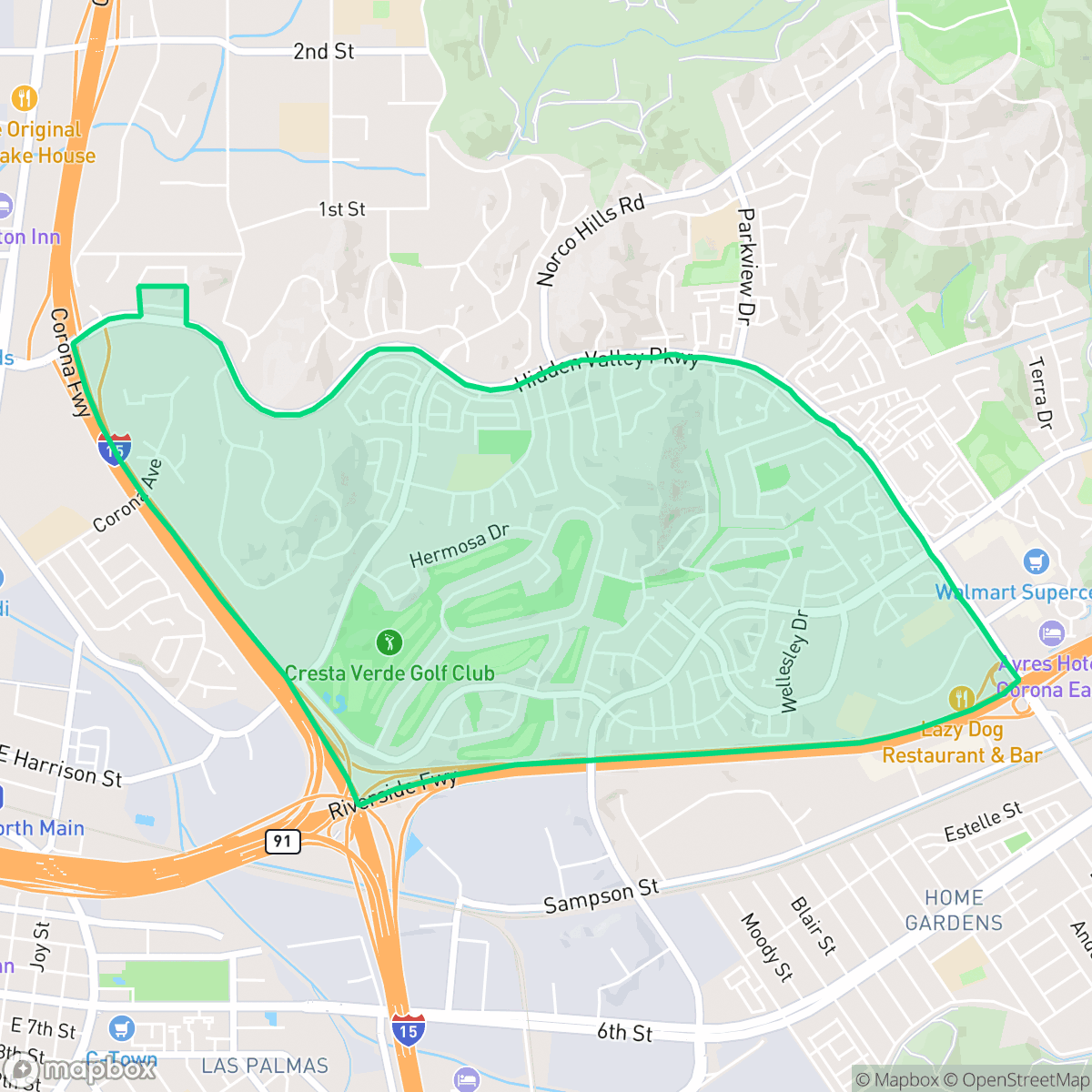
About Corona Hills
Corona Hills, a residential neighborhood in northeastern Corona, California, began its rapid development in the late 1980s following a unique 1985 border agreement in which Corona annexed 712 undeveloped acres from neighboring Norco. Built out primarily in the 1990s, the neighborhood is characterized by Mediterranean-style single-family homes and quiet cul-de-sacs. A prominent local landmark is the historic Cresta Verde Golf Course, originally established in 1927 as the Parkridge Country Club. Designed by actor Randolph Scott and co-founded by stars Henry Fonda and Burt Lancaster, the course served as a popular retreat for Hollywood celebrities, including Clark Gable, Bing Crosby, and Desi Arnaz, long before the surrounding hills were transformed into suburban tracts.
The neighborhood offers a dense suburban environment characterized by well-manicured landscapes and a consistent pattern of single-family homes. It is highly regarded for its pedestrian-friendly design, featuring extensive sidewalk networks and quiet cul-de-sacs that encourage outdoor activity. According to iHuus data, the area maintains a strong connection to local green spaces, which provide ample room for recreation and dog walking. While the setting is primarily residential, its proximity to major highways and light commercial zones ensures that essential services and diverse dining options remain easily accessible.
Prospective residents should be aware of the trade-offs inherent in this suburban setting, including higher density housing that results in limited backyard privacy and moderate noise levels from regional road traffic. However, the area is served by the highly rated Corona-Norco Unified School District, making it a compelling choice for families seeking academic stability. With a favorable balance of suburban comfort and urban convenience, the neighborhood remains a consistent draw for those who prioritize school quality and a walkable residential layout.
Neighborhood Scores Across 15 Qualities
Residential spacing varies from tightly clustered homes to standard suburban lots with small yards. This level of density is roughly in line with the rest of Corona, according to iHuus data.
Comprehensive sidewalk networks and well-connected residential cul-de-sacs provide a safe environment for strollers and pedestrians. This level of walkability is consistent with the average found throughout Corona.
Large homes with well-manicured landscaping and frequent private pools characterize this area. According to iHuus data, the visual quality of the neighborhood is consistent with the city average.
Wide green verges, pocket parks, and connected open spaces provide ample room for pet exercise. According to iHuus data, these walking conditions are slightly above the city average.
Residential tracts are interspersed with managed green spaces and large-scale industrial footprints, resulting in a level of openness that is slightly lower than the Corona average.
A blend of quiet residential streets and active commercial pockets creates a level of activity that is higher than the Corona average. While diverse dining and local services are accessible, most amenities require a vehicle due to the car-dependent nature of the area.
Continuous sound from nearby thoroughfares creates a consistent background hum. This level of acoustic activity is typical for the local area, aligning closely with the city average.
Air quality remains mostly clean with only rare instances of elevated readings; however, levels are slightly lower than the average found throughout Corona.
Residential life remains largely undisturbed by heavy industry, as the area is primarily composed of quiet streets and light commercial zones. While some large logistics hubs and a wastewater treatment plant are located nearby, the neighborhood maintains a level of industrial separation that is slightly higher than the Corona average.
Health insurance coverage among residents is higher than the Corona average, according to iHuus data.
Political leanings in this area are split relatively evenly between conservative and liberal residents. This distribution represents a more moderate ideological mix than the average for Corona.
Residents live alongside a diverse mix of young adults, families, and seniors. This demographic spread is largely in line with the broader Corona area, according to iHuus data.
Flood vulnerability in this area is notably higher than the city average. Residents should prepare for potential elevation challenges and elevated insurance costs, according to iHuus data.
Address-Level Insights for Corona Hills


iHuus Neighborhood Intelligence Insights
Get address-level neighborhood insights for Corona Hills
- Street-level scores — see how individual blocks compare, not just neighborhood averages
- Micro-zone boundaries — identify quiet pockets, flood boundaries, and walkable clusters before you visit
- 15 dimensions in full — walkability, noise, air quality, school quality, insurance coverage, population age profile, urban/rural index, and more
- Boundary risk alerts — know if your address sits near a block boundary where scores drop, the kind of detail no listing will ever mention
- School insights — individual school ratings and insights, not just district-level data
- Compare before you commit — side-by-side data across neighborhoods, down to block precision
No credit card required
Compare with Any Neighborhood
| Dimension | Corona Hills | Brentridge |
|---|---|---|
| 🚶 Walkabilityavg 8.38 | ||
| 🔊 Acoustic Comfortavg 4.43 | ||
| 🤫 Privacy Indexavg 5.19 | ||
| 🎨 Visual Appealavg 7.22 | ||
| 🐕 Dog Friendlinessavg 6.49 | ||
| 🗺️ Urban-Rural Indexavg 6.84 | ||
| ✨ Neighborhood Vibeavg 4.72 | ||
| 🏥 Health Insurance Coverageavg 6.35 | ||
| 🌿 Air Qualityavg 8.72 | ||
| 🏭 Industrial Proximityavg 8.05 | ||
| 🌊 Flood Safetyavg 1.55 | ||
| 🗳️ Ideological Leanavg 4.94 | ||
| 👥 Population Age Profileavg 4.7 | ||
| 🔥 Fire Safetyavg 0.5 | ||
| 🏫 School Quality |
Corona Hills Rankings
School Districts Serving Corona Hills
School Insights for Corona Hills
Below average outcomes; significant attendance and academic challenges.
School Insights
See what's really behind every school rating near Corona Hills
- Individual school ratings — each school's own score with outcome context, not just a district average
- Enrollment & class size data — student-to-teacher ratio and how it compares to the state average
- Full demographics breakdown — ethnicity and gender composition for every school in the enrollment zone
- Every school in the district — all schools within the enrollment boundary ranked by rating, not just the closest one
- Grade levels & benchmarks — elementary through high school, with below/above state-average flags
No credit card required