University, Waco
Updated · 5,418 residents
The University neighborhood is a historic enclave defined by its mid-century architecture and a strong connection to local Mexican-American culture. While the area offers a vibrant selection of long-standing eateries, residents should anticipate a car-dependent environment with notable road noise from nearby thoroughfares.
Key Highlights
About University
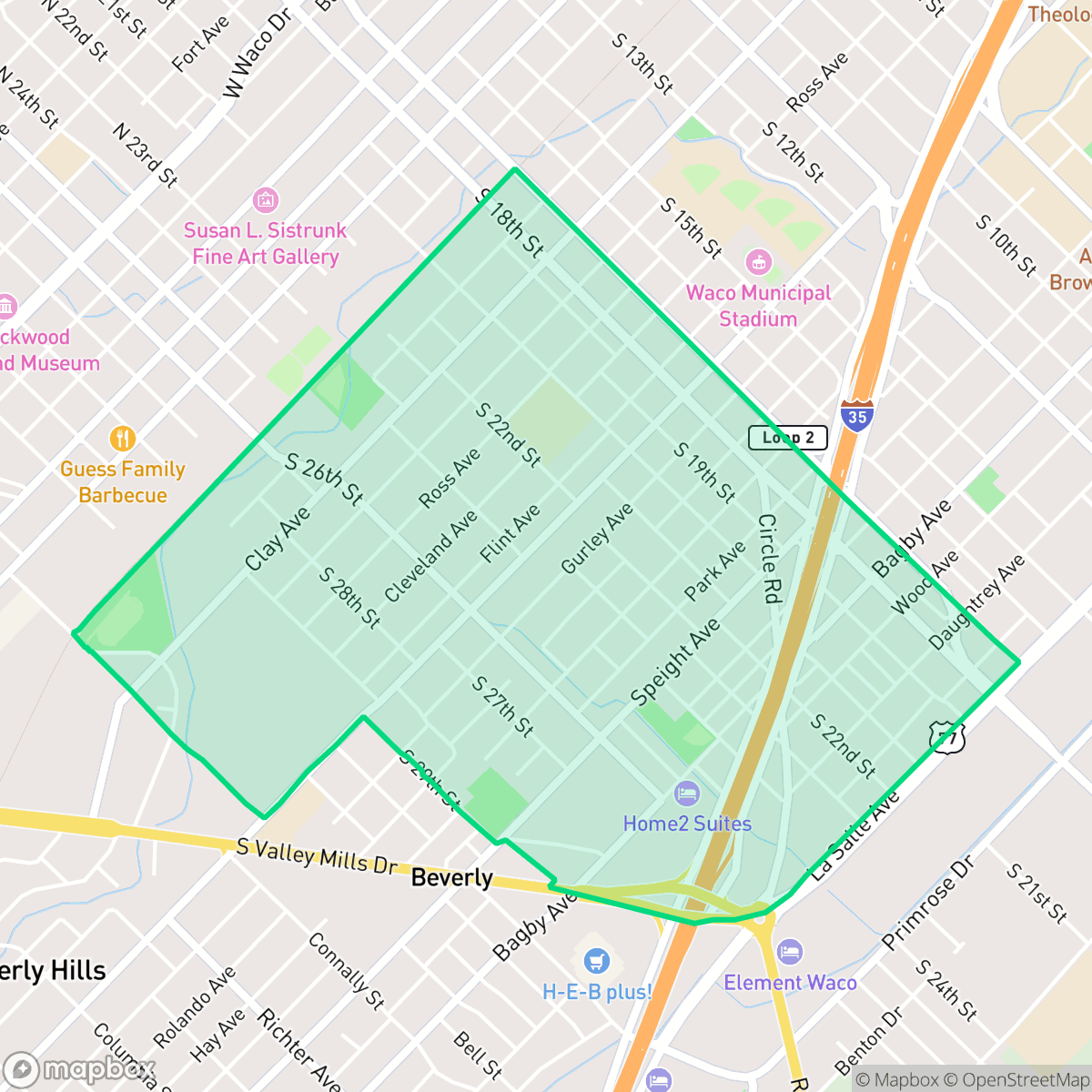
The University neighborhood in South Waco, now represented by the Cesar Chavez Neighborhood Association, is a historic, working-class enclave deeply rooted in Mexican-American culture. Bordering Baylor University, the neighborhood is centered along Speight Avenue, a signature corridor home to legendary local businesses like George’s Bar (founded in 1930 as Harry B’s) and Cupp’s Drive-Inn, a 1947 diner famously frequented by Elvis Presley. A major cultural anchor is the South Waco Community Center, which houses the Waco Hispanic Museum and features the monumental 'Dignidad' mural by artist Jesus Rivera, celebrating the region's Chicano heritage. The neighborhood’s architectural stock is characterized by mid-century single-family homes and bungalows built primarily between 1940 and 1969.
The neighborhood serves as a dense residential grid characterized by its proximity to major transit corridors and industrial sites. It maintains a distinct identity through its mix of residential streets and active commercial zones, where local dining staples continue to serve the community. The layout reflects a traditional suburban structure, blending older single-family homes with light industrial infrastructure that supports daytime commercial activity.
Prospective residents should note that the area experiences elevated noise levels primarily due to road traffic, and the density of the grid results in closely spaced homes with limited private outdoor space. While the community provides access to local centers and parks, it remains largely car-dependent for daily errands. It is best suited for those seeking an established, culturally rich community who prioritize proximity to central Waco over a quiet, secluded living environment.
Neighborhood Scores Across 15 Qualities
Residential spacing is typical for the area, featuring a mix of closely set houses and small yards. This level of separation between neighbors is consistent with the average found throughout Waco.
Quiet streets permit walking, but the absence of continuous sidewalks and the presence of large industrial blocks make pedestrian navigation less convenient than the Waco average. According to iHuus data, the grid layout features intermittent sidewalk gaps.
Residential views consist of standard, uniform housing on compact lots. This area lacks significant greenery or luxury amenities and sits below the Waco average for visual variety.
Residential sidewalks feature narrow verges, though residents benefit from proximity to large sports fields and public parks. Overall pet-friendly infrastructure in this area is below the Waco average, according to iHuus data.
Open land and scattered greenery are common throughout this area, though it feels slightly less urbanized than the typical Waco neighborhood. Residents may find a mix of residential and industrial pockets alongside more natural, low-density landscapes.
A blend of quiet residential streets and active commercial pockets creates a sense of activity that is slightly more vibrant than the Waco average. While local dining and coffee shops provide notable social hubs, much of the area's amenities are concentrated near major highways and require a vehicle to access.
Frequent sounds from nearby railroad tracks and major roadways characterize this area. Acoustic comfort is lower than the Waco average according to iHuus data.
Air quality in this area remains mostly clean with only rare instances of elevated readings, though it sits slightly below the Waco city average according to iHuus data.
Residential life is largely undisturbed by heavy industry, though some nearby warehouses and a power substation introduce occasional noise and visual elements. According to iHuus data, this area has less industrial activity than the Waco average.
Health insurance coverage levels among residents are slightly lower than the average seen across Waco. According to iHuus data, access to coverage is moderate within this area.
Political leanings in this area skew significantly more liberal than the Waco average. According to iHuus data, the neighborhood maintains a liberal majority with a modest opposing presence.
A diverse range of age groups, including young adults, families, and older residents, resides here. This demographic spread is relatively comparable to the average across Waco.
Properties in this area are located within a known floodplain, which may necessitate flood insurance. This level of risk is comparable to the average across Waco.
Address-Level Insights for University


iHuus Neighborhood Intelligence Insights
Get address-level neighborhood insights for University
- Street-level scores — see how individual blocks compare, not just neighborhood averages
- Micro-zone boundaries — identify quiet pockets, flood boundaries, and walkable clusters before you visit
- 15 dimensions in full — walkability, noise, air quality, school quality, insurance coverage, population age profile, urban/rural index, and more
- Boundary risk alerts — know if your address sits near a block boundary where scores drop, the kind of detail no listing will ever mention
- School insights — individual school ratings and insights, not just district-level data
- Compare before you commit — side-by-side data across neighborhoods, down to block precision
No credit card required
Compare with Any Neighborhood
| Dimension | University | Alta Vista |
|---|---|---|
| 🚶 Walkabilityavg 6.02 | ||
| 🔊 Acoustic Comfortavg 4.77 | ||
| 🤫 Privacy Indexavg 6 | ||
| 🎨 Visual Appealavg 5.94 | ||
| 🐕 Dog Friendlinessavg 5.69 | ||
| 🗺️ Urban-Rural Indexavg 7.16 | ||
| ✨ Neighborhood Vibeavg 4.51 | ||
| 🏥 Health Insurance Coverageavg 6 | ||
| 🌿 Air Qualityavg 8.5 | ||
| 🏭 Industrial Proximityavg 8.03 | ||
| 🌊 Flood Safetyavg 2.66 | ||
| 🗳️ Ideological Leanavg 4.79 | ||
| 👥 Population Age Profileavg 4.52 | ||
| 🔥 Fire Safety | ||
| 🏫 School Quality |
University Rankings
School Districts Serving University
School Insights for University
Below average outcomes; significant attendance and academic challenges.
School Insights
See what's really behind every school rating near University
- Individual school ratings — each school's own score with outcome context, not just a district average
- Enrollment & class size data — student-to-teacher ratio and how it compares to the state average
- Full demographics breakdown — ethnicity and gender composition for every school in the enrollment zone
- Every school in the district — all schools within the enrollment boundary ranked by rating, not just the closest one
- Grade levels & benchmarks — elementary through high school, with below/above state-average flags
No credit card required