Sanger Heights, Waco
Updated · 4,411 residents
Sanger Heights is a quiet, historic residential area in Waco characterized by its diverse architectural styles and mature, tree-lined streets. According to iHuus data, the neighborhood offers excellent air quality and a peaceful acoustic environment, though residents will find limited commercial amenities within walking distance.
Key Highlights
About Sanger Heights
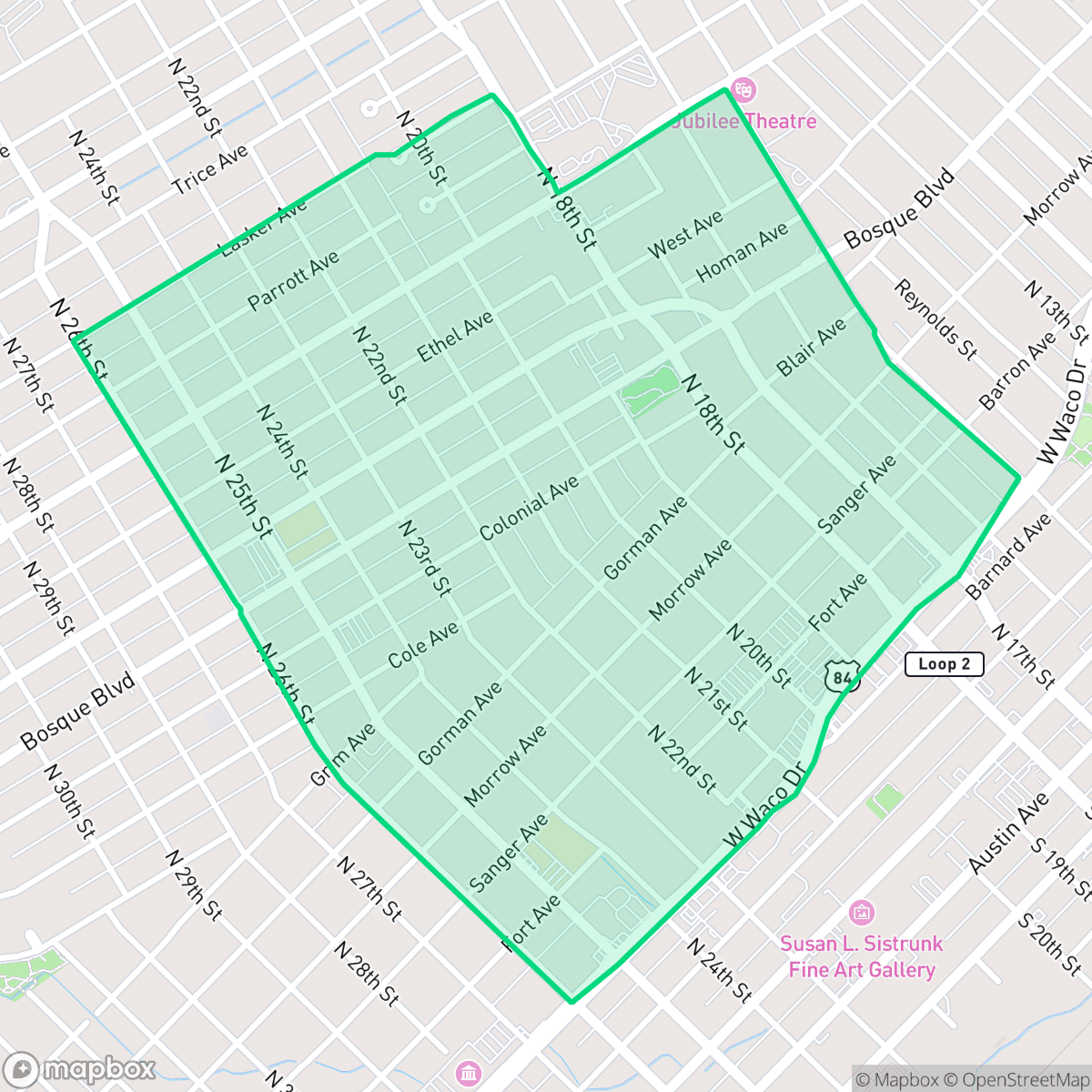
Dating back to the 1880s, Sanger Heights is one of Waco's oldest neighborhoods and developed as an early "streetcar suburb". Intentionally developed by Samuel Colcord of New York, the neighborhood grew around the streetcar line and the nearby Providence Hospital. Its signature tree-lined street, Colcord Avenue, features a rich architectural stock of early 20th-century homes, including Queen Anne, Craftsman, and Colonial Revival styles. For over a century, the neighborhood’s most prominent landmark was the Romanesque-style Sanger Avenue Elementary School. Designed by renowned Waco architect Milton W. Scott and opened in 1904, the school was a cornerstone of the area's historic "Silk Stocking District". Although the school was demolished in 2010 after an arson fire, its historic entrance archway was preserved to anchor the local Nina B. Glass Park.
The neighborhood functions primarily as a residential enclave with a mix of light commercial activity that creates a calm, suburban atmosphere. Residents benefit from high levels of flood safety and air quality, contributing to a stable living environment. While the area maintains a moderate level of visual appeal and privacy, it is defined by its lack of industrial proximity, ensuring a quiet setting for those who value acoustic comfort. The presence of community hubs like the Calvary Baptist Church adds to the local character, though the area remains largely defined by its quiet, residential blocks.
Prospective residents should note that the area presents specific trade-offs regarding infrastructure and accessibility. While the neighborhood is not highly walkable for daily errands, it serves as a stable, historic community. Families should consider that local school performance within the Waco Independent School District remains in a transitional phase, and residents may face challenges regarding health insurance coverage, which iHuus data indicates is lower than the city average.
Neighborhood Scores Across 15 Qualities
Residential spacing provides a balanced level of separation between neighbors, consistent with the average density found throughout Waco. Homes are positioned with moderate gaps that offer a degree of buffer between adjacent properties.
Low traffic volumes on the residential grid allow for relatively safe pavement walking. While sidewalks are often missing or obscured, the walking experience remains consistent with the Waco average.
Standard tract housing with uniform rooflines and small yards characterizes this area. The visual landscape is consistent with the city average, featuring tidy but basic residential lots.
Private backyards provide the primary area for pets, as narrow sidewalks and a lack of nearby public parks offer fewer opportunities for off-leash exercise than the Waco average. According to iHuus data, the absence of wide green verges makes this area less ideal for dog owners seeking accessible walking routes.
Open land and scattered homes characterize this area, offering a more semi-rural atmosphere than the more densely urbanized parts of Waco. Residents will find significant tree canopy and pockets of woodland interspersed with residential grids, according to iHuus data.
Residential streets and green spaces blend with pockets of local dining and services, offering a level of activity that is roughly consistent with the Waco average. While certain blocks feature walkable amenities like coffee shops and libraries, many areas remain primarily quiet and suburban in character.
Steady traffic noise from nearby busy streets is common here, though the area is generally quieter than the Waco average according to iHuus data.
Air quality remains consistently high with very few instances of pollutants, performing slightly above the Waco average according to iHuus data.
Industrial activity is virtually non-existent here, as the area consists of residential and light commercial zones with no detectable heavy warehouses or hazardous sites. This lack of industrial presence is notably higher than the Waco average, according to iHuus data.
Health insurance coverage among residents is notably lower than the Waco average, according to iHuus data. This lack of coverage may impact access to routine medical care and financial protection against healthcare costs.
Political leanings in this area trend significantly more liberal than the Waco average. According to iHuus data, the neighborhood maintains a liberal majority with a modest opposing presence.
Residents live alongside a balanced mix of young adults, families, and older populations. This demographic spread is largely consistent with the broader Waco area, according to iHuus data.
Frequent flood risk exists here due to the area's location within a designated floodplain. According to iHuus data, this level of vulnerability is notably higher than the Waco city average.
Address-Level Insights for Sanger Heights


iHuus Neighborhood Intelligence Insights
Get address-level neighborhood insights for Sanger Heights
- Street-level scores — see how individual blocks compare, not just neighborhood averages
- Micro-zone boundaries — identify quiet pockets, flood boundaries, and walkable clusters before you visit
- 15 dimensions in full — walkability, noise, air quality, school quality, insurance coverage, population age profile, urban/rural index, and more
- Boundary risk alerts — know if your address sits near a block boundary where scores drop, the kind of detail no listing will ever mention
- School insights — individual school ratings and insights, not just district-level data
- Compare before you commit — side-by-side data across neighborhoods, down to block precision
No credit card required
Compare with Any Neighborhood
| Dimension | Sanger Heights | Alta Vista |
|---|---|---|
| 🚶 Walkabilityavg 6.02 | ||
| 🔊 Acoustic Comfortavg 4.77 | ||
| 🤫 Privacy Indexavg 6 | ||
| 🎨 Visual Appealavg 5.94 | ||
| 🐕 Dog Friendlinessavg 5.69 | ||
| 🗺️ Urban-Rural Indexavg 7.16 | ||
| ✨ Neighborhood Vibeavg 4.51 | ||
| 🏥 Health Insurance Coverageavg 6 | ||
| 🌿 Air Qualityavg 8.5 | ||
| 🏭 Industrial Proximityavg 8.03 | ||
| 🌊 Flood Safetyavg 2.66 | ||
| 🗳️ Ideological Leanavg 4.79 | ||
| 👥 Population Age Profileavg 4.52 | ||
| 🔥 Fire Safety | ||
| 🏫 School Quality |
Sanger Heights Rankings
School Districts Serving Sanger Heights
School Insights for Sanger Heights
Below average outcomes; significant attendance and academic challenges.
School Insights
See what's really behind every school rating near Sanger Heights
- Individual school ratings — each school's own score with outcome context, not just a district average
- Enrollment & class size data — student-to-teacher ratio and how it compares to the state average
- Full demographics breakdown — ethnicity and gender composition for every school in the enrollment zone
- Every school in the district — all schools within the enrollment boundary ranked by rating, not just the closest one
- Grade levels & benchmarks — elementary through high school, with below/above state-average flags
No credit card required