North Waco, Waco
Updated · 7,276 residents
North Waco is a quiet, residential community characterized by its dense suburban grid and established tree canopy. While the area is largely car-dependent, residents benefit from excellent air quality and a peaceful atmosphere free from heavy industrial activity.
Key Highlights
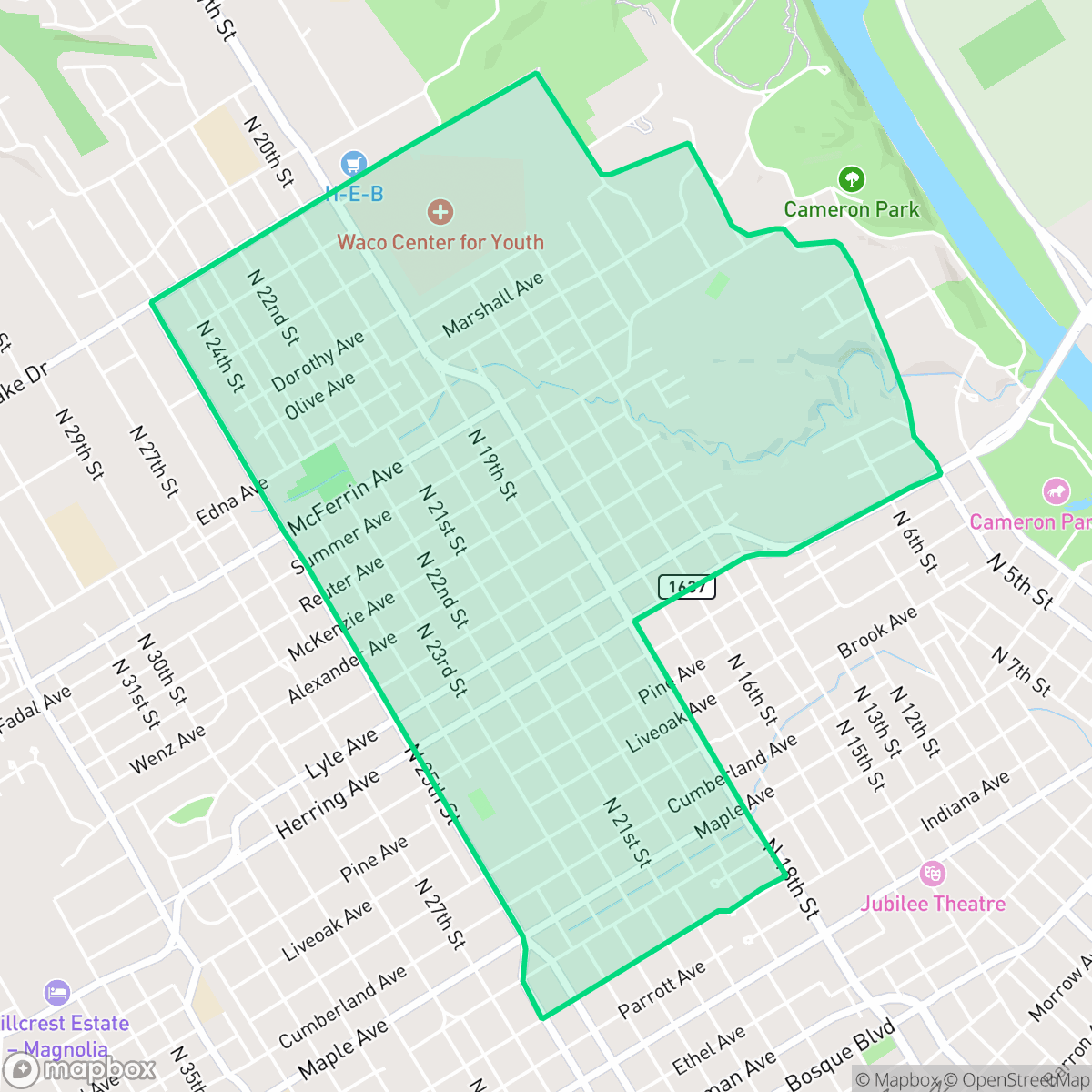
About North Waco
North Waco developed in the late 19th and early 20th centuries as a prominent institutional and educational hub. From 1895 to 1910, the neighborhood was the home of Texas Christian University (TCU) before a devastating fire destroyed its main building, prompting the school's relocation to Fort Worth. Other historic institutions anchored the area, including the Methodist Children's Home, established on Herring Avenue in 1894, and St. Basil's College, a Catholic boys' preparatory school that operated from 1902 to 1915 on the site of today's St. Louis Catholic Church. During World War I, North Waco transformed into a military center, hosting Camp MacArthur—a massive U.S. Army training camp established in 1917—and the adjacent Rich Field aviation base.
North Waco functions as a stable residential enclave defined by its grid of single-story homes and mature trees. The area maintains a quiet, suburban rhythm, supported by a variety of local dining options such as Kitok Restaurant, Dubl-R Old Fashioned Hamburgers, and several taquerias. This neighborhood offers a serene environment with minimal noise pollution and high air quality, providing a consistent, low-density living experience for its residents.
Prospective residents should note that the area is primarily car-dependent, as sidewalks are often inconsistent or missing. While the community enjoys a complete absence of industrial facilities, it faces significant challenges regarding flood safety and lower rates of health insurance coverage. The local schools operate within the Waco Independent School District, which is currently undergoing a period of infrastructure modernization and academic transition. This area is best suited for those seeking a quiet, established suburban environment who prioritize clean air and residential stability over walkability or proximity to high-density commercial hubs.
Neighborhood Scores Across 15 Qualities
Residential spacing provides a moderate level of separation between neighbors. According to iHuus data, the density is roughly average for the Waco area, featuring consistent gaps between homes and small side yards.
Low traffic and a residential grid layout allow for safe walking, though many streets lack formal sidewalks. This level of walkability is consistent with the average for Waco.
Standard tract housing with simple rooflines and small yards characterizes the area. According to iHuus data, the visual landscape is less diverse and contains fewer luxury amenities than the Waco average.
Private fenced backyards are the primary source of greenery here, as narrow sidewalk verges and a lack of visible public parks make street-side walking difficult. This area offers fewer opportunities for outdoor pet exercise compared to the Waco average, according to iHuus data.
Frequent open land and scattered homes among woodlands create a more tranquil setting than the more urbanized areas of Waco. According to iHuus data, the landscape features a mix of dense suburban grids and significant tree canopy coverage.
A mix of lively dining clusters and quiet, rural landscapes provides more activity than the Waco average. While many blocks feature diverse restaurants and social spots, the car-dependent layout limits much of the neighborhood's vibrancy to specific pockets.
Occasional sounds from distant traffic or trains are the primary source of noise, which is noticeably lower than the Waco average according to iHuus data.
Air quality remains consistently high with minimal pollutants present. This level of air cleanliness is better than the average found throughout Waco, according to iHuus data.
Residential and light commercial zones comprise the entire area, with no detected warehouses or heavy industrial hazards. This neighborhood offers a cleaner environment than the Waco average due to the complete absence of industrial facilities.
Health insurance accessibility in this area is lower than the average for the city of Waco. According to iHuus data, a minority of local residents are covered by health insurance plans.
Political leanings in this area trend significantly more liberal than the Waco average. According to iHuus data, the neighborhood maintains a liberal majority with a modest opposing presence.
Residents live alongside a diverse demographic of young adults, families, and older individuals. This age distribution is consistent with the overall profile seen across Waco.
Flood risk is significantly higher here than the Waco average, which may result in elevated or prohibitive insurance costs. According to iHuus data, residents should prepare for potential vulnerabilities to rising water levels.
Address-Level Insights for North Waco


iHuus Neighborhood Intelligence Insights
Get address-level neighborhood insights for North Waco
- Street-level scores — see how individual blocks compare, not just neighborhood averages
- Micro-zone boundaries — identify quiet pockets, flood boundaries, and walkable clusters before you visit
- 15 dimensions in full — walkability, noise, air quality, school quality, insurance coverage, population age profile, urban/rural index, and more
- Boundary risk alerts — know if your address sits near a block boundary where scores drop, the kind of detail no listing will ever mention
- School insights — individual school ratings and insights, not just district-level data
- Compare before you commit — side-by-side data across neighborhoods, down to block precision
No credit card required
Compare with Any Neighborhood
| Dimension | North Waco | Alta Vista |
|---|---|---|
| 🚶 Walkabilityavg 6.02 | ||
| 🔊 Acoustic Comfortavg 4.77 | ||
| 🤫 Privacy Indexavg 6 | ||
| 🎨 Visual Appealavg 5.94 | ||
| 🐕 Dog Friendlinessavg 5.69 | ||
| 🗺️ Urban-Rural Indexavg 7.16 | ||
| ✨ Neighborhood Vibeavg 4.51 | ||
| 🏥 Health Insurance Coverageavg 6 | ||
| 🌿 Air Qualityavg 8.5 | ||
| 🏭 Industrial Proximityavg 8.03 | ||
| 🌊 Flood Safetyavg 2.66 | ||
| 🗳️ Ideological Leanavg 4.79 | ||
| 👥 Population Age Profileavg 4.52 | ||
| 🔥 Fire Safety | ||
| 🏫 School Quality |
North Waco Rankings
School Districts Serving North Waco
School Insights for North Waco
Below average outcomes; significant attendance and academic challenges.
School Insights
See what's really behind every school rating near North Waco
- Individual school ratings — each school's own score with outcome context, not just a district average
- Enrollment & class size data — student-to-teacher ratio and how it compares to the state average
- Full demographics breakdown — ethnicity and gender composition for every school in the enrollment zone
- Every school in the district — all schools within the enrollment boundary ranked by rating, not just the closest one
- Grade levels & benchmarks — elementary through high school, with below/above state-average flags
No credit card required