East Riverside, Waco
Updated · 3,094 residents
East Riverside is a diverse, mixed-use area in East Waco characterized by a blend of industrial warehouses, green spaces, and local landmarks. While the neighborhood offers proximity to unique dining and community hubs, residents should expect frequent road noise and limited privacy due to its industrial-adjacent layout.
Key Highlights
About East Riverside
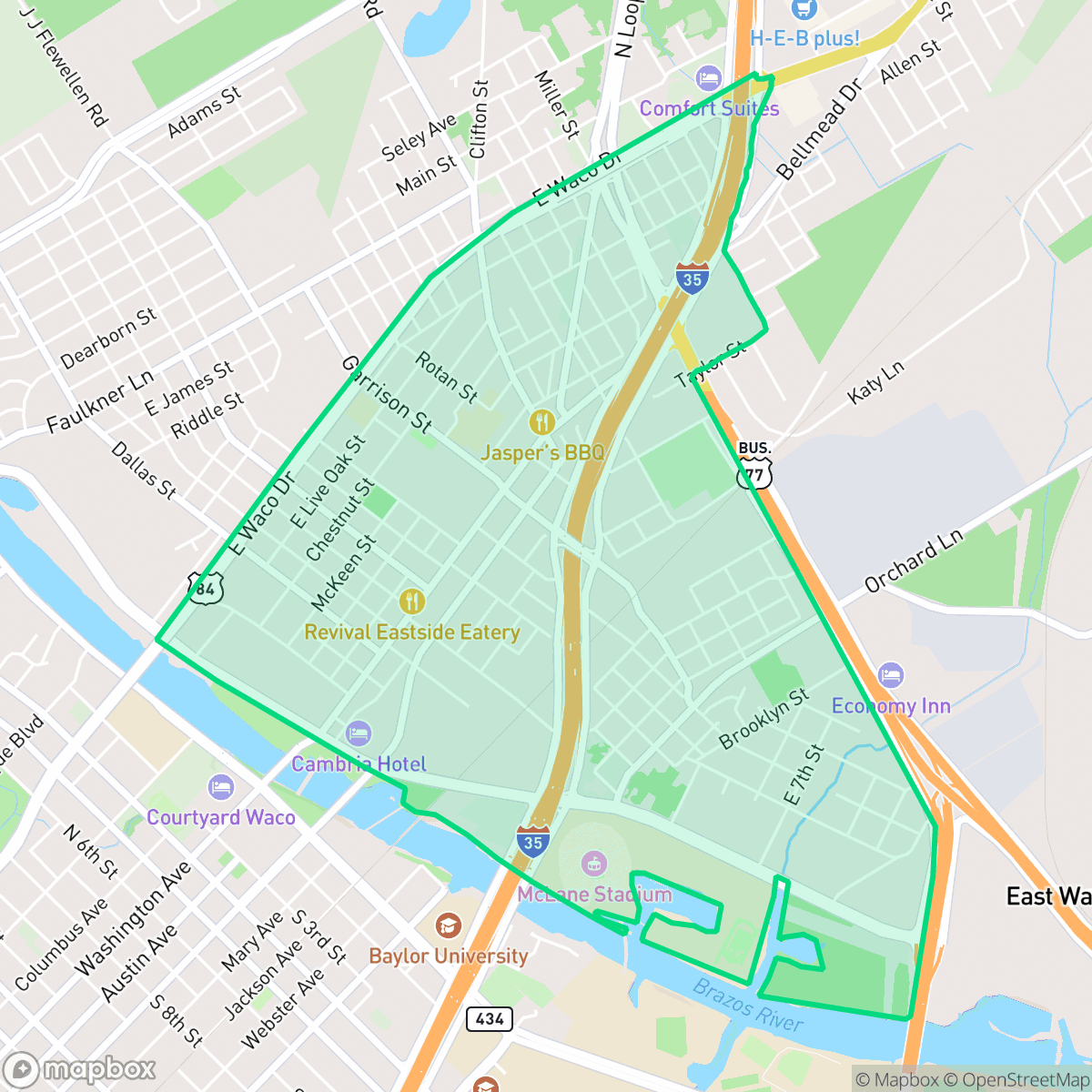
Located east of the Brazos River, East Riverside is a historically African American neighborhood in East Waco. The neighborhood’s cultural and economic heart is the Elm Avenue commercial corridor, which thrived in the mid-20th century as a bustling hub for Black-owned businesses, entertainment, and community life. Following decades of economic disinvestment and urban renewal, many of the area's mid-century homes and commercial buildings fell into disrepair. Today, the neighborhood is experiencing revitalization through the City of Waco’s Elm Avenue Redevelopment Corridor plan, which aims to preserve its history while fostering new growth. East Riverside is defined by local landmarks and long-standing institutions, including the Doris Miller YMCA, Brotherwell Brewing, and the legendary Tony DeMaria’s BBQ.
The neighborhood occupies a distinct position east of the Brazos River, serving as a transit-heavy corridor that balances light industrial activity with residential pockets. The landscape is marked by a mix of logistics hubs, electrical substations, and local social centers, creating a utilitarian atmosphere. According to iHuus data, the area experiences significant road traffic, which contributes to a noticeably louder acoustic environment compared to other parts of Waco. Despite these industrial features, the community maintains pockets of activity around Elm Avenue, where residents access local dining and recreational spots like Hood Street Park.
Prospective residents should weigh the area's central location against its specific livability trade-offs. The neighborhood presents challenges regarding visual appeal and privacy, as well as a high risk for flooding that requires careful consideration. While the area provides access to diverse culinary options and community institutions, it is best suited for those who prioritize proximity to major thoroughfares and industrial employment centers over quiet, suburban seclusion. Educational options vary significantly, with families having access to both Waco and La Vega independent school districts.
Neighborhood Scores Across 15 Qualities
Residential spacing is varied with some buffering between properties, though privacy levels are slightly lower than the Waco average according to iHuus data.
Quiet streets provide a calm environment for walking, though a lack of sidewalks makes the area less walkable than much of Waco. According to iHuus data, navigating the neighborhood on foot is more challenging than the city average.
Standard residential architecture and modest yard spaces define the local landscape. According to iHuus data, the visual variety in this area is lower than the Waco average.
Access to public parks and wide, grassy verges is sparse in this area. According to iHuus data, pet-friendly infrastructure is below the Waco average.
Residential streets and green spaces exist in equal measure with industrial zones and large warehouses. This landscape is less densely developed than the Waco average, featuring a transition from suburban housing to semi-rural wooded areas.
Local activity is slightly below the Waco average, characterized by a mix of quiet residential blocks, light industrial zones, and occasional social hubs. While some areas feature accessible dining and parks, much of the neighborhood maintains a calm, low-density atmosphere near major highways.
Steady sounds from nearby busy streets contribute to a level of acoustic activity that is higher than the Waco average. Residents may experience a consistent hum of local traffic throughout the day.
Air quality in this area is generally good, though slightly lower than the average seen across Waco. Residents can expect mostly clean air with only rare instances of elevated readings according to iHuus data.
Active logistics warehouses, rail yards, and utility infrastructure create more industrial activity and traffic than the Waco average. Residents may experience intermittent noise from freight trains and heavy truck movement near residential pockets.
Health insurance access in this area is lower than the Waco average, according to iHuus data. Residents may face more challenges accessing employer-sponsored or private coverage compared to other parts of the city.
Voting patterns and census indicators show a much more liberal political leaning here than the Waco average, according to iHuus data.
A balanced mix of young adults, families, and older residents characterizes the area. According to iHuus data, this demographic spread is slightly more varied than the average found across Waco.
Flood risk is significantly higher than the Waco average, with properties located in high-hazard zones. Residents should prepare for potentially elevated or prohibitive flood insurance costs according to iHuus data.
Address-Level Insights for East Riverside


iHuus Neighborhood Intelligence Insights
Get address-level neighborhood insights for East Riverside
- Street-level scores — see how individual blocks compare, not just neighborhood averages
- Micro-zone boundaries — identify quiet pockets, flood boundaries, and walkable clusters before you visit
- 15 dimensions in full — walkability, noise, air quality, school quality, insurance coverage, population age profile, urban/rural index, and more
- Boundary risk alerts — know if your address sits near a block boundary where scores drop, the kind of detail no listing will ever mention
- School insights — individual school ratings and insights, not just district-level data
- Compare before you commit — side-by-side data across neighborhoods, down to block precision
No credit card required
Compare with Any Neighborhood
| Dimension | East Riverside | Alta Vista |
|---|---|---|
| 🚶 Walkabilityavg 6.02 | ||
| 🔊 Acoustic Comfortavg 4.77 | ||
| 🤫 Privacy Indexavg 6 | ||
| 🎨 Visual Appealavg 5.94 | ||
| 🐕 Dog Friendlinessavg 5.69 | ||
| 🗺️ Urban-Rural Indexavg 7.16 | ||
| ✨ Neighborhood Vibeavg 4.51 | ||
| 🏥 Health Insurance Coverageavg 6 | ||
| 🌿 Air Qualityavg 8.5 | ||
| 🏭 Industrial Proximityavg 8.03 | ||
| 🌊 Flood Safetyavg 2.66 | ||
| 🗳️ Ideological Leanavg 4.79 | ||
| 👥 Population Age Profileavg 4.52 | ||
| 🔥 Fire Safety | ||
| 🏫 School Quality |
East Riverside Rankings
School Districts Serving East Riverside
School Insights for East Riverside
Below average outcomes; significant attendance and academic challenges.
School Insights
See what's really behind every school rating near East Riverside
- Individual school ratings — each school's own score with outcome context, not just a district average
- Enrollment & class size data — student-to-teacher ratio and how it compares to the state average
- Full demographics breakdown — ethnicity and gender composition for every school in the enrollment zone
- Every school in the district — all schools within the enrollment boundary ranked by rating, not just the closest one
- Grade levels & benchmarks — elementary through high school, with below/above state-average flags
No credit card required