Dean Highland, Waco
Updated · 4,878 residents
Dean Highland is a quiet, established suburban neighborhood in Waco defined by its dense grid of modest single-family homes and mature tree canopy. While the area offers a peaceful acoustic environment, residents generally rely on vehicles for daily errands due to a car-dependent layout and limited local business density.
Key Highlights
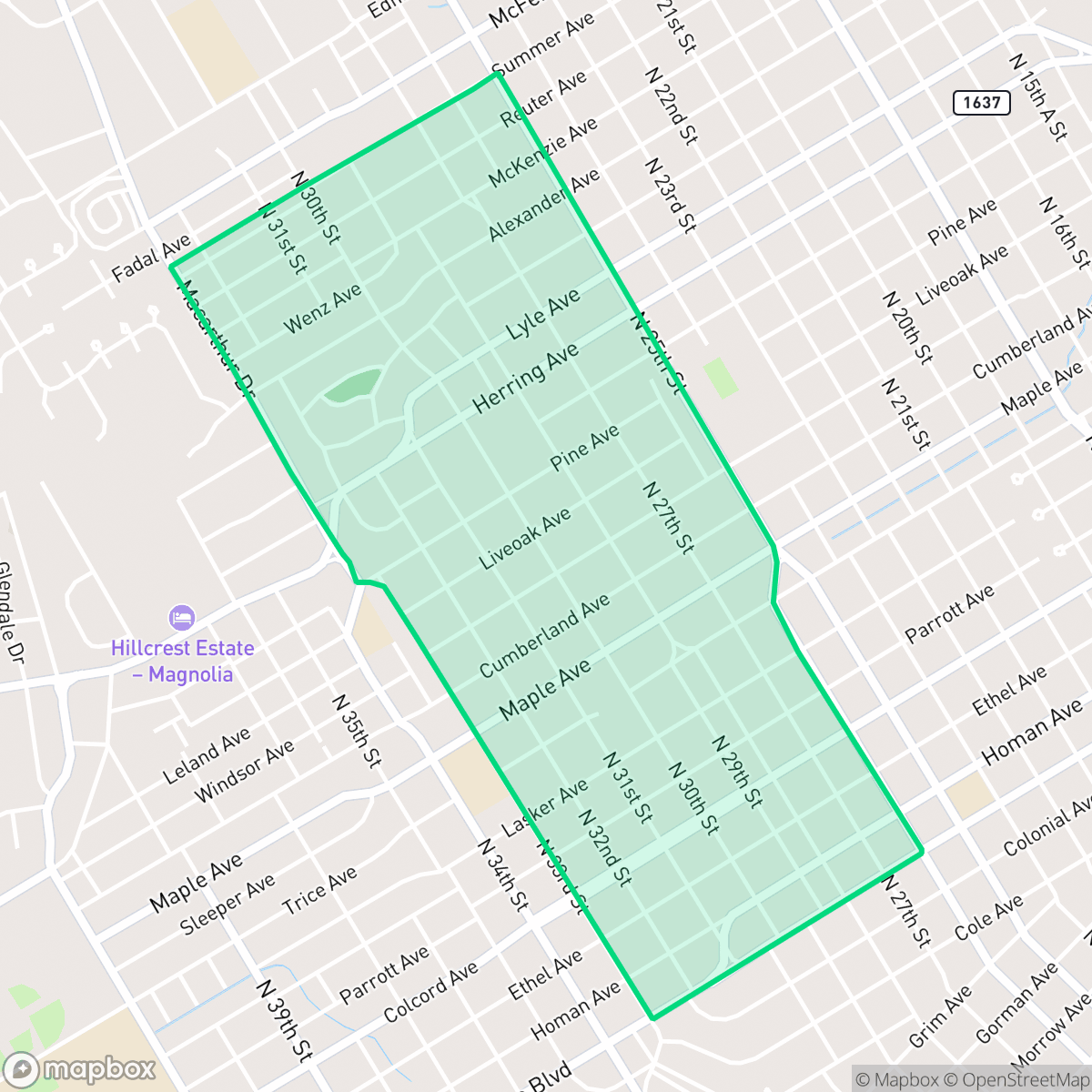
About Dean Highland
Developed from "Dean’s Addition" after land donations by Dr. Jesse Judge Dean in 1916, the Dean Highland neighborhood in Waco, Texas, emerged as a prominent early 20th-century streetcar suburb. The neighborhood’s growth was accelerated by the Texas Electric Railway's "Blue Bonnet" trolley line, which terminated at a historic trolley stop at 28th and Trice. This transit connection fostered a thriving upper-middle-class community characterized by a mix of architectural styles, including century-old Craftsman bungalows with low-slung roofs and postwar ranch homes from the 1940s and 1950s. Historically anchored by the former Hillcrest Baptist Hospital complex and the 1923 Highland Baptist Church—founded as an early antiracist congregation—the neighborhood also features the historic African American Zion Hill Baptist Church, reflecting its rich, diverse cultural heritage.
The area maintains a dense suburban atmosphere characterized by a mix of early 20th-century bungalows and mid-century ranch homes. It serves as a residential enclave with significant tree cover, providing a calm living environment that benefits from low levels of ambient noise. Residents have access to local religious institutions and a few small-scale dining options, though the neighborhood remains primarily residential with light commercial activity.
Prospective residents should consider that the neighborhood is largely car-dependent, as few businesses are within walking distance and the street grid lacks consistent sidewalk infrastructure. While the area boasts good air quality, it faces significant challenges regarding flood safety. Families with children will be served by the Waco Independent School District, which is currently undergoing a period of facility modernization and operational transition.
Neighborhood Scores Across 15 Qualities
Homes are consistently spaced with small side yards, providing a moderate amount of buffer between neighbors. This level of density is typical for the Waco area, according to iHuus data.
Low traffic volumes and a dense tree canopy allow for safe walking on residential streets, even though many areas lack formal sidewalks. This level of walkability is consistent with the average for Waco.
Standard tract housing with simple rooflines and small yards characterizes this area. According to iHuus data, the visual variety in this neighborhood is slightly below the Waco average.
Private fenced yards are the primary feature for pet owners, as narrow road verges and a lack of visible public parks make for limited off-leash walking areas. According to iHuus data, this level of accessibility for pets is slightly below the Waco average.
Frequent open land and scattered homes amid woodlands provide a more semi-rural atmosphere than the typical Waco urban environment. According to iHuus data, the area features a dense suburban layout with significant tree canopy coverage.
Residential life moves at a steady, quiet pace with a few local services and dining options scattered throughout the area. This level of activity is roughly in line with the average for Waco.
Acoustic levels are notably lower than the Waco average, with noise limited to infrequent distant trains and sporadic vehicle traffic. Residents can expect a calm environment according to iHuus data.
Air quality remains consistently high with minimal health concerns for residents. According to iHuus data, the air quality in this area is slightly better than the Waco average.
Residential tranquility is high here due to an absence of heavy industrial hazards or warehouses. According to iHuus data, the area is significantly more free of industrial proximity than the Waco average.
Health insurance enrollment in this area is consistent with the Waco city average. According to iHuus data, a moderate portion of the resident population possesses active health coverage.
Political views in this area are split relatively evenly between conservative and liberal leanings, representing a more balanced ideological landscape than the city average according to iHuus data.
Residents inhabit a demographic mix of young adults, families, and seniors that aligns with the Waco average. According to iHuus data, the area lacks a concentration of any single age group, providing a balanced community profile.
Significant flood hazards exist in this area, posing much greater risks than the average Waco neighborhood. Residents should anticipate much higher insurance premiums and potential for property damage according to iHuus data.
Address-Level Insights for Dean Highland


iHuus Neighborhood Intelligence Insights
Get address-level neighborhood insights for Dean Highland
- Street-level scores — see how individual blocks compare, not just neighborhood averages
- Micro-zone boundaries — identify quiet pockets, flood boundaries, and walkable clusters before you visit
- 15 dimensions in full — walkability, noise, air quality, school quality, insurance coverage, population age profile, urban/rural index, and more
- Boundary risk alerts — know if your address sits near a block boundary where scores drop, the kind of detail no listing will ever mention
- School insights — individual school ratings and insights, not just district-level data
- Compare before you commit — side-by-side data across neighborhoods, down to block precision
No credit card required
Compare with Any Neighborhood
| Dimension | Dean Highland | Alta Vista |
|---|---|---|
| 🚶 Walkabilityavg 6.02 | ||
| 🔊 Acoustic Comfortavg 4.77 | ||
| 🤫 Privacy Indexavg 6 | ||
| 🎨 Visual Appealavg 5.94 | ||
| 🐕 Dog Friendlinessavg 5.69 | ||
| 🗺️ Urban-Rural Indexavg 7.16 | ||
| ✨ Neighborhood Vibeavg 4.51 | ||
| 🏥 Health Insurance Coverageavg 6 | ||
| 🌿 Air Qualityavg 8.5 | ||
| 🏭 Industrial Proximityavg 8.03 | ||
| 🌊 Flood Safetyavg 2.66 | ||
| 🗳️ Ideological Leanavg 4.79 | ||
| 👥 Population Age Profileavg 4.52 | ||
| 🔥 Fire Safety | ||
| 🏫 School Quality |
Dean Highland Rankings
School Districts Serving Dean Highland
School Insights for Dean Highland
Below average outcomes; significant attendance and academic challenges.
School Insights
See what's really behind every school rating near Dean Highland
- Individual school ratings — each school's own score with outcome context, not just a district average
- Enrollment & class size data — student-to-teacher ratio and how it compares to the state average
- Full demographics breakdown — ethnicity and gender composition for every school in the enrollment zone
- Every school in the district — all schools within the enrollment boundary ranked by rating, not just the closest one
- Grade levels & benchmarks — elementary through high school, with below/above state-average flags
No credit card required