Brook Oaks, Waco
Updated · 4,975 residents
Brook Oaks is a quiet, suburban neighborhood in central Waco characterized by its mid-century residential architecture and excellent air quality. While the area provides a peaceful atmosphere with low noise levels, residents have limited access to walkable businesses and should be aware of the proximity to local industrial infrastructure.
Key Highlights
About Brook Oaks
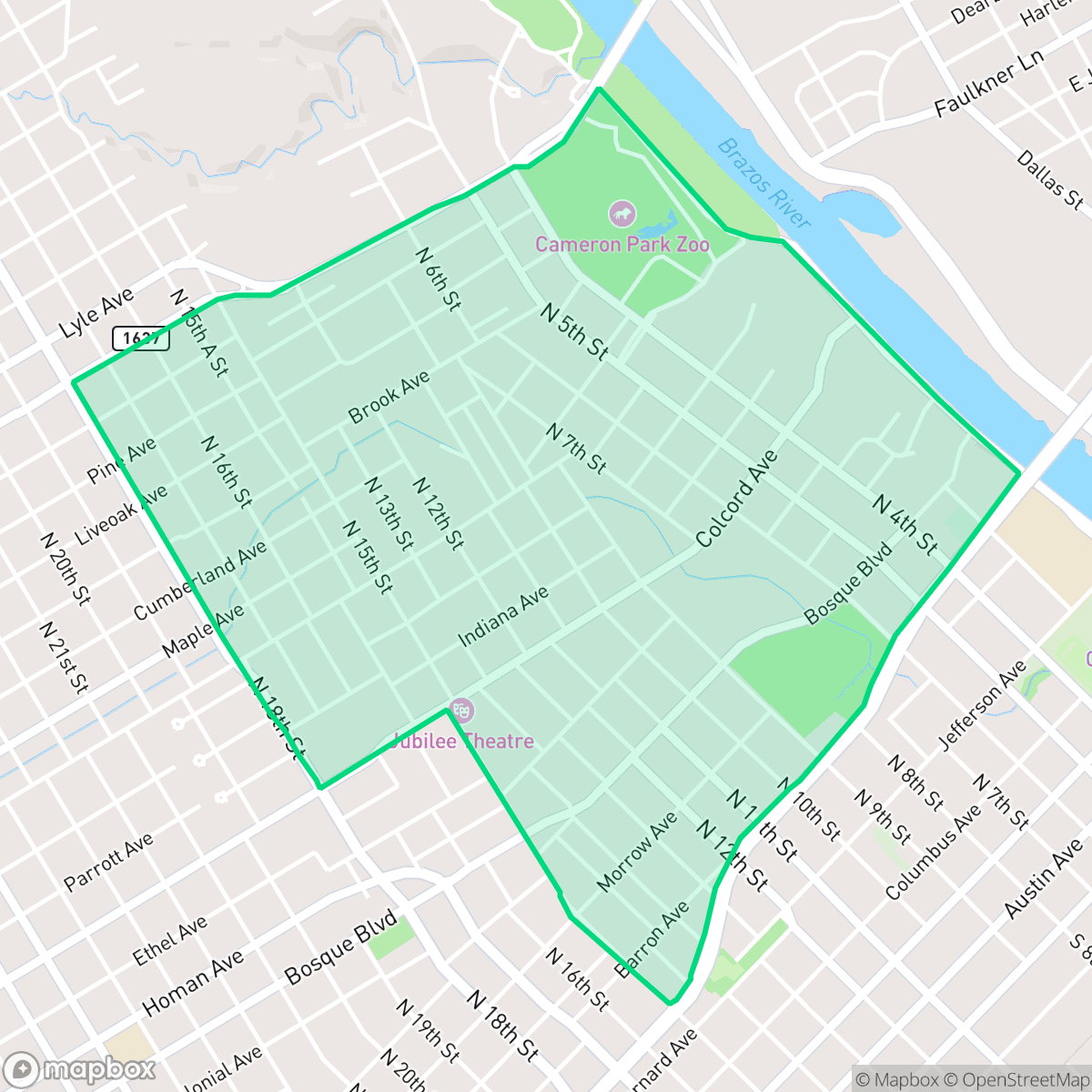
Located in central Waco, Texas, the Brook Oaks neighborhood is bounded by Waco Drive, Herring Avenue, the Brazos River, and the 15th and 18th Street corridors. The community was named in honor of the historic Brook Avenue Elementary School—originally established as a local landmark and rebuilt in 1999—and the area's abundant, stately oak trees. Formally organized in 1993 with the establishment of the Brook Oaks Neighborhood Association, the neighborhood features a residential landscape dominated by mid-century homes built primarily between 1940 and 1969. Local landmarks include Dewey Park and its community center, which serves as a central gathering hub. The neighborhood has also been a focal point for affordable housing initiatives, notably hosting a Habitat for Humanity home dedication on Morrow Avenue that featured a speech by former President George W. Bush.
The neighborhood maintains a suburban character defined by its mid-century housing stock and a blend of residential streets and open green spaces. While it offers a tranquil environment with significantly lower noise levels than the city average, the landscape is punctuated by industrial features, including a wastewater treatment plant and concrete infrastructure near the Brazos River. Local amenities are sparse, with only a few coffee shops and cafes serving as focal points for the community, meaning most daily errands require a vehicle despite the area's modest walkability score.
Prospective residents should consider the trade-offs associated with this location, including a lower flood safety rating and limited health insurance coverage across the population. The area is served by the Waco Independent School District, which is currently undergoing facility modernizations and academic improvements. Given its quiet nature and affordable housing history, the neighborhood is best suited for individuals or families seeking a stable, suburban environment who prioritize clean air and acoustic comfort over immediate access to dense commercial hubs.
Neighborhood Scores Across 15 Qualities
Residential spacing provides a consistent buffer between neighbors, maintaining a level of separation that is roughly comparable to the Waco average.
Low traffic levels on residential streets allow for relatively safe pavement walking despite a lack of consistent sidewalks. This level of walkability is slightly above the Waco average according to iHuus data.
Uniform tract housing and small yards define the landscape, which offers slightly less visual variety than the Waco average according to iHuus data.
Private backyards provide the primary greenery for pets, as sidewalk verges are narrow and public park access is restricted. This level of dog friendliness is below the Waco average according to iHuus data.
Open land and woodland areas provide a more semi-rural atmosphere than the more densely urbanized parts of Waco. Residents will find a mix of scattered homes and significant tree canopy throughout the area, according to iHuus data.
Suburban streets and green spaces provide a steady rhythm of life, though the neighborhood's activity levels are slightly below the Waco average. Most residents will find a mix of essential services and local dining scattered throughout the area, but the setting remains largely car-dependent.
A steady hum of local traffic from a nearby busy street is present; however, acoustic levels are notably quieter than the Waco average according to iHuus data.
Air quality remains consistently high with minimal pollutants, performing better than the Waco average according to iHuus data.
Residential life remains undisturbed by heavy industry or large warehouses, though a wastewater treatment facility is located near the river. This area maintains a slightly cleaner profile regarding industrial proximity than the Waco average, according to iHuus data.
Health insurance enrollment in Brook Oaks is lower than the average seen across Waco. According to iHuus data, a minority of the neighborhood's population is covered by a health insurance plan.
Voting patterns and census indicators in Brook Oaks reflect a much stronger liberal leaning than the typical Waco neighborhood, according to iHuus data.
Residents live alongside a varied mix of young adults, families, and seniors. This age distribution is largely comparable to the broader Waco area according to iHuus data.
Significant flood hazards are present in this area, which is much higher than the Waco average. Residents should anticipate elevated or potentially prohibitive flood insurance costs due to the local risk level identified by iHuus data.
Address-Level Insights for Brook Oaks


iHuus Neighborhood Intelligence Insights
Get address-level neighborhood insights for Brook Oaks
- Street-level scores — see how individual blocks compare, not just neighborhood averages
- Micro-zone boundaries — identify quiet pockets, flood boundaries, and walkable clusters before you visit
- 15 dimensions in full — walkability, noise, air quality, school quality, insurance coverage, population age profile, urban/rural index, and more
- Boundary risk alerts — know if your address sits near a block boundary where scores drop, the kind of detail no listing will ever mention
- School insights — individual school ratings and insights, not just district-level data
- Compare before you commit — side-by-side data across neighborhoods, down to block precision
No credit card required
Compare with Any Neighborhood
| Dimension | Brook Oaks | Alta Vista |
|---|---|---|
| 🚶 Walkabilityavg 6.02 | ||
| 🔊 Acoustic Comfortavg 4.77 | ||
| 🤫 Privacy Indexavg 6 | ||
| 🎨 Visual Appealavg 5.94 | ||
| 🐕 Dog Friendlinessavg 5.69 | ||
| 🗺️ Urban-Rural Indexavg 7.16 | ||
| ✨ Neighborhood Vibeavg 4.51 | ||
| 🏥 Health Insurance Coverageavg 6 | ||
| 🌿 Air Qualityavg 8.5 | ||
| 🏭 Industrial Proximityavg 8.03 | ||
| 🌊 Flood Safetyavg 2.66 | ||
| 🗳️ Ideological Leanavg 4.79 | ||
| 👥 Population Age Profileavg 4.52 | ||
| 🔥 Fire Safety | ||
| 🏫 School Quality |
Brook Oaks Rankings
School Districts Serving Brook Oaks
School Insights for Brook Oaks
Below average outcomes; significant attendance and academic challenges.
School Insights
See what's really behind every school rating near Brook Oaks
- Individual school ratings — each school's own score with outcome context, not just a district average
- Enrollment & class size data — student-to-teacher ratio and how it compares to the state average
- Full demographics breakdown — ethnicity and gender composition for every school in the enrollment zone
- Every school in the district — all schools within the enrollment boundary ranked by rating, not just the closest one
- Grade levels & benchmarks — elementary through high school, with below/above state-average flags
No credit card required