Baylor, Waco
Updated · 10,047 residents
The Baylor neighborhood is a vibrant, student-centered enclave defined by its proximity to Baylor University and high walkability. Residents benefit from excellent air quality and a lively social atmosphere, with numerous local dining spots and green spaces integrated into the campus-adjacent grid.
Key Highlights
About Baylor
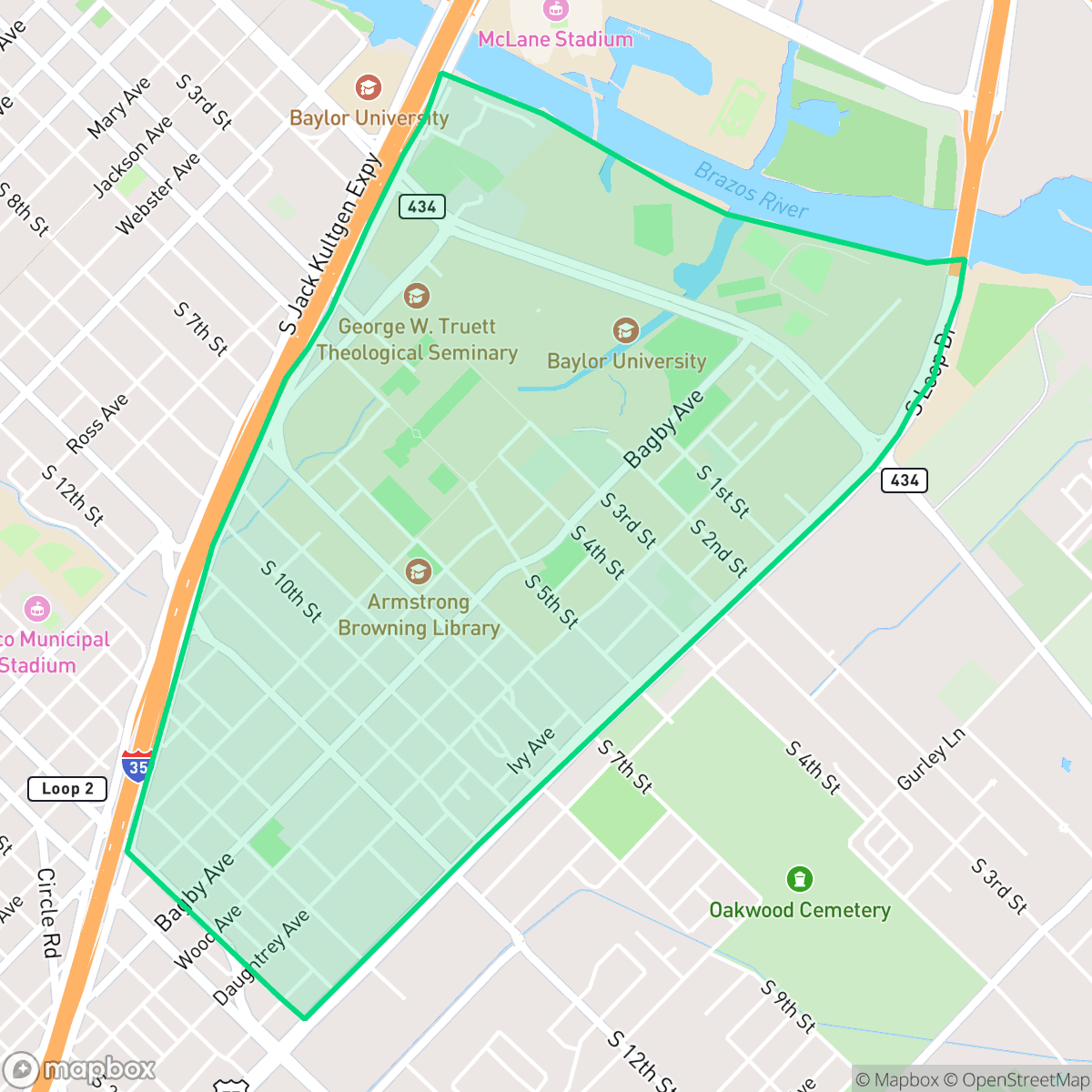
The Baylor neighborhood in Waco, Texas, is deeply intertwined with Baylor University, which relocated to the area in 1886. Originally consisting of residential areas and adjacent communities like Edgefield, the neighborhood underwent a dramatic transformation beginning in 1958. Under the Baylor University Project (Baylor 1A)—the first urban renewal project completed in Texas—the City of Waco and the university demolished 272 structures, displacing primarily Black residents to expand the campus. Today, the neighborhood is a densely populated, student-dominated urban enclave. It features a mix of mid-to-late 20th-century apartment complexes and single-family homes, alongside university landmarks and Georgian-style campus architecture.
The area functions as a dense urban hub where campus life and residential living converge. With a grid layout that promotes pedestrian activity, it offers easy access to university landmarks and local social centers like Shorty's Pizza Shack and La Familia. The neighborhood maintains a higher degree of acoustic comfort than many surrounding areas, supported by a lack of industrial activity and a focus on academic and residential use. According to iHuus data, the area benefits from high health insurance coverage and clean air, contributing to a stable environment for its younger demographic.
Living here involves a trade-off between privacy and convenience, as housing density is high and homes are often positioned close together. While the neighborhood lacks large public parks, the abundance of university lawns provides ample space for outdoor activities and dog walking. It is best suited for students, faculty, or those who prioritize proximity to the university and a walkable lifestyle over the seclusion of a traditional suburban setting.
Neighborhood Scores Across 15 Qualities
Residential spacing varies between high-density student housing and more spread-out academic structures. According to iHuus data, the level of privacy and separation between neighbors is slightly lower than the Waco average.
Extensive sidewalk networks and pedestrian paths are available throughout the campus and surrounding residential blocks, making this area more walkable than the Waco average. While the highway acts as a significant barrier to movement, most streets feature well-connected paths and safe crossings according to iHuus data.
Standard apartment complexes and tract housing define the area, offering a tidy appearance that is roughly in line with the Waco average. Landscapes consist of modest yards and shared institutional amenities rather than private luxury features.
Extensive university lawns and wide sidewalk verges offer more space for pet owners to walk dogs safely than is typical for Waco. While some areas are bisected by highways, the abundance of campus greenery provides significant room for exercise.
A blend of institutional campus grounds and residential clusters creates a setting that is less densely developed than the Waco average. Residents will find a mix of large university buildings, apartment complexes, and scattered open spaces.
Frequent social activity and a high concentration of local dining and amenities make this area significantly more vibrant than the Waco average. While some blocks offer a quiet suburban feel, many parts of the neighborhood feature a steady rhythm of activity around various restaurants and community landmarks.
Steady traffic sounds from nearby busy streets are noticeable, making the acoustic environment slightly more active than the Waco average according to iHuus data.
Air quality remains consistently high with very few instances of pollution. According to iHuus data, these levels are slightly better than the average found throughout Waco.
Industrial activity is notably absent from the area, which consists primarily of academic, residential, and light commercial uses. Residents benefit from a landscape that is significantly clearer of warehouses and heavy industry than the Waco average.
Health insurance access is significantly higher in this area than the Waco average, according to iHuus data. Most residents in the neighborhood possess active health coverage.
Political leanings in this area are split relatively evenly between conservative and liberal viewpoints, representing a more balanced ideological landscape than the Waco average according to iHuus data.
A significant majority of the population consists of young adults, making the age profile notably lower than the Waco average. According to iHuus data, there is a much smaller presence of families and older residents in this area.
Flood risk is notably higher than the Waco average because parts of this area fall within the 100-year floodplain. According to iHuus data, residents may need to secure flood insurance due to this increased susceptibility to rising waters.
Address-Level Insights for Baylor


iHuus Neighborhood Intelligence Insights
Get address-level neighborhood insights for Baylor
- Street-level scores — see how individual blocks compare, not just neighborhood averages
- Micro-zone boundaries — identify quiet pockets, flood boundaries, and walkable clusters before you visit
- 15 dimensions in full — walkability, noise, air quality, school quality, insurance coverage, population age profile, urban/rural index, and more
- Boundary risk alerts — know if your address sits near a block boundary where scores drop, the kind of detail no listing will ever mention
- School insights — individual school ratings and insights, not just district-level data
- Compare before you commit — side-by-side data across neighborhoods, down to block precision
No credit card required
Compare with Any Neighborhood
| Dimension | Baylor | Alta Vista |
|---|---|---|
| 🚶 Walkabilityavg 6.02 | ||
| 🔊 Acoustic Comfortavg 4.77 | ||
| 🤫 Privacy Indexavg 6 | ||
| 🎨 Visual Appealavg 5.94 | ||
| 🐕 Dog Friendlinessavg 5.69 | ||
| 🗺️ Urban-Rural Indexavg 7.16 | ||
| ✨ Neighborhood Vibeavg 4.51 | ||
| 🏥 Health Insurance Coverageavg 6 | ||
| 🌿 Air Qualityavg 8.5 | ||
| 🏭 Industrial Proximityavg 8.03 | ||
| 🌊 Flood Safetyavg 2.66 | ||
| 🗳️ Ideological Leanavg 4.79 | ||
| 👥 Population Age Profileavg 4.52 | ||
| 🔥 Fire Safety | ||
| 🏫 School Quality |
Baylor Rankings
School Districts Serving Baylor
School Insights for Baylor
Below average outcomes; significant attendance and academic challenges.
School Insights
See what's really behind every school rating near Baylor
- Individual school ratings — each school's own score with outcome context, not just a district average
- Enrollment & class size data — student-to-teacher ratio and how it compares to the state average
- Full demographics breakdown — ethnicity and gender composition for every school in the enrollment zone
- Every school in the district — all schools within the enrollment boundary ranked by rating, not just the closest one
- Grade levels & benchmarks — elementary through high school, with below/above state-average flags
No credit card required