Research Forest, The Woodlands
Updated · 1,762 residents
Research Forest serves as a balanced hub of corporate office space and quiet residential enclaves, characterized by its dense pine canopy and proximity to Lake Woodlands. While the area offers high walkability and convenient access to local services, residents should expect moderate noise levels from nearby road traffic.
Key Highlights
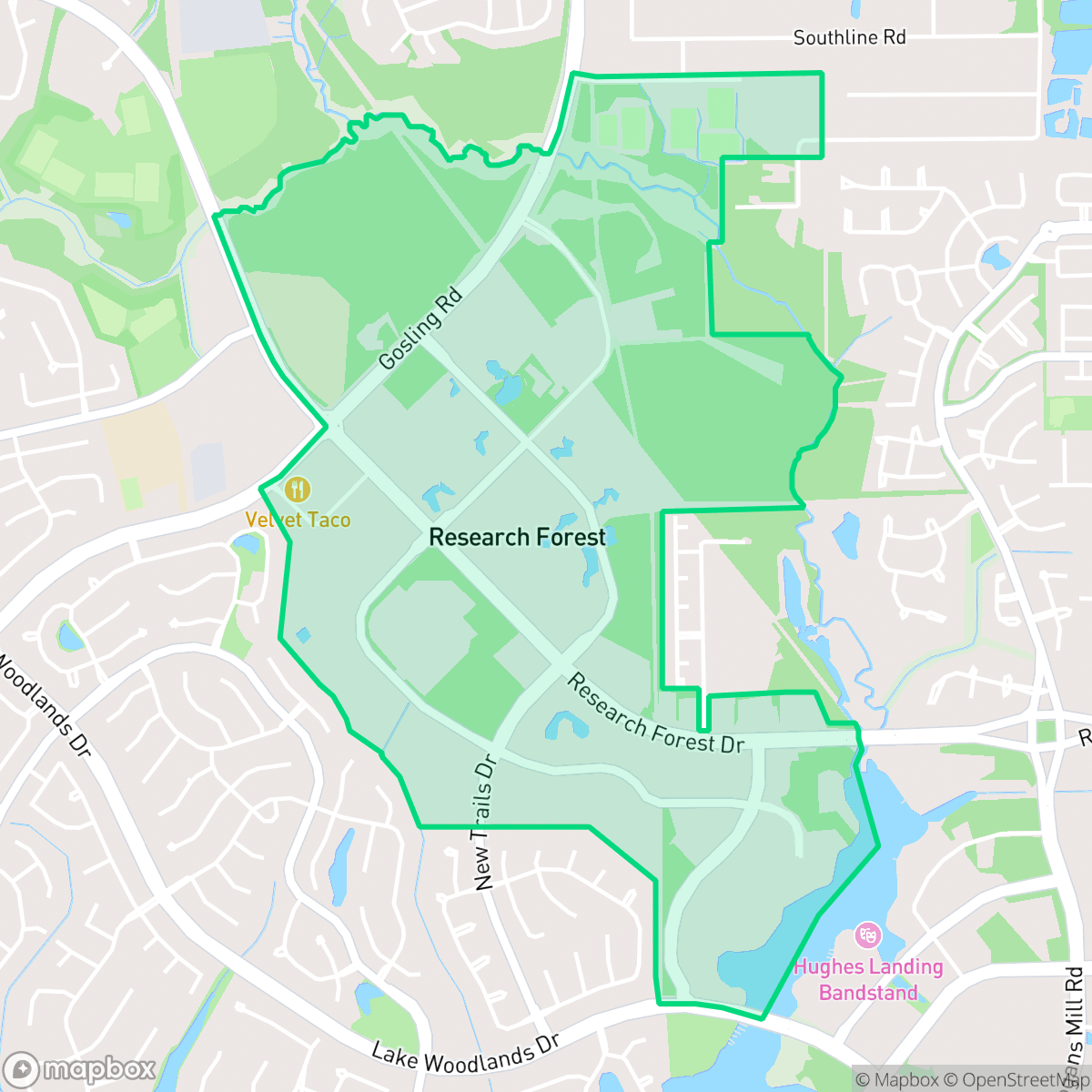
About Research Forest
Established in 1982, the Research Forest area in The Woodlands, Texas, was founded to realize developer George P. Mitchell’s vision of a self-contained, high-tech hub where residents could live, work, and play. The neighborhood’s origins are tied to the Houston Advanced Research Center (HARC), a non-profit research consortium established that same year to bridge academic research and market applications. This anchor institution catalyzed the development of a sprawling research and corporate campus, attracting major biotechnology, healthcare, and energy firms. Today, the neighborhood blends residential enclaves with commercial centers like Research Forest Lakeside, a 77-acre mixed-use development overlooking Lake Woodlands. The area is defined by its dense pine canopy, extensive nature trails, and premier local public spaces such as Bear Branch Park and Northshore Park.
The area functions as a distinct blend of professional environments and residential comfort, situated within the broader framework of The Woodlands. It provides residents with access to established amenities such as Bear Branch Park and various dining options near the lake, supported by the high-performing Conroe Independent School District. According to iHuus data, the neighborhood maintains a high level of health insurance coverage, reflecting the stable socioeconomic profile of its inhabitants. The landscape is defined by its suburban layout, which integrates natural green spaces with essential municipal infrastructure. Prospective residents will find a community that prioritizes accessibility, though the proximity to major roadways results in a higher acoustic footprint compared to other parts of the city. The neighborhood is well-suited for professionals and families who value a quiet, structured environment with easy access to regional commerce and outdoor recreational trails. While the area is not the most lively in the city, its combination of functional infrastructure and natural beauty makes it a consistent choice for those seeking a balance between work and home life.
Neighborhood Scores Across 15 Qualities
Large lot sizes and significant distance between homes provide more seclusion than the average area in The Woodlands, according to iHuus data.
Pedestrian movement is supported by sidewalks on one side of the street and safe crossings. According to iHuus data, this level of walkability is higher than the average found throughout the city.
Low density estates featuring custom architecture and significant privacy buffers provide a highly aesthetic environment that sits above the city average. According to iHuus data, the landscape is characterized by luxury amenities and well-maintained greenery.
Extensive parklands, trail networks, and open green spaces provide ample room for pet owners. According to iHuus data, the availability of these recreational areas is slightly above the city average.
Frequent open land and a heavy tree canopy create a semi-rural feel that is very similar to the city average. This low-density layout provides a sense of seclusion through scattered homes nestled among significant woodland cover, according to iHuus data.
Low-density residential blocks and serene waterfront areas create a peaceful atmosphere that is slightly more subdued than the typical rhythm found across The Woodlands. While some pockets offer walkable access to dining and social hubs, much of the area remains characterized by significant open space and quiet, scattered structures.
Steady noise from nearby busy streets is present, though the acoustic environment remains more tranquil than the average for the city.
Frequent unhealthy air quality levels pose a significant risk to sensitive groups. This condition is consistent with the average levels found throughout the city, according to iHuus data.
Industrial activity is virtually non-existent here, matching the high standards seen across The Woodlands. While a few utility structures like a water treatment plant and an electrical substation are visible in certain sectors, the area remains almost entirely free of warehouses or heavy industrial facilities.
Health insurance accessibility is exceptionally high among residents, performing slightly above the city average according to iHuus data.
Voting patterns and census indicators show a strong conservative leaning that is consistent with the broader city average, according to iHuus data.
Residents experience a diverse age range ranging from young adults to seniors, representing a slightly more varied demographic spread than the Woodlands city average. According to iHuus data, this balance provides a stable community structure without being dominated by any single age group.
Residual flood risk exists within this area due to its location in a 500 year floodplain, though safety levels remain slightly above the city average according to iHuus data.
Address-Level Insights for Research Forest


iHuus Neighborhood Intelligence Insights
Get address-level neighborhood insights for Research Forest
- Street-level scores — see how individual blocks compare, not just neighborhood averages
- Micro-zone boundaries — identify quiet pockets, flood boundaries, and walkable clusters before you visit
- 15 dimensions in full — walkability, noise, air quality, school quality, insurance coverage, population age profile, urban/rural index, and more
- Boundary risk alerts — know if your address sits near a block boundary where scores drop, the kind of detail no listing will ever mention
- School insights — individual school ratings and insights, not just district-level data
- Compare before you commit — side-by-side data across neighborhoods, down to block precision
No credit card required
Compare with Any Neighborhood
| Dimension | Research Forest | Alden Bridge |
|---|---|---|
| 🚶 Walkabilityavg 7.89 | ||
| 🔊 Acoustic Comfortavg 3.94 | ||
| 🤫 Privacy Indexavg 6.17 | ||
| 🎨 Visual Appealavg 8.35 | ||
| 🐕 Dog Friendlinessavg 8.67 | ||
| 🗺️ Urban-Rural Indexavg 8.19 | ||
| ✨ Neighborhood Vibeavg 4.46 | ||
| 🏥 Health Insurance Coverageavg 8.51 | ||
| 🌿 Air Qualityavg 2.03 | ||
| 🏭 Industrial Proximityavg 9.14 | ||
| 🌊 Flood Safetyavg 7.24 | ||
| 🗳️ Ideological Leanavg 1.32 | ||
| 👥 Population Age Profileavg 4.97 | ||
| 🔥 Fire Safety | ||
| 🏫 School Quality |
Research Forest Rankings
School Districts Serving Research Forest
School Insights for Research Forest
Below average outcomes; significant attendance and academic challenges.
School Insights
See what's really behind every school rating near Research Forest
- Individual school ratings — each school's own score with outcome context, not just a district average
- Enrollment & class size data — student-to-teacher ratio and how it compares to the state average
- Full demographics breakdown — ethnicity and gender composition for every school in the enrollment zone
- Every school in the district — all schools within the enrollment boundary ranked by rating, not just the closest one
- Grade levels & benchmarks — elementary through high school, with below/above state-average flags
No credit card required