Grogan's Mill, The Woodlands
Updated · 18,983 residents
Grogan's Mill is the oldest village in The Woodlands, defined by its mature forest canopy, estate-style homes, and an extensive network of shaded walking paths. Residents enjoy a highly dog-friendly environment and a quiet, suburban atmosphere that balances proximity to local amenities with significant natural buffers.
Key Highlights
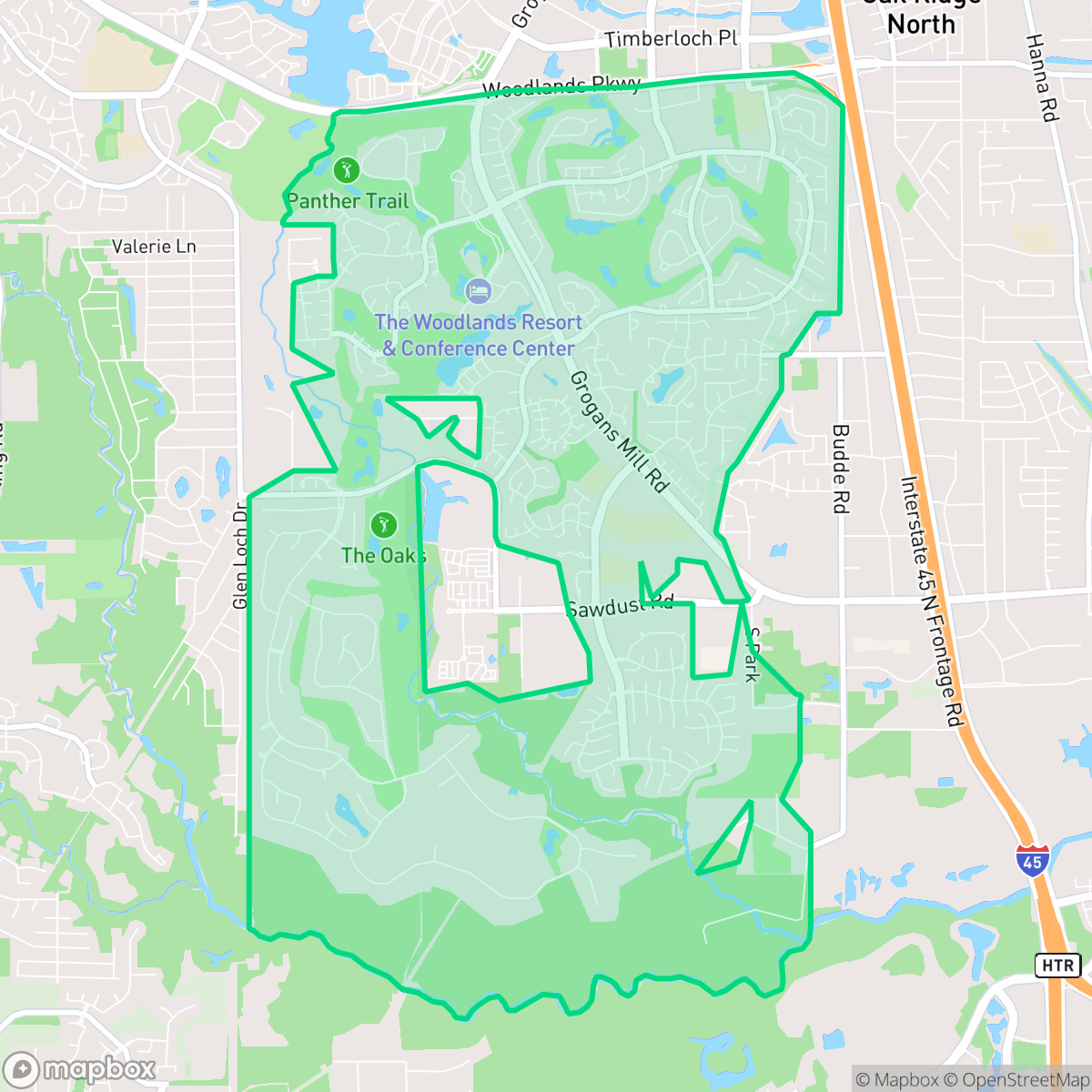
About Grogan's Mill
Established in 1972, Grogan’s Mill is the oldest village in the master-planned community of The Woodlands. It was named after the Grogan-Cochran Lumber Company, which operated the area’s final sawmill until 1964, when oilman George P. Mitchell purchased the timberland to realize his vision of a nature-integrated development. Today, a historic millpond in Tamarac Park is the sole physical remnant of the logging era. The village officially opened in October 1974 with a flag-raising ceremony at its information center. Early architectural highlights include custom homes designed by Mitchell’s architect son, Scott, on Slash Pine Place. The neighborhood is home to key community landmarks, including The Woodlands Resort and Conference Center and the Grogan’s Mill Village Center—originally known as 'The Wharf'—which hosts the community’s weekly farmers market.
The area maintains a distinct aesthetic characterized by large, custom-designed residences and professional landscaping nestled within dense, wooded surroundings. It offers a high degree of visual appeal due to its estate-style architecture and private green spaces. While it provides a serene residential environment, the neighborhood remains connected to the broader community through well-maintained trails and proximity to essential local services. The presence of significant tree buffers and low-density residential pockets ensures a high level of privacy for homeowners.
Prospective residents should note that while the area is exceptionally dog-friendly and features high-quality schools like Hailey Elementary, it experiences moderate noise levels primarily from road traffic. The neighborhood is best suited for those who prioritize a quiet, nature-integrated lifestyle and appreciate the architectural character of an established community. Daily life here relies on a mix of walking paths and car travel, as the layout balances suburban convenience with the preservation of natural, low-density landscapes.
Neighborhood Scores Across 15 Qualities
Residential seclusion varies throughout the area, with some low-density clusters offering significant forest buffers and larger lot separations. According to iHuus data, the level of privacy is roughly comparable to the city average.
Tree-lined sidewalks and low-traffic streets offer pleasant walking conditions, though some high-speed arterials can divide certain zones. This level of connectivity is slightly below the city average for The Woodlands.
Manicured landscaping, custom estate homes, and frequent private pools create an aesthetically pleasing environment that is more visually refined than the Woodlands average. According to iHuus data, the presence of golf course frontage and complex architectural rooflines contributes to a high level of visual prestige.
Extensive wooded trails, greenbelts, and park-like buffers provide significant space for walking dogs. According to iHuus data, the availability of these open spaces and grassy medians is higher than the city average.
Extensive tree canopy and a mix of residential and low-rise commercial pockets create a semi-rural atmosphere that is consistent with the broader city average. This landscape provides a dense, forested setting characterized by significant greenery and a seamless transition between homes and nature, according to iHuus data.
A balanced mix of residential streets and local dining establishments provides a steady pace of life that is consistent with the city average. While some pockets offer lively social hubs and diverse restaurants, other areas remain quiet and low-density near the water or major highways.
Steady hum from nearby busy streets creates a consistent level of ambient noise. This acoustic environment is slightly more active than the typical level found across the rest of the city.
Frequent periods of unhealthy air quality present significant risks for sensitive groups. According to iHuus data, these levels are consistent with the city average.
Residential and light commercial uses dominate the area with no large warehouses or hazardous industrial zones present. This level of industrial separation is consistent with the city average, according to iHuus data.
Health insurance coverage among residents is high, though slightly lower than the average seen across The Woodlands. According to iHuus data, the majority of the population maintains active coverage.
Political preferences in this area lean conservative, representing a more right-leaning community than the average resident in The Woodlands. According to iHuus data, a conservative majority exists here alongside a modest presence of opposing viewpoints.
A balanced mix of young adults, families, and older residents characterizes the area, closely aligning with the broader community profile in The Woodlands according to iHuus data.
Residual flood risk exists within this area because it is situated within a 500-year floodplain; according to iHuus data, this level of safety is slightly lower than the average for The Woodlands.
Address-Level Insights for Grogan's Mill


iHuus Neighborhood Intelligence Insights
Get address-level neighborhood insights for Grogan's Mill
- Street-level scores — see how individual blocks compare, not just neighborhood averages
- Micro-zone boundaries — identify quiet pockets, flood boundaries, and walkable clusters before you visit
- 15 dimensions in full — walkability, noise, air quality, school quality, insurance coverage, population age profile, urban/rural index, and more
- Boundary risk alerts — know if your address sits near a block boundary where scores drop, the kind of detail no listing will ever mention
- School insights — individual school ratings and insights, not just district-level data
- Compare before you commit — side-by-side data across neighborhoods, down to block precision
No credit card required
Compare with Any Neighborhood
| Dimension | Grogan's Mill | Alden Bridge |
|---|---|---|
| 🚶 Walkabilityavg 7.89 | ||
| 🔊 Acoustic Comfortavg 3.94 | ||
| 🤫 Privacy Indexavg 6.17 | ||
| 🎨 Visual Appealavg 8.35 | ||
| 🐕 Dog Friendlinessavg 8.67 | ||
| 🗺️ Urban-Rural Indexavg 8.19 | ||
| ✨ Neighborhood Vibeavg 4.46 | ||
| 🏥 Health Insurance Coverageavg 8.51 | ||
| 🌿 Air Qualityavg 2.03 | ||
| 🏭 Industrial Proximityavg 9.14 | ||
| 🌊 Flood Safetyavg 7.24 | ||
| 🗳️ Ideological Leanavg 1.32 | ||
| 👥 Population Age Profileavg 4.97 | ||
| 🔥 Fire Safety | ||
| 🏫 School Quality |
Grogan's Mill Rankings
School Districts Serving Grogan's Mill
School Insights for Grogan's Mill
Below average outcomes; significant attendance and academic challenges.
School Insights
See what's really behind every school rating near Grogan's Mill
- Individual school ratings — each school's own score with outcome context, not just a district average
- Enrollment & class size data — student-to-teacher ratio and how it compares to the state average
- Full demographics breakdown — ethnicity and gender composition for every school in the enrollment zone
- Every school in the district — all schools within the enrollment boundary ranked by rating, not just the closest one
- Grade levels & benchmarks — elementary through high school, with below/above state-average flags
No credit card required