Downtown, Texarkana
Updated · 1,315 residents
Downtown Texarkana serves as a unique cultural crossroads, famously straddling the Texas and Arkansas state line. This historic district features a revitalized arts scene anchored by the Perot Theatre and the Regional Arts Center, offering a quiet, functional atmosphere for residents who value a blend of industrial heritage and emerging local culture.
Key Highlights
About Downtown
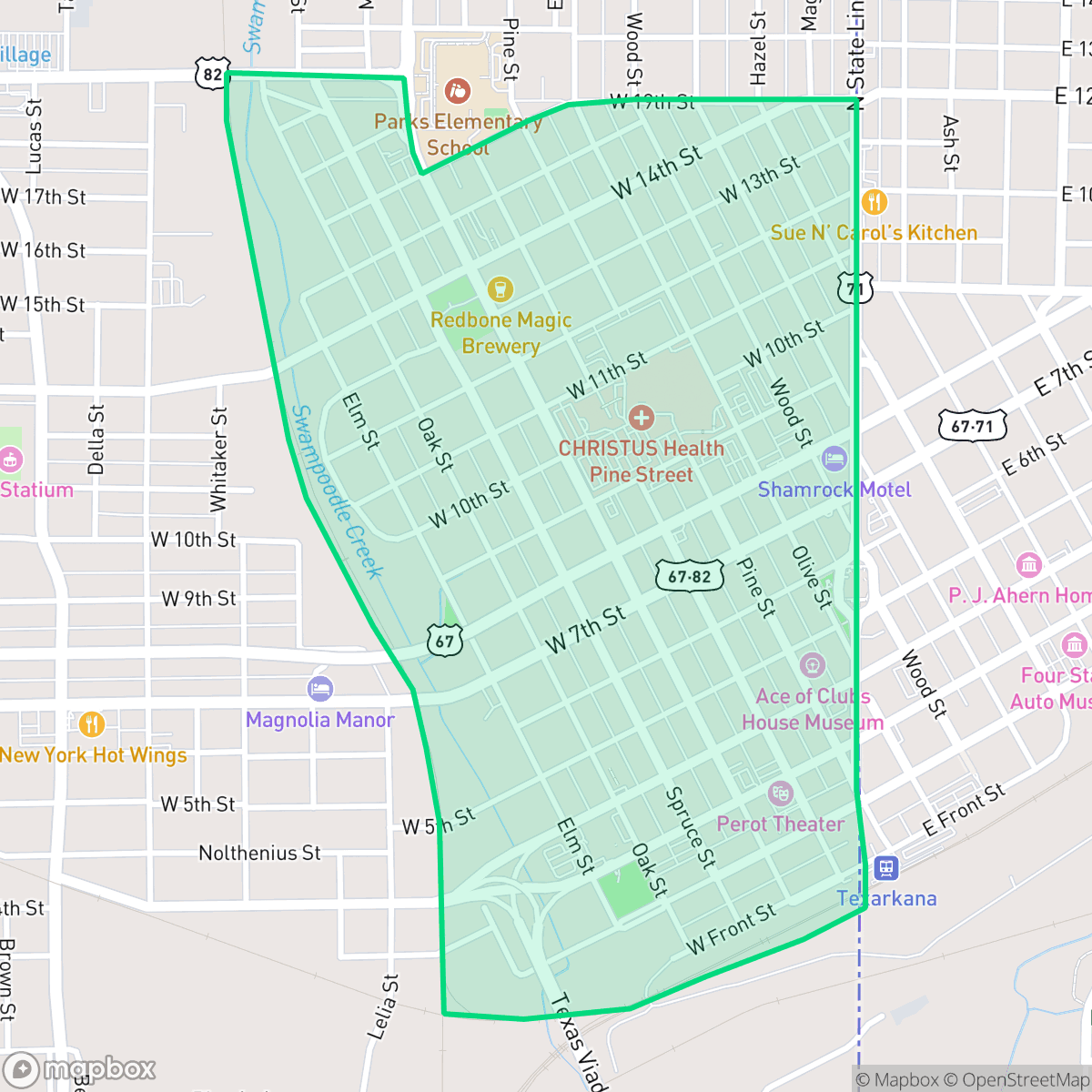
Downtown Texarkana, established in 1873 at the intersection of the Cairo and Fulton Railroad and the Texas and Pacific Railway, serves as the historic heart of the city. The district is uniquely bisected by the Texas-Arkansas state line, a feature exemplified by the State Line Post Office and Federal Building, the only federal building in the United States located on a state boundary. The area features well-preserved early 20th-century architecture, most notably the 1924 Perot Theatre, originally the Saenger Theatre, which remains a cultural anchor. Once a bustling hub for rail-based commerce and industry, the downtown area has undergone revitalization efforts to repurpose its historic building stock, maintaining its identity as a significant regional crossroads defined by its dual-state geography and industrial heritage.
The neighborhood functions as the historic core of the city, characterized by its well-preserved early 20th-century architecture and its role as a regional arts and culture hub. Beyond the iconic federal building on the state line, the area hosts a growing number of community assets, including the Texarkana Farmers Market and the Regional Arts Center. Residents benefit from a steady, functional environment where local dining and performance venues provide a distinct sense of place, supported by ongoing revitalization efforts aimed at repurposing historic building stock for modern use.
Neighborhood Scores Across 15 Qualities
Mixed building spacing provides some buffer between neighbors, though levels of seclusion are slightly lower than the Texarkana average according to iHuus data.
Low traffic volumes make for calm streets, though a lack of sidewalks may impact pedestrian ease. This area offers slightly better walking conditions than the rest of the city according to iHuus data.
Standard tract housing with modest yards and uniform rooflines defines the area. This visual landscape is less varied than the Texarkana city average.
Minimal green space and a lack of direct park access make daily walks with pets more difficult. According to iHuus data, this area offers fewer dog-friendly amenities than the Texarkana average.
Frequent open land and dense woodland characterize this area, which feels more rural than the typical Texarkana urban core. According to iHuus data, the landscape features a mix of heavy infrastructure and sparsely developed industrial fringes.
A mix of light industrial units and local dining spots creates a moderately active atmosphere that is slightly more lively than the city average. While some social hubs exist near the railway, the area remains largely car-dependent due to the spread of services.
Steady hum from local traffic on nearby busy streets is common here. According to iHuus data, acoustic comfort levels are slightly below the Texarkana average.
Air quality remains consistently good with rare instances of elevated readings. According to iHuus data, the air quality levels in this area are on par with the Texarkana city average.
Commercial transit and light industrial activity blend with residential pockets, though proximity to an EPA Superfund site and heavy freight zones indicates more industrial density than the Texarkana average. Residents may encounter active daytime traffic and potential environmental considerations related to nearby-site contamination.
Health insurance access among residents is lower than the Texarkana average, according to iHuus data. This disparity may impact the ease of accessing consistent medical care within the neighborhood.
Political leanings in this area are more evenly split between conservative and liberal views than the broader Texarkana average. This creates a politically diverse environment according to iHuus data.
Residents live alongside a diverse demographic of young professionals, families, and seniors. This age distribution is slightly more concentrated in certain age brackets than the Texarkana city average, according to iHuus data.
Flood vulnerability in this area is significantly higher than the city average, which may result in elevated insurance premiums for property owners. According to iHuus data, the location sits within a high-hazard zone that requires careful consideration regarding flood mitigation and safety.
Address-Level Insights for Downtown


iHuus Neighborhood Intelligence Insights
Get address-level neighborhood insights for Downtown
- Street-level scores — see how individual blocks compare, not just neighborhood averages
- Micro-zone boundaries — identify quiet pockets, flood boundaries, and walkable clusters before you visit
- 15 dimensions in full — walkability, noise, air quality, school quality, insurance coverage, population age profile, urban/rural index, and more
- Boundary risk alerts — know if your address sits near a block boundary where scores drop, the kind of detail no listing will ever mention
- School insights — individual school ratings and insights, not just district-level data
- Compare before you commit — side-by-side data across neighborhoods, down to block precision
No credit card required
Compare with Any Neighborhood
| Dimension | Downtown | Beverly Heights |
|---|---|---|
| 🚶 Walkabilityavg 5.47 | ||
| 🔊 Acoustic Comfortavg 4.51 | ||
| 🤫 Privacy Indexavg 6.27 | ||
| 🎨 Visual Appealavg 5.8 | ||
| 🐕 Dog Friendlinessavg 5.89 | ||
| 🗺️ Urban-Rural Indexavg 7.71 | ||
| ✨ Neighborhood Vibeavg 3.98 | ||
| 🏥 Health Insurance Coverageavg 6.14 | ||
| 🌿 Air Qualityavg 7.97 | ||
| 🏭 Industrial Proximityavg 7.49 | ||
| 🌊 Flood Safetyavg 2.84 | ||
| 🗳️ Ideological Leanavg 3.77 | ||
| 👥 Population Age Profileavg 4.89 | ||
| 🔥 Fire Safety | ||
| 🏫 School Quality |
Downtown Rankings
School Districts Serving Downtown
School Insights for Downtown
Below average outcomes; significant attendance and academic challenges.
School Insights
See what's really behind every school rating near Downtown
- Individual school ratings — each school's own score with outcome context, not just a district average
- Enrollment & class size data — student-to-teacher ratio and how it compares to the state average
- Full demographics breakdown — ethnicity and gender composition for every school in the enrollment zone
- Every school in the district — all schools within the enrollment boundary ranked by rating, not just the closest one
- Grade levels & benchmarks — elementary through high school, with below/above state-average flags
No credit card required