Austin Park, Sugar Land
Updated · 919 residents
Austin Park is a quiet, residential enclave in Sugar Land known for its mature trees, well-maintained lawns, and exceptional walkability. The area offers a peaceful, suburban environment with high air quality and no industrial hazards, making it a stable choice for those seeking a tranquil lifestyle.
Key Highlights
About Austin Park
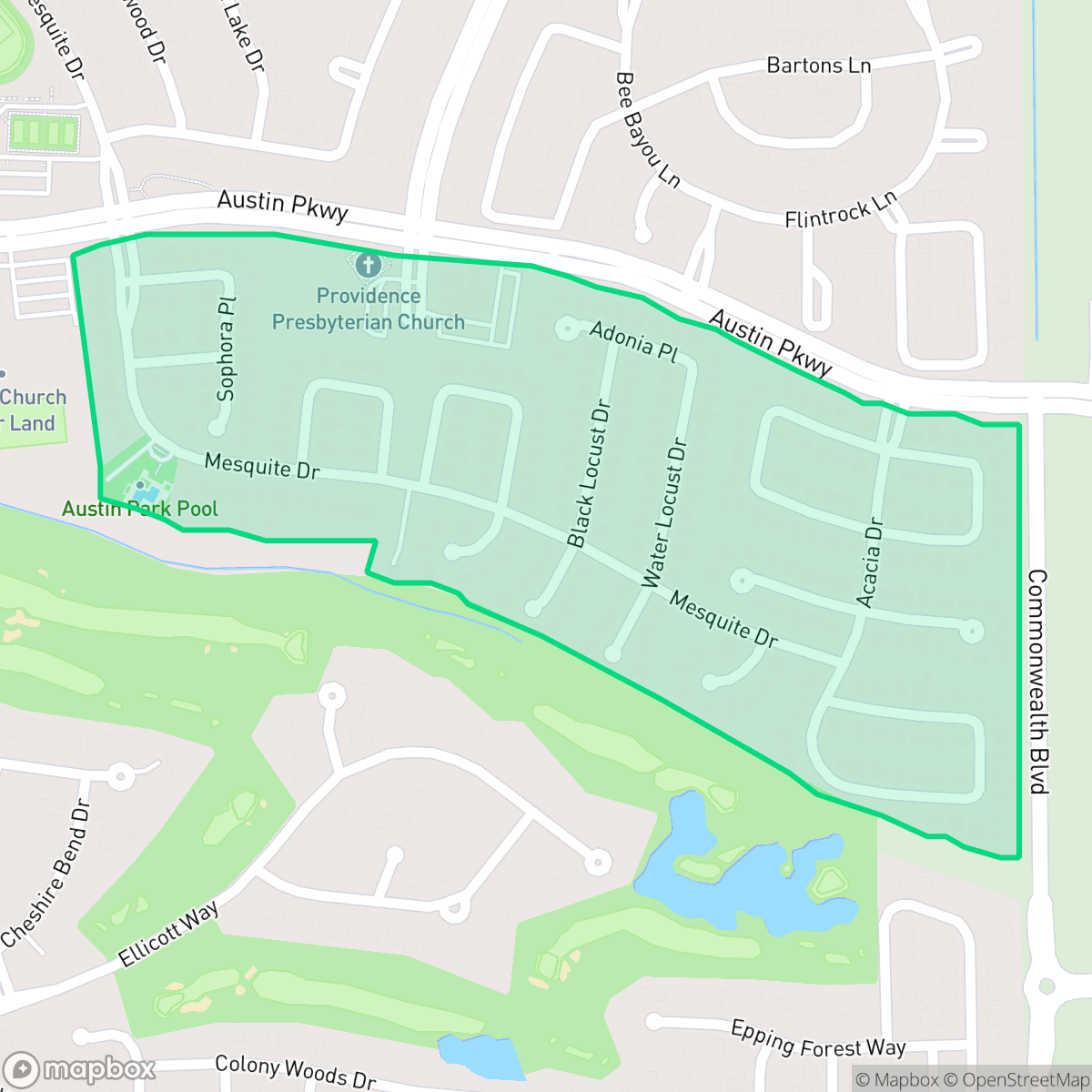
Austin Park, also known as Lakes of Austin Park, is an established residential subdivision within the First Colony master-planned community in Sugar Land, Texas. Developed primarily during the mid-to-late 1980s, the neighborhood features single-family homes constructed by prominent regional builders like Village Builders. A defining historical and geographical milestone for the area was the 1982 formation of the First Colony Levee Improvement District (FCLID). This critical land reclamation and flood-protection project constructed a system of levees and detention ponds to drain the area south of State Highway 6 into Steepbank Creek, enabling the safe residential development of Austin Park. Today, the neighborhood is characterized by its tree-lined streets, the local Austin Park Pool, and its integration into the highly rated Fort Bend Independent School District.
The area offers a distinct suburban atmosphere characterized by large single-family homes and abundant green space. Pedestrian infrastructure is a primary feature, with extensive sidewalk networks that allow for easy movement throughout the community. The environment is notably quiet, with low levels of ambient noise and a complete absence of industrial activity, contributing to a high standard of acoustic comfort. According to iHuus data, the neighborhood provides a consistently clean environment, free from industrial hazards and notable for its superior air quality.
While the neighborhood provides a serene setting, the overall vibe is subdued, appealing to those who prioritize privacy and a low-density living environment over proximity to commercial hubs. Prospective residents should note the current state of the Fort Bend Independent School District, which is navigating a period of fiscal transition and school consolidation. Despite these regional educational shifts, the area remains a secure and well-planned residential destination for families and individuals alike.
Neighborhood Scores Across 15 Qualities
Residential spacing offers a balanced level of separation between homes, sitting slightly above the Sugar Land average. According to iHuus data, the neighborhood features standard suburban density with noticeable buffers between properties.
Pedestrian infrastructure is excellent here, featuring wide sidewalks on both sides of the street and paths separated from busy roads. According to iHuus data, the network of crossings and pedestrian-priority areas is notably more comprehensive than the Sugar Land average.
Large suburban homes with private pools and manicured lawns characterize the landscape; according to iHuus data, the area offers a higher level of visual appeal than the Sugar Land average.
Extensive greenbelts, parks, and wide sidewalk verges provide ample room for outdoor activities. This abundance of open space and trail access is notably higher than the Sugar Land average, according to iHuus data.
Frequent open land and significant green space provide a semi-rural feel that is more expansive than the Sugar Land average. According to iHuus data, the area features planned suburban development characterized by scattered homes amidst fields and woodland.
Residential life here is characterized by a serene, suburban atmosphere with significant open space and minimal commercial activity. According to iHuus data, this level of activity is notably lower than the Sugar Land average, reflecting a tranquil setting focused more on quiet housing blocks than social density.
Acoustic levels are notably lower than the Sugar Land average, with noise consisting primarily of infrequent distant trains or sporadic passing vehicles. According to iHuus data, this area provides a much more tranquil setting than most parts of the city.
Air quality remains mostly clean with rare instances of elevated readings. This level of air purity is significantly higher than the Sugar Land average, according to iHuus data.
Industrial presence is non-existent in this area, offering a quiet environment free from warehouses or manufacturing facilities. This lack of industrial proximity is notably higher than the Sugar Land average, according to iHuus data.
Health insurance accessibility is high within this area, performing slightly above the Sugar Land average according to iHuus data.
Political leanings in this area trend more conservative than the Sugar Land average. Residents will find a community with a modest opposing presence but a clear conservative majority according to iHuus data.
Residents live alongside a balanced mix of young professionals, families, and seniors. This demographic distribution is consistent with the broader Sugar Land area according to iHuus data.
Residual flood risk exists within this area as it sits inside a 500-year floodplain. According to iHuus data, the flood safety levels are consistent with the Sugar Land average.
Address-Level Insights for Austin Park


iHuus Neighborhood Intelligence Insights
Get address-level neighborhood insights for Austin Park
- Street-level scores — see how individual blocks compare, not just neighborhood averages
- Micro-zone boundaries — identify quiet pockets, flood boundaries, and walkable clusters before you visit
- 15 dimensions in full — walkability, noise, air quality, school quality, insurance coverage, population age profile, urban/rural index, and more
- Boundary risk alerts — know if your address sits near a block boundary where scores drop, the kind of detail no listing will ever mention
- School insights — individual school ratings and insights, not just district-level data
- Compare before you commit — side-by-side data across neighborhoods, down to block precision
No credit card required
Compare with Any Neighborhood
| Dimension | Austin Park | Chimeystone |
|---|---|---|
| 🚶 Walkabilityavg 8.48 | ||
| 🔊 Acoustic Comfortavg 4.44 | ||
| 🤫 Privacy Indexavg 5.79 | ||
| 🎨 Visual Appealavg 7.94 | ||
| 🐕 Dog Friendlinessavg 8.2 | ||
| 🗺️ Urban-Rural Indexavg 7.01 | ||
| ✨ Neighborhood Vibeavg 4.44 | ||
| 🏥 Health Insurance Coverageavg 8.04 | ||
| 🌿 Air Qualityavg 5.25 | ||
| 🏭 Industrial Proximityavg 8.33 | ||
| 🌊 Flood Safetyavg 7.57 | ||
| 🗳️ Ideological Leanavg 4.05 | ||
| 👥 Population Age Profileavg 5.01 | ||
| 🔥 Fire Safety | ||
| 🏫 School Quality |
Austin Park Rankings
School Districts Serving Austin Park
School Insights for Austin Park
Below average outcomes; significant attendance and academic challenges.
School Insights
See what's really behind every school rating near Austin Park
- Individual school ratings — each school's own score with outcome context, not just a district average
- Enrollment & class size data — student-to-teacher ratio and how it compares to the state average
- Full demographics breakdown — ethnicity and gender composition for every school in the enrollment zone
- Every school in the district — all schools within the enrollment boundary ranked by rating, not just the closest one
- Grade levels & benchmarks — elementary through high school, with below/above state-average flags
No credit card required