Wallace Addition, San Marcos
Updated · 637 residents
Wallace Addition is a residential neighborhood in San Marcos featuring a blend of historic 19th-century homes and modern infill housing. While the area offers a quiet atmosphere and access to local parks, residents should anticipate elevated noise levels from nearby road traffic.
Key Highlights
About Wallace Addition
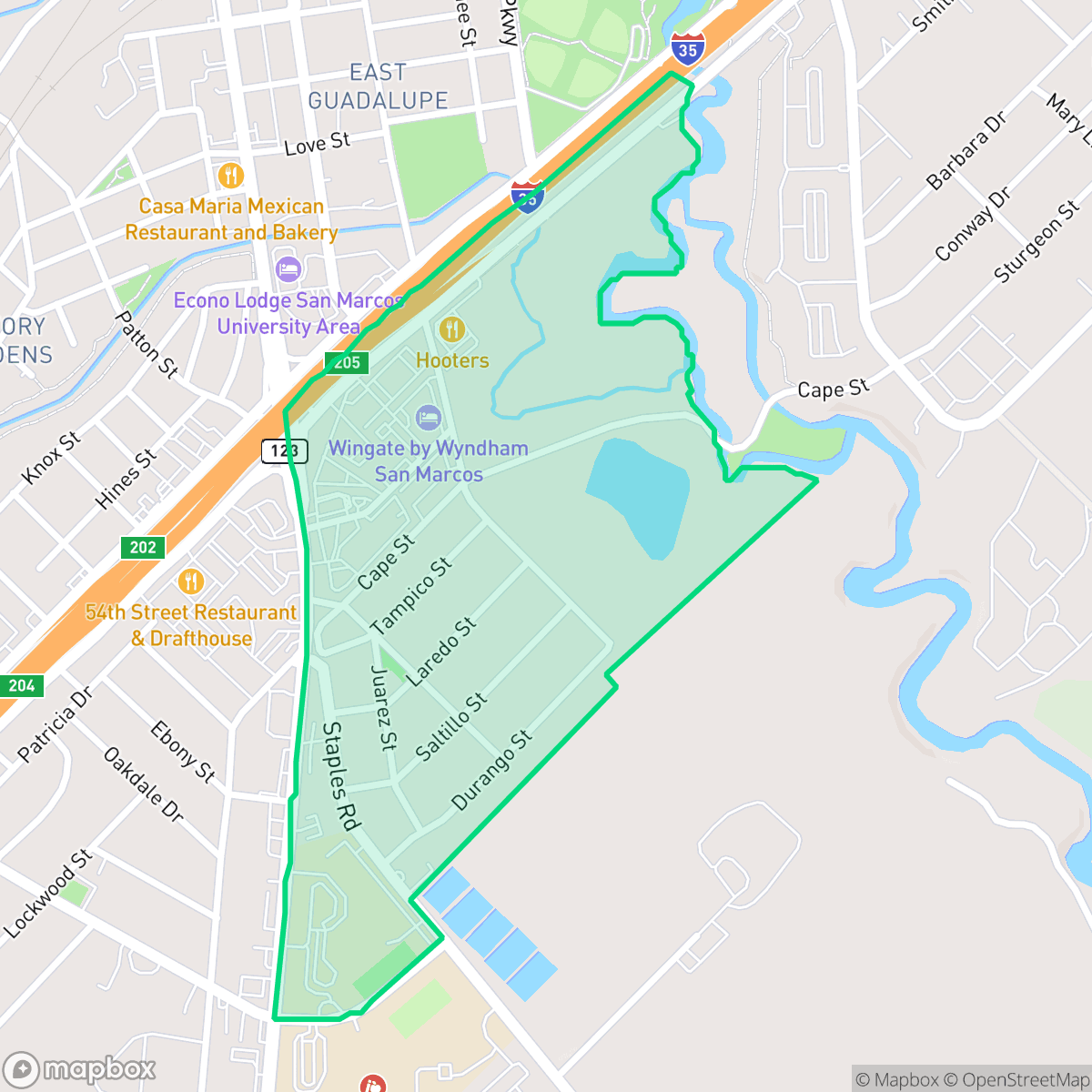
The Wallace Addition neighborhood in San Marcos, Texas, is an established residential subdivision plotted from the historic C.D. Wallace tract. Developing from the late 19th century onward, the neighborhood features a mix of historic homes dating back to the 1890s alongside mid-century and modern infill housing. The area carries strong local cultural significance; in 1976, the San Marcos City Council honored Luciano Flores—the city's first Mexican-American mayor—by naming a newly constructed street in the neighborhood Luciano H. Flores Drive. Bordered by streets like Durango, Juarez, and Staples Road, the neighborhood has historically faced severe flooding issues due to its low-lying geography. This prompted major municipal investments, including the multi-million dollar Wallace Addition Subdivision and Offsite Drainage Improvements projects to modernize its aging water, wastewater, and storm infrastructure.
This neighborhood functions as a distinct residential pocket within San Marcos, characterized by its mix of architectural styles that span from the late 1800s to the present day. The area provides suburban convenience with proximity to commercial corridors, local dining options, and recreational spaces like John Stokes Park. While the neighborhood maintains a moderate level of privacy and average walkability, the physical landscape is influenced by its proximity to industrial infrastructure, including a nearby wastewater treatment facility.
Prospective residents should weigh the trade-offs regarding acoustic comfort, as road traffic noise is notably higher than the city average. Although the district has faced challenges regarding school funding and health insurance coverage, recent municipal investments have significantly enhanced the area's flood safety. The neighborhood is best suited for individuals seeking an established community that balances historic character with modernized drainage and utility infrastructure.
Neighborhood Scores Across 15 Qualities
Homes feature a mix of spacing and some buffer between neighbors, consistent with the average density found throughout San Marcos.
Low traffic volumes make for a peaceful environment for pedestrians, though the lack of sidewalks means walkers must share the road with vehicles. This level of walkability is roughly in line with the San Marcos average, according to iHuus data.
Uniform tract housing with modest yards characterizes this area, providing a visual experience that is roughly consistent with the San Marcos average.
Connected green spaces and wide, low-traffic paths provide an environment that is more dog friendly than the San Marcos average, according to iHuus data.
Scattered homes and open land provide a more rural feel than the typical San Marcos suburban landscape. According to iHuus data, the area features a blend of residential blocks and utility land that is less densely developed than the city average.
A mix of industrial and suburban landscapes provides a subdued atmosphere with a steady flow of local services. This area offers less social activity than the San Marcos average, characterized by car-oriented streets and scattered dining options near highway corridors.
Frequent noise from nearby railroad tracks and heavy freeway traffic characterizes this area. According to iHuus data, acoustic comfort is notably lower than the San Marcos city average.
Air quality in this area fluctuates between acceptable and unhealthy levels. According to iHuus data, the air quality is roughly in line with the San Marcos average, though sensitive groups may experience occasional concern.
Large wastewater treatment facilities and aeration ponds are located adjacent to residential areas. This level of industrial proximity is notably lower than the San Marcos city average, according to iHuus data.
Health insurance access is significantly lower here than in the rest of San Marcos, according to iHuus data. This lack of coverage may impact the availability of local medical resources for residents.
Voting patterns and census indicators show a predominantly liberal leaning that is more pronounced than the San Marcos average. According to iHuus data, this area reflects a highly progressive political landscape.
Residents live alongside a diverse mix of young adults, families, and older individuals. This age distribution is more varied than the average found throughout San Marcos, according to iHuus data.
Flood risk levels in this area are difficult to determine because a detailed FEMA study has not yet been completed. According to iHuus data, the level of uncertainty regarding potential flooding is slightly higher than the San Marcos city average.
Address-Level Insights for Wallace Addition


iHuus Neighborhood Intelligence Insights
Get address-level neighborhood insights for Wallace Addition
- Street-level scores — see how individual blocks compare, not just neighborhood averages
- Micro-zone boundaries — identify quiet pockets, flood boundaries, and walkable clusters before you visit
- 15 dimensions in full — walkability, noise, air quality, school quality, insurance coverage, population age profile, urban/rural index, and more
- Boundary risk alerts — know if your address sits near a block boundary where scores drop, the kind of detail no listing will ever mention
- School insights — individual school ratings and insights, not just district-level data
- Compare before you commit — side-by-side data across neighborhoods, down to block precision
No credit card required
Compare with Any Neighborhood
| Dimension | Wallace Addition | Blanco Gardens |
|---|---|---|
| 🚶 Walkabilityavg 6.09 | ||
| 🔊 Acoustic Comfortavg 3.79 | ||
| 🤫 Privacy Indexavg 6.04 | ||
| 🎨 Visual Appealavg 6.1 | ||
| 🐕 Dog Friendlinessavg 6.89 | ||
| 🗺️ Urban-Rural Indexavg 7.6 | ||
| ✨ Neighborhood Vibeavg 5.43 | ||
| 🏥 Health Insurance Coverageavg 5.95 | ||
| 🌿 Air Qualityavg 6.09 | ||
| 🏭 Industrial Proximityavg 8.2 | ||
| 🌊 Flood Safetyavg 3.71 | ||
| 🗳️ Ideological Leanavg 8.3 | ||
| 👥 Population Age Profileavg 3.91 | ||
| 🔥 Fire Safety | ||
| 🏫 School Quality |
Wallace Addition Rankings
School Districts Serving Wallace Addition
School Insights for Wallace Addition
Below average outcomes; significant attendance and academic challenges.
School Insights
See what's really behind every school rating near Wallace Addition
- Individual school ratings — each school's own score with outcome context, not just a district average
- Enrollment & class size data — student-to-teacher ratio and how it compares to the state average
- Full demographics breakdown — ethnicity and gender composition for every school in the enrollment zone
- Every school in the district — all schools within the enrollment boundary ranked by rating, not just the closest one
- Grade levels & benchmarks — elementary through high school, with below/above state-average flags
No credit card required