Sessom Creek, San Marcos
Updated · 1,848 residents
Sessom Creek is a quiet, wooded neighborhood perched on a sloping ravine adjacent to Texas State University. While it offers a peaceful suburban atmosphere with high dog friendliness, residents should expect moderate road noise and a lack of formal sidewalks throughout the residential streets.
Key Highlights
About Sessom Creek
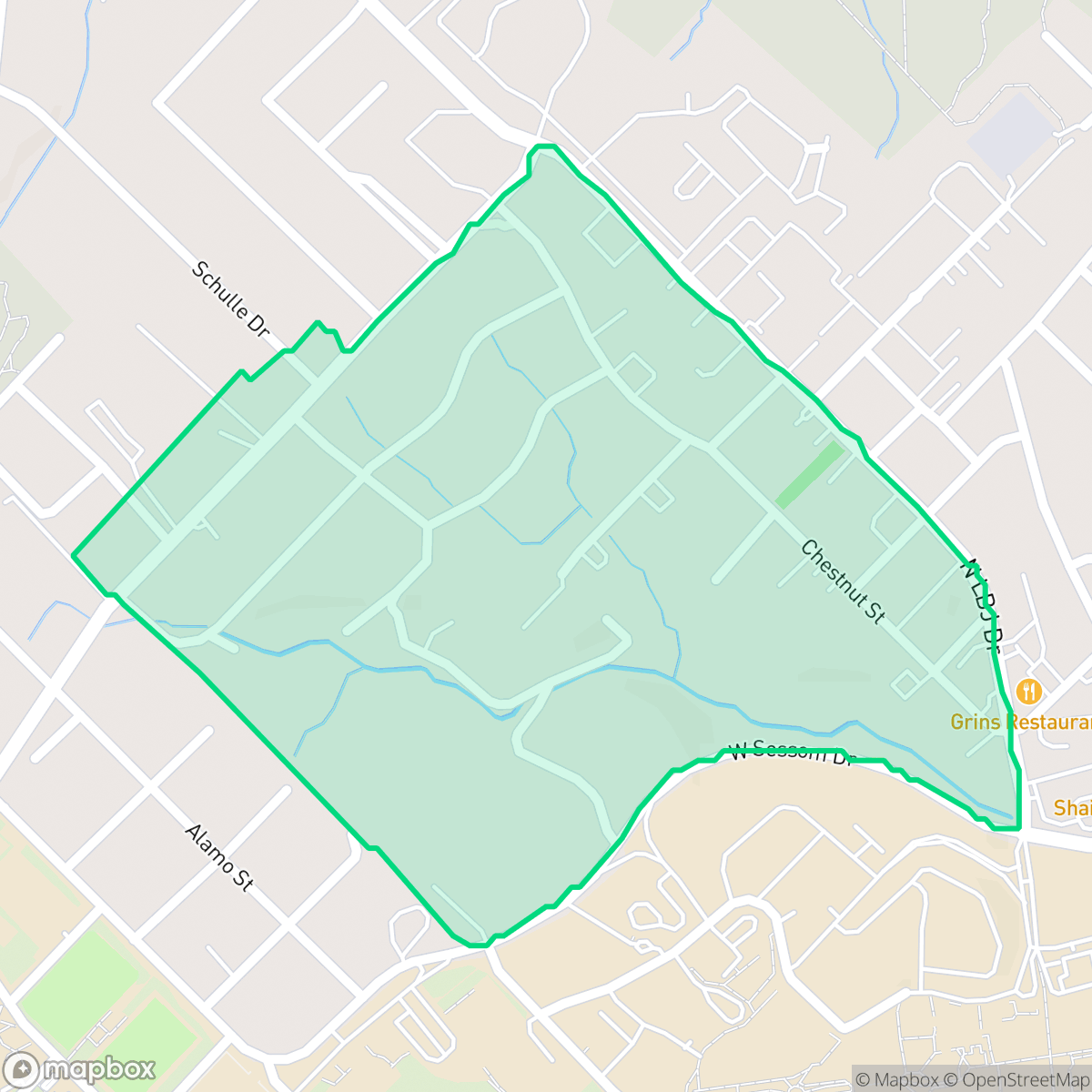
Named after Mike Sessom, one of San Marcos’s original 1845 settlers, Sessom Creek is a leafy, sloping ravine neighborhood adjacent to Texas State University. The residential area features a diverse mix of housing, including single-family homes, duplexes, and small apartment complexes largely built in the 1980s. Historically, the neighborhood is defined by its environmental activism and close connection to its namesake waterway. In 2013, residents organized a major petition, gathering over 2,000 signatures to successfully block a massive student housing development to protect the fragile watershed. Today, the neighborhood is anchored by the 14-acre Sessom Creek Park, which is undergoing ecological restoration to stabilize the creek banks, manage runoff, and remove invasive species, preserving the critical natural link between the neighborhood and the San Marcos River.
The area features a mix of 1980s single-family homes and apartment complexes nestled within a dense tree canopy. Its proximity to the university makes it a convenient location for students and faculty, though the terrain is defined by its steep, ravine-like topography. According to iHuus data, the neighborhood maintains a balanced urban-rural feel, providing a sense of seclusion despite its central position in San Marcos. The presence of a large electrical substation on the eastern edge is a notable industrial feature that contrasts with the otherwise natural landscape.
Living here involves navigating a few distinct trade-offs. While the area boasts better-than-average flood safety and strong health insurance coverage rates, the local school district faces ongoing financial and operational challenges that may impact families. Pedestrians may find the lack of sidewalks in some residential pockets limiting, though the natural environment and proximity to green spaces provide excellent opportunities for dog owners. The neighborhood is best suited for those who prioritize a quiet, nature-adjacent environment over high-density walkability or immediate access to commercial hubs.
Neighborhood Scores Across 15 Qualities
Privacy levels fluctuate throughout the area due to a mix of closely clustered apartment buildings and single-family homes with significant woodland buffers. According to iHuus data, the overall sense of seclusion is slightly lower than the San Marcos average.
Extensive sidewalk networks and pedestrian plazas near the university campus make much of the area easy to navigate on foot. According to iHuus data, walkability in this neighborhood is significantly higher than the San Marcos average.
Residential views consist of modest tract housing and large apartment complexes with a middle-class character. This area remains largely in line with the typical visual landscape found across San Marcos.
Abundant woodlands, green buffers, and wide grass verges provide ample space for pet walking. This neighborhood offers more accessible areas for dogs than the San Marcos average according to iHuus data.
Open land and scattered homes among woodlands create a more tranquil setting than the more densely urbanized areas of San Marcos. According to iHuus data, this area features a greater presence of fields and tree cover compared to the city average.
Local dining options and social pockets around the water create a more vibrant atmosphere than the San Marcos average. Residents have access to a balanced mix of green spaces and various community gathering spots, according to iHuus data.
Local traffic from a nearby busy street creates a steady hum. This level of acoustic activity is slightly higher than the San Marcos average, according to iHuus data.
Air quality in this area fluctuates between acceptable and unhealthy levels, which may cause occasional concern for sensitive groups. According to iHuus data, these conditions are largely consistent with the average seen across San Marcos.
Industrial presence is minimal in this area, as the neighborhood is composed almost entirely of residential and educational spaces. Aside from a single electrical substation on the east side, there are no visible warehouses or heavy manufacturing sites, making it notably cleaner of industrial infrastructure than the San Marcos average.
Health insurance enrollment among residents is notably higher than the San Marcos average, according to iHuus data.
Voting patterns and census indicators reflect a deeply liberal political leaning that is more pronounced than the San Marcos city average.
Young adults represent the primary demographic in this area, with a significantly lower concentration of families and seniors compared to the San Marcos average.
Property locations within this area are situated inside a designated floodplain, which represents a significantly higher risk of flooding than the San Marcos average. According to iHuus data, residents should anticipate that flood insurance is typically required for homes in this neighborhood.
Address-Level Insights for Sessom Creek


iHuus Neighborhood Intelligence Insights
Get address-level neighborhood insights for Sessom Creek
- Street-level scores — see how individual blocks compare, not just neighborhood averages
- Micro-zone boundaries — identify quiet pockets, flood boundaries, and walkable clusters before you visit
- 15 dimensions in full — walkability, noise, air quality, school quality, insurance coverage, population age profile, urban/rural index, and more
- Boundary risk alerts — know if your address sits near a block boundary where scores drop, the kind of detail no listing will ever mention
- School insights — individual school ratings and insights, not just district-level data
- Compare before you commit — side-by-side data across neighborhoods, down to block precision
No credit card required
Compare with Any Neighborhood
| Dimension | Sessom Creek | Blanco Gardens |
|---|---|---|
| 🚶 Walkabilityavg 6.09 | ||
| 🔊 Acoustic Comfortavg 3.79 | ||
| 🤫 Privacy Indexavg 6.04 | ||
| 🎨 Visual Appealavg 6.1 | ||
| 🐕 Dog Friendlinessavg 6.89 | ||
| 🗺️ Urban-Rural Indexavg 7.6 | ||
| ✨ Neighborhood Vibeavg 5.43 | ||
| 🏥 Health Insurance Coverageavg 5.95 | ||
| 🌿 Air Qualityavg 6.09 | ||
| 🏭 Industrial Proximityavg 8.2 | ||
| 🌊 Flood Safetyavg 3.71 | ||
| 🗳️ Ideological Leanavg 8.3 | ||
| 👥 Population Age Profileavg 3.91 | ||
| 🔥 Fire Safety | ||
| 🏫 School Quality |
Sessom Creek Rankings
School Districts Serving Sessom Creek
School Insights for Sessom Creek
Below average outcomes; significant attendance and academic challenges.
School Insights
See what's really behind every school rating near Sessom Creek
- Individual school ratings — each school's own score with outcome context, not just a district average
- Enrollment & class size data — student-to-teacher ratio and how it compares to the state average
- Full demographics breakdown — ethnicity and gender composition for every school in the enrollment zone
- Every school in the district — all schools within the enrollment boundary ranked by rating, not just the closest one
- Grade levels & benchmarks — elementary through high school, with below/above state-average flags
No credit card required