Rio Vista, San Marcos
Updated · 1,137 residents
Rio Vista is defined by its namesake park and river access, offering a semi-rural atmosphere that attracts dog owners and those seeking an active social scene. While the area provides a quiet, residential setting with a liberal community lean, residents should be aware of frequent noise from nearby rail and freeway traffic, as well as significant flood risks.
Key Highlights
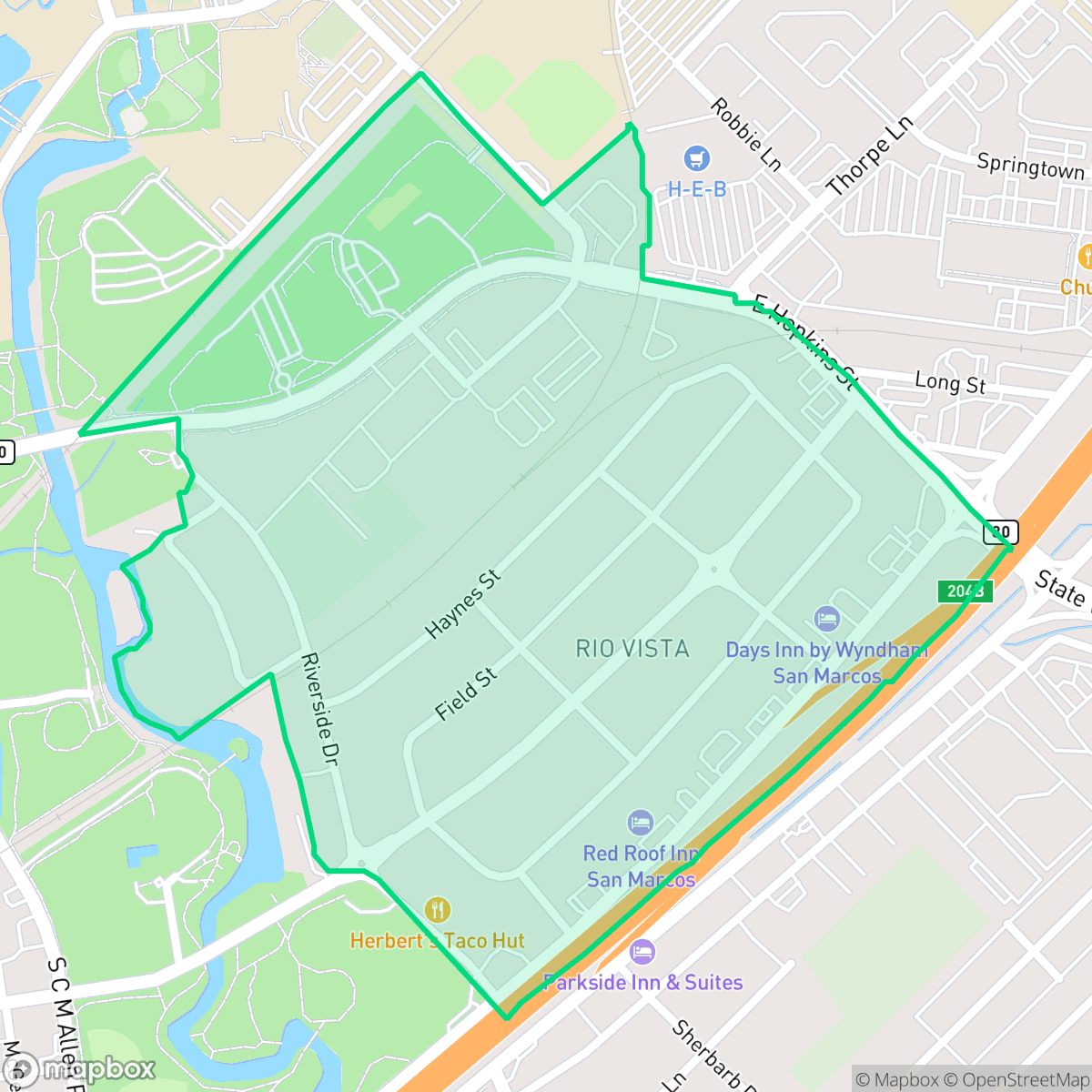
About Rio Vista
The area now known as Rio Vista in San Marcos was once a vibrant Hispanic, Mexican, and Tejano community. For decades, hundreds of families owned homes and land along the San Marcos River, contributing significantly to the local economy. In the 1960s, this established neighborhood was largely dismantled by urban renewal projects and eminent domain claims, which sought to clear the riverfront to develop parks and tourism infrastructure. Many displaced families were forced to relocate to other parts of the city, losing their generational wealth and community ties. Today, the area is primarily defined by the 13-acre Rio Vista Park, which features a reconstructed whitewater dam—originally built in 1904—that serves as a popular destination for swimming, tubing, and kayaking, standing in contrast to the residential history that once occupied the riverbanks.
Rio Vista serves as a residential hub characterized by its semi-rural landscape and proximity to the San Marcos River. The area maintains a quiet, low-density environment where residents enjoy a strong sense of community and active social engagement, often centered around local dining and the expansive green space of the park. It is a highly dog-friendly neighborhood with wide, low-traffic streets that encourage walking, despite the lack of formal sidewalks throughout the tract housing developments. According to iHuus data, the neighborhood consists primarily of quiet streets and open green spaces that remain undisturbed by industrial activity.
Potential residents should consider the practical trade-offs of living in the area, specifically regarding environmental and acoustic factors. The neighborhood experiences notable noise levels due to its proximity to railroad tracks and major freeway corridors. Additionally, portions of the area are situated within a designated floodplain, necessitating careful consideration of flood insurance requirements. While the local school district offers a supportive environment, it is currently navigating financial challenges and performance gaps. This community is best suited for those who prioritize outdoor access and a liberal, diverse social environment over absolute quiet or modern urban infrastructure.
Neighborhood Scores Across 15 Qualities
Residential spacing offers a balance of proximity and separation, matching the typical density found throughout San Marcos. Neighbors are positioned with some buffer between homes, according to iHuus data.
Lack of sidewalks exists throughout the area, but low traffic volumes make the streets suitable for walking. This level of walkability is consistent with the San Marcos average according to iHuus data.
Residential views consist primarily of conventional tract housing with modest yards. This level of visual variety is roughly in line with the San Marcos average.
Connected green spaces and wide, traffic-safe paths make this area significantly more dog-friendly than the San Marcos average, according to iHuus data.
Open land and scattered homes among woodlands characterize this area. The landscape feels more rural than the typical San Marcos neighborhood, according to iHuus data.
Frequent visits to local dining and social hubs are common here, as this area features a higher concentration of lively establishments than the San Marcos average. While various restaurants and parks provide plenty of activity, many of these social spots require a car to access due to the suburban layout.
Frequent noise from nearby railroad tracks and heavy freeway traffic characterizes this area. According to iHuus data, acoustic comfort is significantly lower than the San Marcos average.
Air quality levels in Rio Vista fluctuate between acceptable and unhealthy levels, which may occasionally cause concern for sensitive groups. According to iHuus data, these conditions are largely in line with the broader San Marcos area.
Residential life remains undisturbed by warehouses or industrial facilities, as this area lacks the heavy manufacturing presence found in other parts of San Marcos. According to iHuus data, the neighborhood consists primarily of quiet streets and open green spaces.
Health insurance access among residents is slightly below the San Marcos city average, according to iHuus data.
Voting patterns and census indicators show a notably more liberal lean than the San Marcos city average, according to iHuus data.
Residents live alongside a varied demographic of young adults, families, and seniors. This age distribution is more balanced than the typical profile found across San Marcos, according to iHuus data.
Frequent flood risk exists here because parts of the area sit within a designated floodplain, which is considerably higher than the San Marcos average. Residents should prepare for the potential necessity of flood insurance according to iHuus data.
Address-Level Insights for Rio Vista


iHuus Neighborhood Intelligence Insights
Get address-level neighborhood insights for Rio Vista
- Street-level scores — see how individual blocks compare, not just neighborhood averages
- Micro-zone boundaries — identify quiet pockets, flood boundaries, and walkable clusters before you visit
- 15 dimensions in full — walkability, noise, air quality, school quality, insurance coverage, population age profile, urban/rural index, and more
- Boundary risk alerts — know if your address sits near a block boundary where scores drop, the kind of detail no listing will ever mention
- School insights — individual school ratings and insights, not just district-level data
- Compare before you commit — side-by-side data across neighborhoods, down to block precision
No credit card required
Compare with Any Neighborhood
| Dimension | Rio Vista | Blanco Gardens |
|---|---|---|
| 🚶 Walkabilityavg 6.09 | ||
| 🔊 Acoustic Comfortavg 3.79 | ||
| 🤫 Privacy Indexavg 6.04 | ||
| 🎨 Visual Appealavg 6.1 | ||
| 🐕 Dog Friendlinessavg 6.89 | ||
| 🗺️ Urban-Rural Indexavg 7.6 | ||
| ✨ Neighborhood Vibeavg 5.43 | ||
| 🏥 Health Insurance Coverageavg 5.95 | ||
| 🌿 Air Qualityavg 6.09 | ||
| 🏭 Industrial Proximityavg 8.2 | ||
| 🌊 Flood Safetyavg 3.71 | ||
| 🗳️ Ideological Leanavg 8.3 | ||
| 👥 Population Age Profileavg 3.91 | ||
| 🔥 Fire Safety | ||
| 🏫 School Quality |
Rio Vista Rankings
School Districts Serving Rio Vista
School Insights for Rio Vista
Below average outcomes; significant attendance and academic challenges.
School Insights
See what's really behind every school rating near Rio Vista
- Individual school ratings — each school's own score with outcome context, not just a district average
- Enrollment & class size data — student-to-teacher ratio and how it compares to the state average
- Full demographics breakdown — ethnicity and gender composition for every school in the enrollment zone
- Every school in the district — all schools within the enrollment boundary ranked by rating, not just the closest one
- Grade levels & benchmarks — elementary through high school, with below/above state-average flags
No credit card required