Millview West, San Marcos
Updated · 2,673 residents
Millview West is a vibrant San Marcos neighborhood characterized by its proximity to Texas State University and a lively mix of student-oriented housing and local eateries. While the area offers convenient access to campus facilities and diverse dining options, residents should expect elevated noise levels from nearby road traffic.
Key Highlights
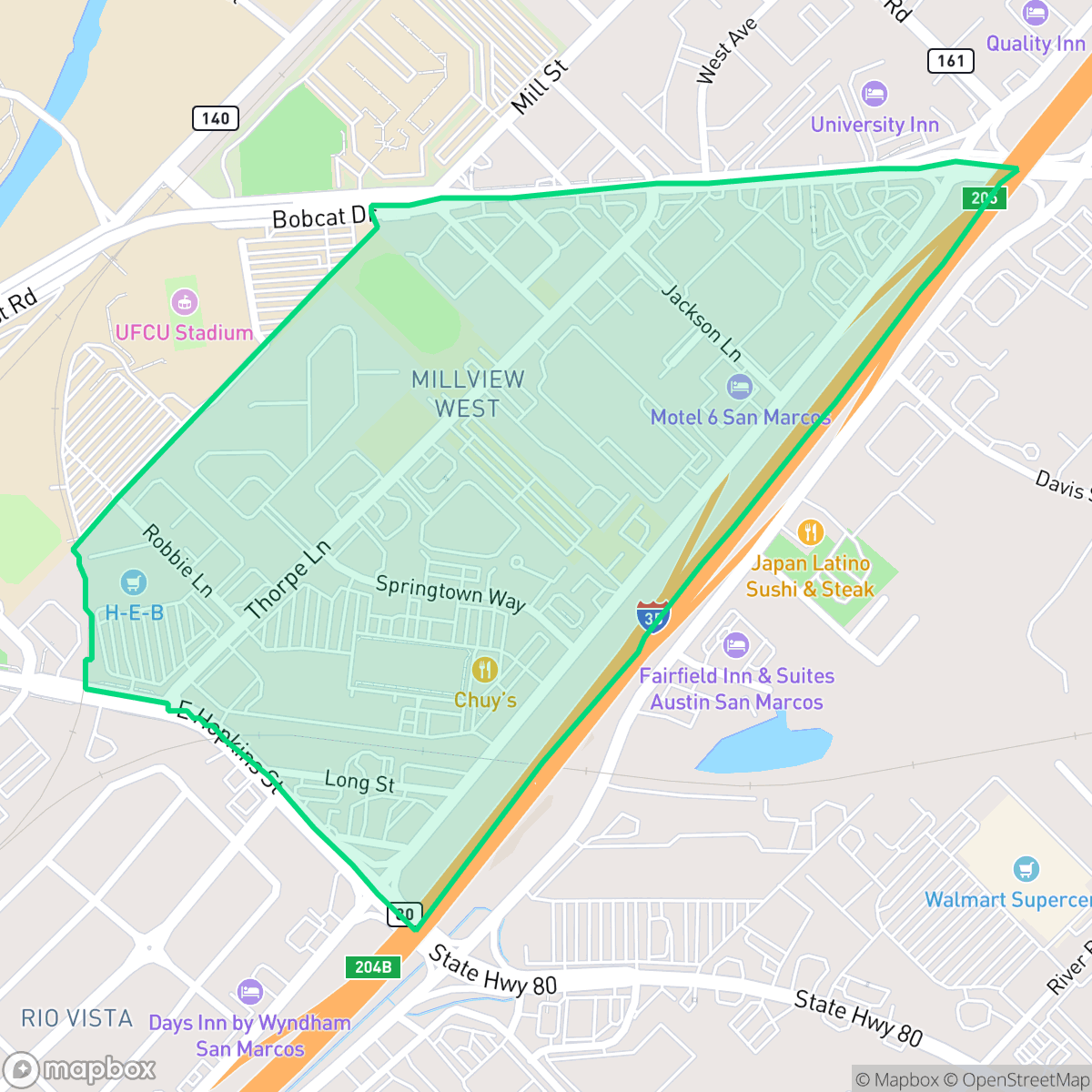
About Millview West
The Millview West neighborhood in San Marcos, Texas, is historically defined by its proximity and connection to the local textile industry. The area developed around the historic San Marcos Cotton Mill, which began construction in 1924 and was completed in 1929. In 1938, the facility was converted into the San Marcos Wool Mill (later the Bollman Wool Mill), which grew to become the largest wool processing plant west of the Mississippi River. The mill manufactured industrial-grade lanolin and the nationally distributed "Blue Bonnet Blankets" before closing in 1985. Today, the Millview West neighborhood has transitioned into a residential enclave near Texas State University, featuring a mix of mid-to-late 20th-century single-family homes, duplexes, and student-friendly condominiums.
The neighborhood functions as a dynamic residential and institutional hub, defined by its adjacency to Texas State University and local landmarks like the nearby football stadium. The area maintains a lively atmosphere, supported by a variety of local dining establishments such as Loli's Cafe and Sakura Sushi. The architectural landscape is a blend of mid-century single-family homes and high-density student apartments, creating a unique suburban environment that caters to a diverse population of students and long-term residents.
Prospective residents should weigh the benefits of this central location against the realities of living in a high-traffic zone. The area experiences noticeable noise from road traffic, which may impact acoustic comfort for some households. While the neighborhood provides good flood safety and high health insurance coverage, families with school-aged children should consider the current academic and financial challenges facing the San Marcos Consolidated Independent School District.
Neighborhood Scores Across 15 Qualities
Residential spacing varies significantly across the area, featuring a mix of dense student housing and more buffered single-family zones. According to iHuus data, this level of density is slightly higher than the San Marcos average, particularly near highway-adjacent commercial clusters.
A lack of consistent sidewalks and major highway barriers make walking more difficult here than in most parts of San Marcos. While residential streets remain quiet, high speed traffic on arterial roads presents challenges for pedestrians.
Typical residential architecture and manicured yards define the area, offering a visual experience very similar to the San Marcos average. Residents will find a mix of standard apartment complexes and collegiate-style density throughout the neighborhood.
Green spaces for walking are primarily restricted to lawns within apartment complexes and sports fields. According to iHuus data, the neighborhood lacks large public parks and features fragmented greenery near highways, making it less pet-friendly than the San Marcos average.
Open land and scattered homes amidst woodlands characterize this area. It offers a more rural atmosphere than the more developed urban centers found across San Marcos.
Frequent visits to local coffee shops and diverse dining options are easy due to a concentration of social hubs that is higher than the San Marcos average. While these lively commercial clusters are plentiful, the surrounding suburban layout remains largely car-dependent.
Frequent noise from nearby railroad tracks and heavy freeway traffic characterizes this area. According to iHuus data, acoustic comfort is significantly lower than the San Marcos average.
Air quality in this area is largely acceptable, though sensitive individuals may experience occasional periods of concern. This level of-air quality is roughly in line with the San Marcos average, according to iHuus data.
Residential streets and open green spaces predominate here, though some light commercial warehouses near the highway may introduce occasional noise or light. This area features slightly more proximity to commercial activity than the San Marcos average.
Health insurance access among residents is slightly higher than the San Marcos average, according to iHuus data.
Voting patterns and census indicators show a distinctly liberal leaning that is more pronounced than the San Marcos city average, according to iHuus data.
A significant portion of the population consists of young adults, with a relatively small presence of families or older residents. This demographic profile is slightly lower than the average seen throughout San Marcos, according to iHuus data.
Flood risk levels in this area are slightly higher than the San Marcos average, though a lack of detailed FEMA studies means the exact vulnerability remains undetermined. Residents should exercise caution as official flood maps for this specific location have not been fully updated.
Address-Level Insights for Millview West


iHuus Neighborhood Intelligence Insights
Get address-level neighborhood insights for Millview West
- Street-level scores — see how individual blocks compare, not just neighborhood averages
- Micro-zone boundaries — identify quiet pockets, flood boundaries, and walkable clusters before you visit
- 15 dimensions in full — walkability, noise, air quality, school quality, insurance coverage, population age profile, urban/rural index, and more
- Boundary risk alerts — know if your address sits near a block boundary where scores drop, the kind of detail no listing will ever mention
- School insights — individual school ratings and insights, not just district-level data
- Compare before you commit — side-by-side data across neighborhoods, down to block precision
No credit card required
Compare with Any Neighborhood
| Dimension | Millview West | Blanco Gardens |
|---|---|---|
| 🚶 Walkabilityavg 6.09 | ||
| 🔊 Acoustic Comfortavg 3.79 | ||
| 🤫 Privacy Indexavg 6.04 | ||
| 🎨 Visual Appealavg 6.1 | ||
| 🐕 Dog Friendlinessavg 6.89 | ||
| 🗺️ Urban-Rural Indexavg 7.6 | ||
| ✨ Neighborhood Vibeavg 5.43 | ||
| 🏥 Health Insurance Coverageavg 5.95 | ||
| 🌿 Air Qualityavg 6.09 | ||
| 🏭 Industrial Proximityavg 8.2 | ||
| 🌊 Flood Safetyavg 3.71 | ||
| 🗳️ Ideological Leanavg 8.3 | ||
| 👥 Population Age Profileavg 3.91 | ||
| 🔥 Fire Safety | ||
| 🏫 School Quality |
Millview West Rankings
School Districts Serving Millview West
School Insights for Millview West
Below average outcomes; significant attendance and academic challenges.
School Insights
See what's really behind every school rating near Millview West
- Individual school ratings — each school's own score with outcome context, not just a district average
- Enrollment & class size data — student-to-teacher ratio and how it compares to the state average
- Full demographics breakdown — ethnicity and gender composition for every school in the enrollment zone
- Every school in the district — all schools within the enrollment boundary ranked by rating, not just the closest one
- Grade levels & benchmarks — elementary through high school, with below/above state-average flags
No credit card required