Forest Hills, San Marcos
Updated · 1,101 residents
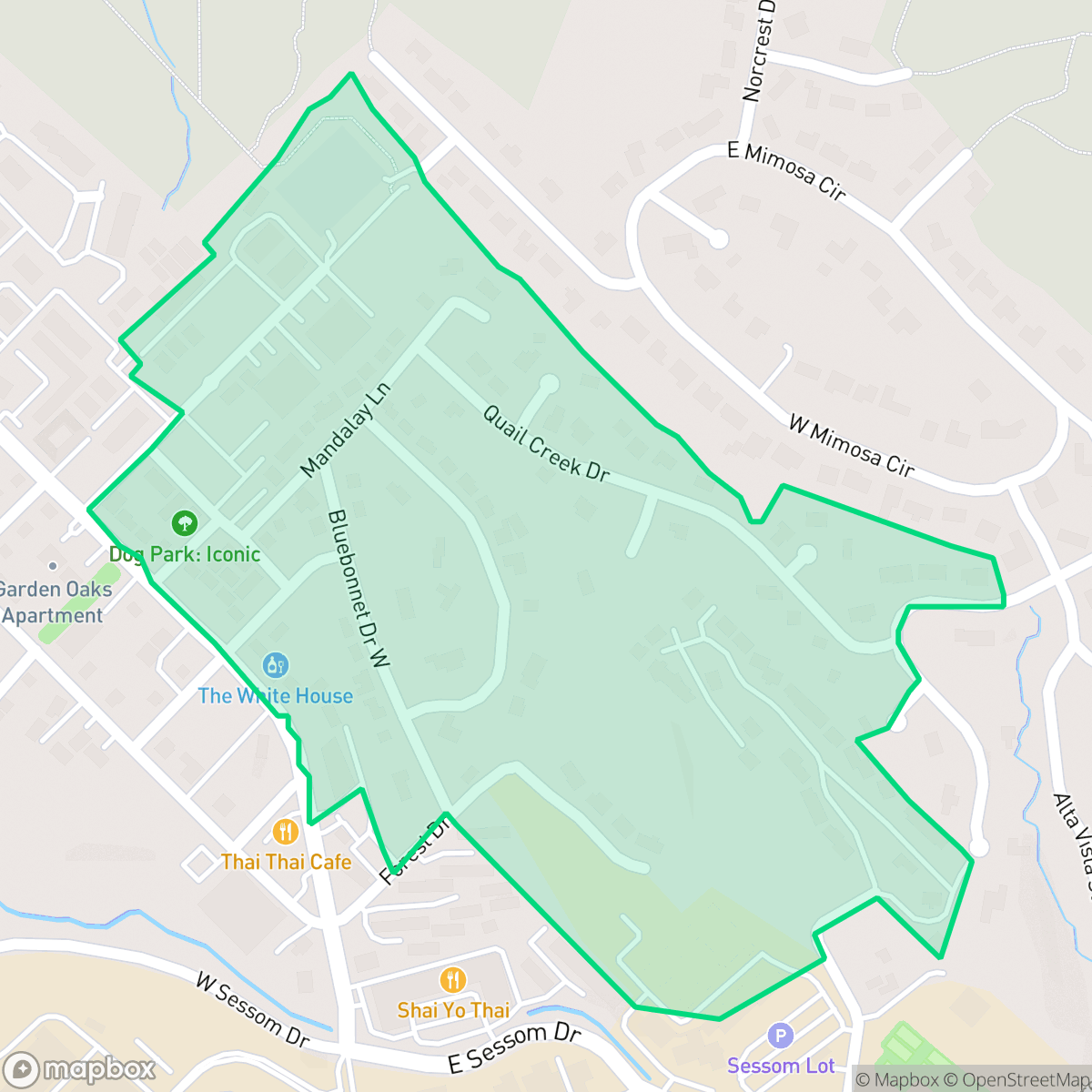
Forest Hills is a highly walkable neighborhood in San Marcos, defined by its proximity to Texas State University and a vibrant, student-centered atmosphere. While the area offers excellent access to local dining and green spaces for pet owners, residents experience limited privacy and higher noise levels due to dense, institutional-style housing.
Key Highlights
About Forest Hills
Forest Hills is characterized by its dense, academic-focused urban fabric, situated adjacent to Texas State University. The neighborhood is exceptionally walkable, featuring extensive sidewalk networks and pedestrian plazas that connect residents to popular local establishments like Don Japanese Kitchen, Pie Society, and Mochas and Javas. According to iHuus data, the area maintains a lively environment, supported by generous green buffers and park-like grounds that provide significant utility for dog owners. The demographic profile is heavily skewed toward a younger population, contributing to the active and social character of the streets. Prospective residents should note that the neighborhood presents specific livability trade-offs. The high-density residential and dormitory-style architecture results in lower levels of privacy and consistent road traffic noise. Furthermore, the area faces significant flood safety risks, and families with school-aged children should consider the current financial and operational challenges facing the San Marcos Consolidated Independent School District. This neighborhood is primarily suited for students and young professionals who prioritize proximity to campus and high walkability over quiet, suburban seclusion.
Neighborhood Scores Across 15 Qualities
Residential spacing fluctuates between dense apartment clusters with minimal separation and single-family homes that benefit from significant woodland buffers. This lack of consistent spacing makes privacy levels lower than the San Marcos average according to iHuus data.
Pedestrian infrastructure is significantly more developed here than the San Marcos average, featuring comprehensive sidewalk networks and safe crossings near the university campus. While some residential cul-de-sacs lack visible sidewalks, connected trails and low-traffic streets maintain high levels of walkability according to iHuus data.
A mix of standard housing and large apartment complexes provides a moderately pleasing environment that is slightly above the San Marcos average. According to iHuus data, the area features spacious driveways and well-maintained university facilities, though it lacks private luxury estates.
Abundant natural woodlands and extensive green buffers provide ample space for walking dogs. According to iHuus data, these interconnected natural areas and wide paths offer significantly more space for pets than the San Marcos average.
Frequent open land and scattered homes amidst woodland define this area, though it feels slightly more developed than the San Marcos average. According to iHuus data, the landscape features a mix of dense tree canopy and suburban residential pockets.
Lively blocks with a noticeable concentration of local dining and social hubs make this area more active than the San Marcos average. Residents have access to diverse amenities ranging from cafes to specialty eateries near local green spaces, according to iHuus data.
Steady hum from nearby busy streets defines the local soundscape, though acoustic comfort remains notably higher than the San Marcos average according to iHuus data.
Air quality levels in this area fluctuate between acceptable and unhealthy, posing occasional concerns for sensitive groups. This level of air quality is roughly consistent with the average found throughout San Marcos.
Residential tranquility is high here due to an absence of warehouses or manufacturing plants, which is noticeably better than the San Marcos average. While a single electrical substation is located on the eastern edge, the area remains free of heavy industrial hazards according to iHuus data.
Health insurance access among Forest Hills residents is higher than the San Marcos city average, according to iHuus data.
Voting patterns and census indicators show a predominantly liberal leaning, which is more pronounced here than in the rest of San Marcos according to iHuus data.
Young adults make up the majority of the population here, resulting in a demographic profile that is notably younger than the San Marcos city average. According to iHuus data, the area has a limited presence of families or older residents.
Flood risk levels are difficult to determine because FEMA has not yet completed a detailed study for this area. This lack of data places the neighborhood at a slightly higher level of uncertainty compared to the San Marcos average.
Address-Level Insights for Forest Hills


iHuus Neighborhood Intelligence Insights
Get address-level neighborhood insights for Forest Hills
- Street-level scores — see how individual blocks compare, not just neighborhood averages
- Micro-zone boundaries — identify quiet pockets, flood boundaries, and walkable clusters before you visit
- 15 dimensions in full — walkability, noise, air quality, school quality, insurance coverage, population age profile, urban/rural index, and more
- Boundary risk alerts — know if your address sits near a block boundary where scores drop, the kind of detail no listing will ever mention
- School insights — individual school ratings and insights, not just district-level data
- Compare before you commit — side-by-side data across neighborhoods, down to block precision
No credit card required
Compare with Any Neighborhood
| Dimension | Forest Hills | Blanco Gardens |
|---|---|---|
| 🚶 Walkabilityavg 6.09 | ||
| 🔊 Acoustic Comfortavg 3.79 | ||
| 🤫 Privacy Indexavg 6.04 | ||
| 🎨 Visual Appealavg 6.1 | ||
| 🐕 Dog Friendlinessavg 6.89 | ||
| 🗺️ Urban-Rural Indexavg 7.6 | ||
| ✨ Neighborhood Vibeavg 5.43 | ||
| 🏥 Health Insurance Coverageavg 5.95 | ||
| 🌿 Air Qualityavg 6.09 | ||
| 🏭 Industrial Proximityavg 8.2 | ||
| 🌊 Flood Safetyavg 3.71 | ||
| 🗳️ Ideological Leanavg 8.3 | ||
| 👥 Population Age Profileavg 3.91 | ||
| 🔥 Fire Safety | ||
| 🏫 School Quality |
Forest Hills Rankings
School Districts Serving Forest Hills
School Insights for Forest Hills
Below average outcomes; significant attendance and academic challenges.
School Insights
See what's really behind every school rating near Forest Hills
- Individual school ratings — each school's own score with outcome context, not just a district average
- Enrollment & class size data — student-to-teacher ratio and how it compares to the state average
- Full demographics breakdown — ethnicity and gender composition for every school in the enrollment zone
- Every school in the district — all schools within the enrollment boundary ranked by rating, not just the closest one
- Grade levels & benchmarks — elementary through high school, with below/above state-average flags
No credit card required