East Guadalupe, San Marcos
Updated · 1,251 residents
East Guadalupe is a culturally significant neighborhood in San Marcos known for its deep-rooted Mexican American heritage and historic landmarks. Residents enjoy a dog-friendly atmosphere and proximity to local parks, though the area experiences notable noise from nearby road traffic and the railroad.
Key Highlights
About East Guadalupe
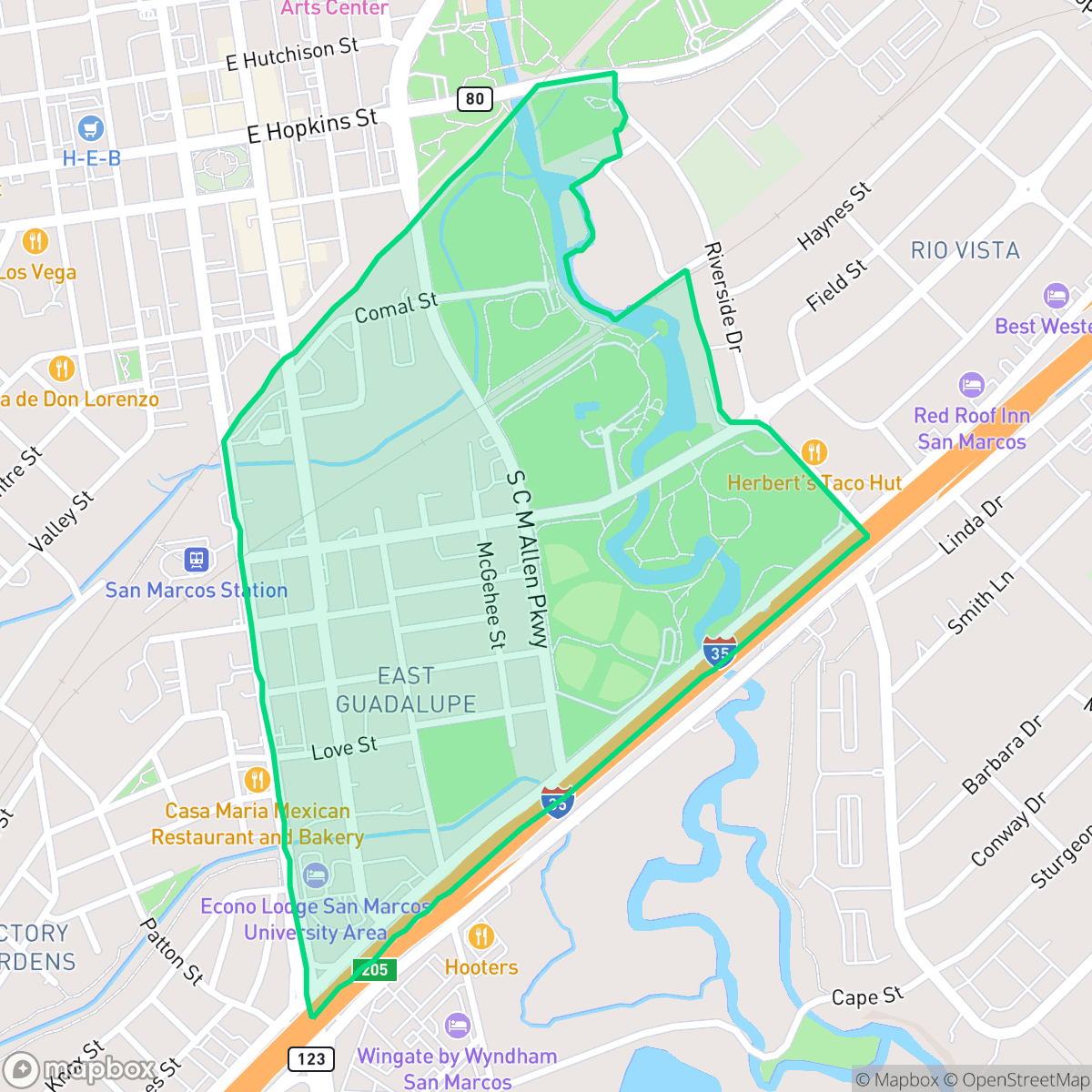
The East Guadalupe neighborhood in San Marcos, Texas—roughly bounded by Cheatham, South Guadalupe, and McKie streets, and Interstate 35—stands as the city’s earliest known Mexican American neighborhood. Separated from the historically Black Dunbar neighborhood by Purgatory Creek and the railroad tracks, East Guadalupe has been a hub of Mexican American culture since the early 20th century. In 2021, it was designated as part of a Mexican American and Indigenous Heritage and Culture District. Key local landmarks include the Southside Mexican School at 211 Lee Street, which now houses the Centro Cultural Hispano de San Marcos and holds a Texas Historical Marker. The neighborhood is also home to the historic Los Angeles Funeral Home (originally a Mexican Lodge Hall) and several historic Mexican churches, reflecting its deep-rooted community heritage.
The neighborhood functions as a blend of residential living and active commercial corridors. Residents benefit from accessible green spaces like Eddie Durham Park and local dining staples, creating a community with a distinct, lived-in feel. Its central location provides convenient access to major transit routes and city amenities, grounding the area in the daily rhythm of San Marcos life.
Prospective residents should consider the trade-offs associated with this location. The area faces higher noise levels due to road traffic and railroad activity, and residents must account for low flood safety ratings. While the local school district offers diverse educational opportunities, it currently faces financial and operational challenges. The neighborhood is best suited for those who prioritize cultural heritage and community accessibility over quiet, suburban seclusion.
Neighborhood Scores Across 15 Qualities
Residential spacing provides a moderate level of separation between neighbors. This balance of density and buffer is consistent with the average found across San Marcos.
Pedestrians can navigate the area via safe crossings and sidewalks present on one side of the street. This level of walkability is slightly above the San Marcos average according to iHuus data.
Standard tract housing with small yards and simple rooflines characterizes the area. This level of visual variety is roughly in line with the rest of San Marcos.
Extensive parks, trails, and open spaces provide ample room for pets. This accessibility to outdoor space is significantly higher than the San Marcos average, according to iHuus data.
Open land and woodland areas are common here, providing a more semi-rural feel than the more densely developed city average. According to iHuus data, the area features a blend of residential blocks and utility land alongside scattered homes.
A noticeable concentration of local dining, parks, and social hubs makes this area more active than the San Marcos average. Residents have access to diverse amenities ranging from established barbecue spots to riverside parks, according to iHuus data.
Frequent disruptions from nearby railroad tracks and heavy freeway traffic characterize this area. According to iHuus data, acoustic comfort is significantly lower than the San Marcos average.
Air quality fluctuates between acceptable and unhealthy levels, presenting occasional concerns for sensitive groups. This level of air quality is roughly consistent with the San Marcos average, according to iHuus data.
Industrial presence is limited, though a large wastewater treatment facility and settling ponds are located near some housing. This area features more industrial proximity than the San Marcos average, as some blocks blend residential life with active commercial daytime traffic.
Health insurance access is lower than the San Marcos average, according to iHuus data. This indicates a higher proportion of uninsured residents compared to the rest of the city.
Voting patterns and census indicators show a significantly more liberal political leaning than the San Marcos average. According to iHuus data, this area exhibits a high concentration of progressive-leaning residents.
Residents live alongside a varied demographic of young adults, families, and older individuals. This population spread is more balanced than the average found across San Marcos, according to iHuus data.
Property locations within the 100-year floodplain present a notable risk of inundation; according to iHuus data, this area carries a higher vulnerability to flooding than the San Marcos average.
Address-Level Insights for East Guadalupe


iHuus Neighborhood Intelligence Insights
Get address-level neighborhood insights for East Guadalupe
- Street-level scores — see how individual blocks compare, not just neighborhood averages
- Micro-zone boundaries — identify quiet pockets, flood boundaries, and walkable clusters before you visit
- 15 dimensions in full — walkability, noise, air quality, school quality, insurance coverage, population age profile, urban/rural index, and more
- Boundary risk alerts — know if your address sits near a block boundary where scores drop, the kind of detail no listing will ever mention
- School insights — individual school ratings and insights, not just district-level data
- Compare before you commit — side-by-side data across neighborhoods, down to block precision
No credit card required
Compare with Any Neighborhood
| Dimension | East Guadalupe | Blanco Gardens |
|---|---|---|
| 🚶 Walkabilityavg 6.09 | ||
| 🔊 Acoustic Comfortavg 3.79 | ||
| 🤫 Privacy Indexavg 6.04 | ||
| 🎨 Visual Appealavg 6.1 | ||
| 🐕 Dog Friendlinessavg 6.89 | ||
| 🗺️ Urban-Rural Indexavg 7.6 | ||
| ✨ Neighborhood Vibeavg 5.43 | ||
| 🏥 Health Insurance Coverageavg 5.95 | ||
| 🌿 Air Qualityavg 6.09 | ||
| 🏭 Industrial Proximityavg 8.2 | ||
| 🌊 Flood Safetyavg 3.71 | ||
| 🗳️ Ideological Leanavg 8.3 | ||
| 👥 Population Age Profileavg 3.91 | ||
| 🔥 Fire Safety | ||
| 🏫 School Quality |
East Guadalupe Rankings
School Districts Serving East Guadalupe
School Insights for East Guadalupe
Below average outcomes; significant attendance and academic challenges.
School Insights
See what's really behind every school rating near East Guadalupe
- Individual school ratings — each school's own score with outcome context, not just a district average
- Enrollment & class size data — student-to-teacher ratio and how it compares to the state average
- Full demographics breakdown — ethnicity and gender composition for every school in the enrollment zone
- Every school in the district — all schools within the enrollment boundary ranked by rating, not just the closest one
- Grade levels & benchmarks — elementary through high school, with below/above state-average flags
No credit card required