Dunbar, San Marcos
Updated · 2,103 residents
Dunbar is a historically significant neighborhood characterized by its quiet, low-density atmosphere and proximity to central San Marcos. While the area offers a high degree of dog friendliness and a rural aesthetic, residents should be aware of significant flood risks and the car-dependent nature of the local layout.
Key Highlights
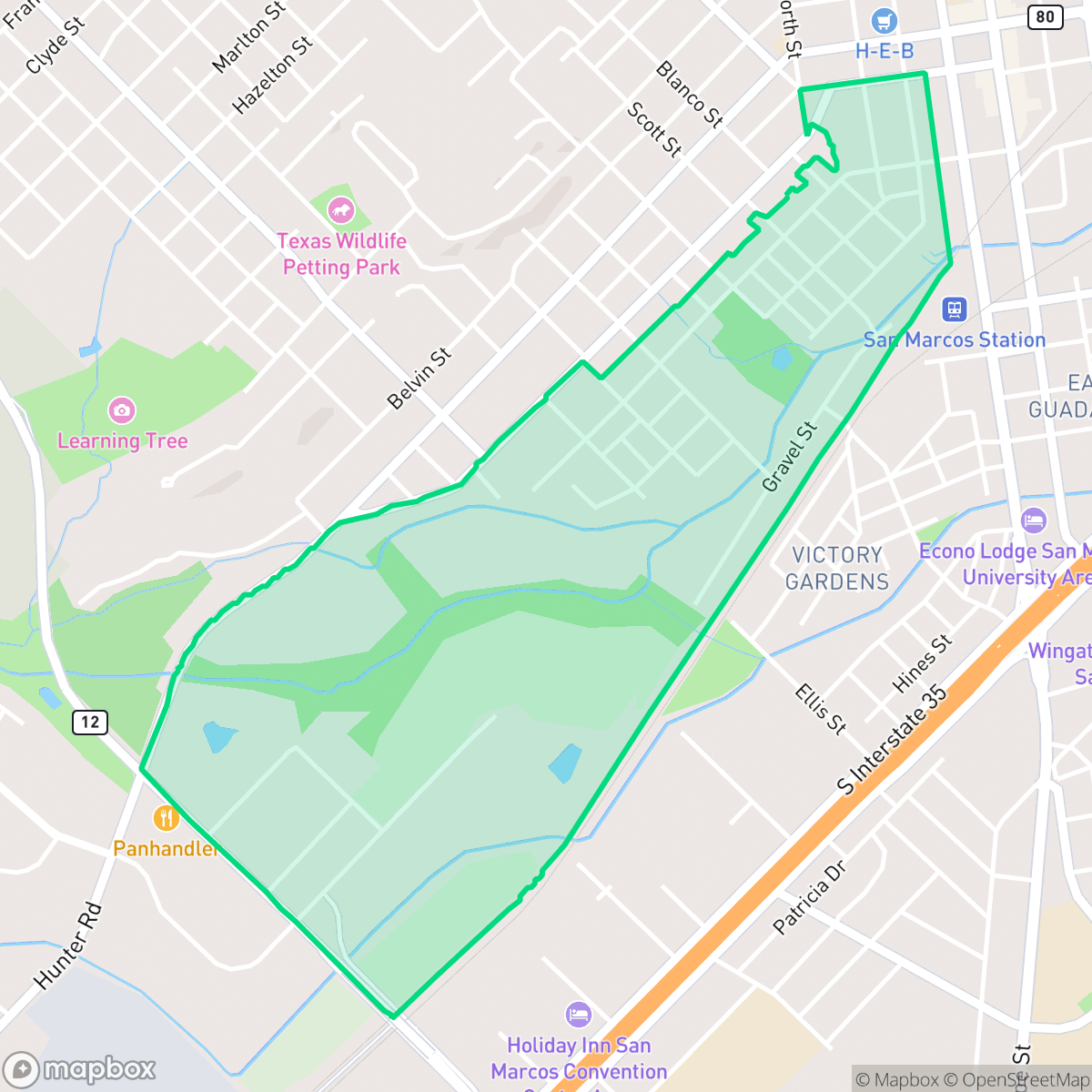
About Dunbar
Established southwest of San Marcos’s courthouse square after the Civil War, the Dunbar neighborhood became a thriving African American community settled by formerly enslaved people. Historically prone to flooding from Purgatory Creek, the neighborhood grew around early institutions like a Freedmen’s Bureau school, which evolved into the Dunbar School—the area's first public school for Black children. Key landmarks include the 1908 First Baptist Church, the restored Cephas House (home of blacksmith Ulysses Cephas), and the Calaboose African American History Museum, housed in an 1873 jail that served as a Black USO facility during World War II. The neighborhood also celebrates jazz pioneer Eddie Durham at a dedicated local park. Despite 20th-century redevelopment losses, the Dunbar Historic District was added to the National Register of Historic Places in 2024.
The neighborhood functions as a mixed-use community where residential blocks blend with light industrial activity. It maintains a distinct identity rooted in its heritage, with a layout that favors open space over dense urban development. According to iHuus data, the area provides a relatively quiet acoustic environment, though the presence of nearby highways and commercial traffic necessitates a reliance on personal vehicles for most daily errands. The atmosphere is generally low-key, reflecting a community that balances its historical roots with the practical realities of modern San Marcos.
Potential residents should weigh the neighborhood's cultural significance and pet-friendly environment against notable infrastructure challenges. The area faces a substantial risk of flooding, which remains a primary consideration for property owners. Students are served by the San Marcos Consolidated Independent School District, which is currently navigating a period of financial and operational transition. This neighborhood is best suited for those who value a slower pace of life and historic character over high-density urban convenience.
Neighborhood Scores Across 15 Qualities
Residential spacing is somewhat compressed due to a prevalence of multi-unit housing and small setbacks. This density is slightly higher than the average found throughout San Marcos, according to iHuus data.
Quiet streets and a pedestrian friendly campus layout in the north make for pleasant walks, though a lack of sidewalks in some areas makes the score slightly below the San Marcos average.
Uniform rooftops and small yards define this area, which offers a visual landscape very similar to the San Marcos average. Most properties consist of standard single-family homes and apartment complexes.
Green verges between sidewalks and nearby campus fields provide some space for walks, though overall amenities for dogs are below the San Marcos average according to iHuus data.
Open land and scattered residential pockets provide a sense of space, though the area is slightly less rural than the San Marcos average. According to iHuus data, the landscape features a mix of woodland, large-scale warehouses, and low-density residential clusters.
Social hubs and diverse dining options provide a noticeable energy that is higher than the San Marcos average. While the area features various local eateries and parks, the layout remains largely car-dependent due to the presence of light industrial units and highway proximity.
Proximity to major transit corridors and rail lines results in higher noise levels than the San Marcos average. Residents may experience frequent disruptions from nearby freeway and railroad activity.
Air quality in this area fluctuates between acceptable and unhealthy levels, which may cause occasional concern for sensitive groups. According to iHuus data, these conditions are largely in line with the average levels seen across San Marcos.
Industrial presence is minimal in this area, though some nearby logistics hubs with heavy truck traffic are located adjacent to residential zones. This neighborhood maintains a slightly lower level of industrial proximity compared to the San Marcos city average according to iHuus data.
Health insurance access in this area is slightly above the San Marcos average. According to iHuus data, a significant portion of the resident population remains uninsured.
Voting patterns and census indicators in Dunbar reflect a more liberal political leaning than the San Marcos average, according to iHuus data.
A balanced mix of young adults, families, and older residents characterizes the area. This age distribution is largely consistent with the broader San Marcos population, according to iHuus data.
Flood risk levels in this area remain undetermined because official federal studies for this specific location are currently incomplete. According to iHuus data, this level of uncertainty is slightly higher than the San Marcos city average.
Address-Level Insights for Dunbar


iHuus Neighborhood Intelligence Insights
Get address-level neighborhood insights for Dunbar
- Street-level scores — see how individual blocks compare, not just neighborhood averages
- Micro-zone boundaries — identify quiet pockets, flood boundaries, and walkable clusters before you visit
- 15 dimensions in full — walkability, noise, air quality, school quality, insurance coverage, population age profile, urban/rural index, and more
- Boundary risk alerts — know if your address sits near a block boundary where scores drop, the kind of detail no listing will ever mention
- School insights — individual school ratings and insights, not just district-level data
- Compare before you commit — side-by-side data across neighborhoods, down to block precision
No credit card required
Compare with Any Neighborhood
| Dimension | Dunbar | Blanco Gardens |
|---|---|---|
| 🚶 Walkabilityavg 6.09 | ||
| 🔊 Acoustic Comfortavg 3.79 | ||
| 🤫 Privacy Indexavg 6.04 | ||
| 🎨 Visual Appealavg 6.1 | ||
| 🐕 Dog Friendlinessavg 6.89 | ||
| 🗺️ Urban-Rural Indexavg 7.6 | ||
| ✨ Neighborhood Vibeavg 5.43 | ||
| 🏥 Health Insurance Coverageavg 5.95 | ||
| 🌿 Air Qualityavg 6.09 | ||
| 🏭 Industrial Proximityavg 8.2 | ||
| 🌊 Flood Safetyavg 3.71 | ||
| 🗳️ Ideological Leanavg 8.3 | ||
| 👥 Population Age Profileavg 3.91 | ||
| 🔥 Fire Safety | ||
| 🏫 School Quality |
Dunbar Rankings
School Districts Serving Dunbar
School Insights for Dunbar
Below average outcomes; significant attendance and academic challenges.
School Insights
See what's really behind every school rating near Dunbar
- Individual school ratings — each school's own score with outcome context, not just a district average
- Enrollment & class size data — student-to-teacher ratio and how it compares to the state average
- Full demographics breakdown — ethnicity and gender composition for every school in the enrollment zone
- Every school in the district — all schools within the enrollment boundary ranked by rating, not just the closest one
- Grade levels & benchmarks — elementary through high school, with below/above state-average flags
No credit card required