Downtown, San Marcos
Updated · 1,911 residents
Downtown San Marcos is a highly walkable urban hub defined by its vibrant social scene, diverse dining, and proximity to historic cultural landmarks. Residents enjoy a pedestrian-friendly environment, though the area experiences moderate traffic noise and denser housing arrangements than other parts of the city.
Key Highlights
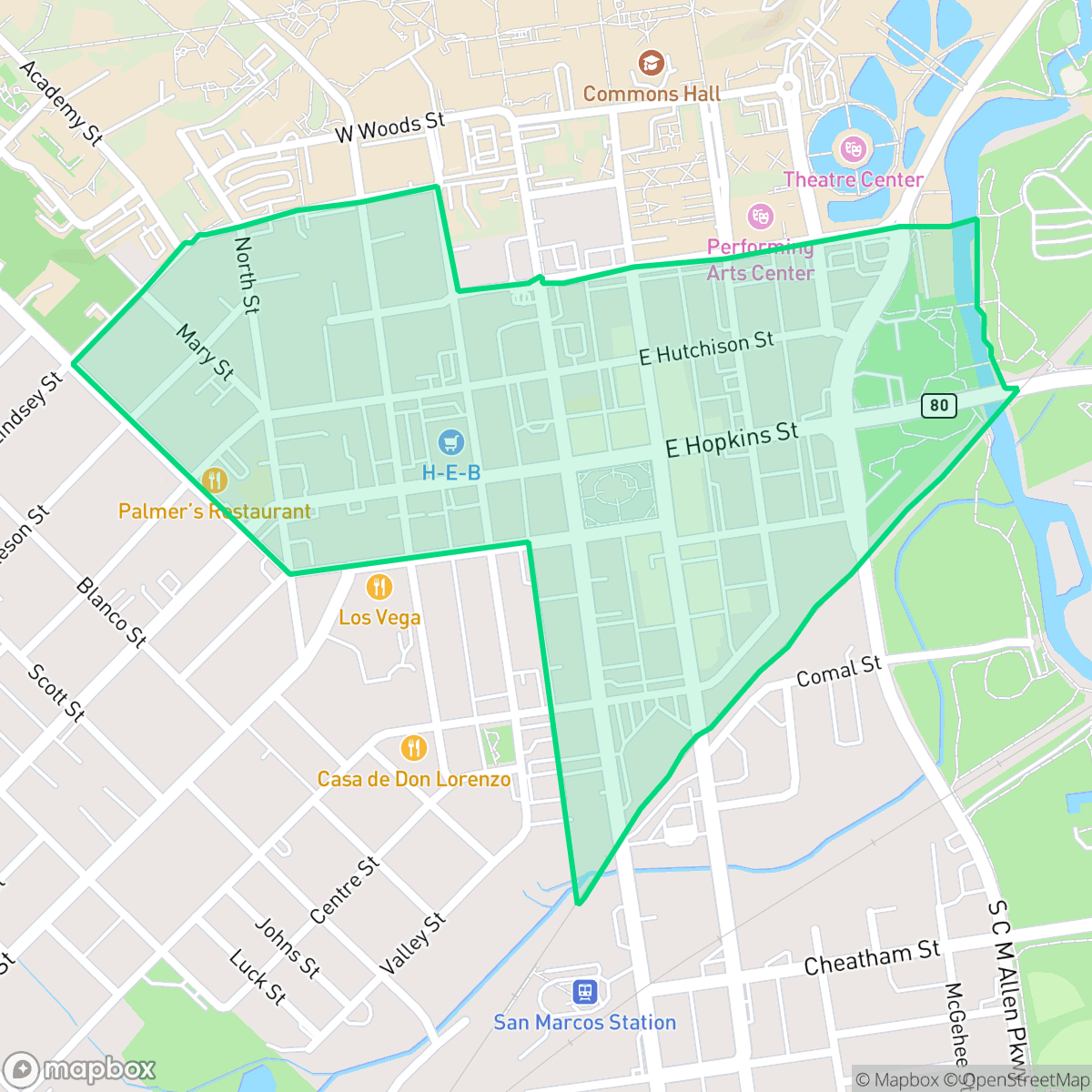
About Downtown
Downtown San Marcos, centered around the 1909 Hays County Courthouse, serves as the historic heart of the city. Its architectural character is defined by late 19th and early 20th-century commercial buildings, many contributing to the National Register-listed San Marcos Downtown Historic District. The area reflects the city's growth as a regional trade hub following the arrival of the International-Great Northern Railroad in 1880. Key landmarks include the Beaux-Arts courthouse and the historic Price Center. Since its 1986 designation as a Texas Main Street city, the neighborhood has maintained its cultural identity through a commitment to historic preservation and the revitalization of its town square, which remains a focal point for community commerce and civic life.
The area functions as a lively social center with a high concentration of restaurants, art venues, and community spaces. Its walkability is a standout feature, supported by a continuous grid of sidewalks that makes navigating the neighborhood efficient for those who prefer to travel on foot. The absence of industrial facilities contributes to a cleaner environment, while the neighborhood’s strong liberal leaning and youthful demographic shape its progressive and energetic atmosphere. This setting is well suited for students and young professionals who value proximity to local culture and an active social life.
Prospective residents should consider that the neighborhood features a mix of apartment complexes and smaller residential plots, which results in a moderate level of privacy between neighbors. While the area is pet friendly with accessible green spaces, it faces moderate flood risk and higher traffic noise levels compared to the rest of the city. The local school district remains in a state of transition, balancing academic improvement efforts with ongoing financial and operational challenges. Overall, the neighborhood offers a distinct urban experience for those who prioritize convenience and community engagement over suburban seclusion.
Neighborhood Scores Across 15 Qualities
Residential spacing is relatively tight due to a prevalence of multi-unit housing and small setbacks. This level of density offers less separation between neighbors than the San Marcos average, according to iHuus data.
Pedestrian connectivity is much higher than the San Marcos average due to a continuous sidewalk grid and a user-friendly campus layout in the northern section. Safe crossings and well-connected streets make navigating the area on foot efficient for residents.
Standard residential and student housing dominate the area, featuring typical apartment complexes and small yards. This landscape is largely consistent with the broader San Marcos average.
Green verges and nearby open fields provide safe areas for walking pets. According to iHuus data, these accessible paths and nearby parks offer a level of dog friendliness that is slightly above the San Marcos average.
A blend of university facilities, apartment complexes, and single-family residential blocks creates a lower density of development than the San Marcos average. Open land and scattered residential pockets are frequently interspersed with more urbanized structures according to iHuus data.
Frequent activity and a high concentration of local dining and cultural landmarks make this area significantly more vibrant than the San Marcos average. According to iHuus data, the neighborhood features a diverse mix of parks, art centers, and social venues that contribute to a steady neighborhood energy.
Steady sounds from nearby busy streets characterize this area. According to iHuus data, acoustic levels are slightly higher than the San Marcos average.
Air quality levels fluctuate between acceptable and unhealthy ranges, primarily presenting occasional concerns for sensitive groups. This neighborhood maintains an air quality profile that is largely in line with the San Marcos city average, according to iHuus data.
Industrial facilities and warehouses are absent from this area, which features a mix of residential, institutional, and commercial uses. This lack of heavy industry makes the neighborhood notably cleaner of industrial signatures than the San Marcos average, according to iHuus data.
Health insurance access is relatively stable in this area, aligning closely with the city average. According to iHuus data, coverage levels remain consistent with broader San Marcos trends.
Voting patterns and census indicators reflect a notably more liberal leaning than the San Marcos city average, according to iHuus data.
Residents are predominantly young adults, with a demographic profile that is slightly younger than the San Marcos average. This area features a modest presence of families and older residents according to iHuus data.
Flood risk levels in this area are higher than the San Marcos average. According to iHuus data, the lack of a detailed FEMA study means residents should remain cautious during heavy rain events.
Address-Level Insights for Downtown


iHuus Neighborhood Intelligence Insights
Get address-level neighborhood insights for Downtown
- Street-level scores — see how individual blocks compare, not just neighborhood averages
- Micro-zone boundaries — identify quiet pockets, flood boundaries, and walkable clusters before you visit
- 15 dimensions in full — walkability, noise, air quality, school quality, insurance coverage, population age profile, urban/rural index, and more
- Boundary risk alerts — know if your address sits near a block boundary where scores drop, the kind of detail no listing will ever mention
- School insights — individual school ratings and insights, not just district-level data
- Compare before you commit — side-by-side data across neighborhoods, down to block precision
No credit card required
Compare with Any Neighborhood
| Dimension | Downtown | Blanco Gardens |
|---|---|---|
| 🚶 Walkabilityavg 6.09 | ||
| 🔊 Acoustic Comfortavg 3.79 | ||
| 🤫 Privacy Indexavg 6.04 | ||
| 🎨 Visual Appealavg 6.1 | ||
| 🐕 Dog Friendlinessavg 6.89 | ||
| 🗺️ Urban-Rural Indexavg 7.6 | ||
| ✨ Neighborhood Vibeavg 5.43 | ||
| 🏥 Health Insurance Coverageavg 5.95 | ||
| 🌿 Air Qualityavg 6.09 | ||
| 🏭 Industrial Proximityavg 8.2 | ||
| 🌊 Flood Safetyavg 3.71 | ||
| 🗳️ Ideological Leanavg 8.3 | ||
| 👥 Population Age Profileavg 3.91 | ||
| 🔥 Fire Safety | ||
| 🏫 School Quality |
Downtown Rankings
School Districts Serving Downtown
School Insights for Downtown
Below average outcomes; significant attendance and academic challenges.
School Insights
See what's really behind every school rating near Downtown
- Individual school ratings — each school's own score with outcome context, not just a district average
- Enrollment & class size data — student-to-teacher ratio and how it compares to the state average
- Full demographics breakdown — ethnicity and gender composition for every school in the enrollment zone
- Every school in the district — all schools within the enrollment boundary ranked by rating, not just the closest one
- Grade levels & benchmarks — elementary through high school, with below/above state-average flags
No credit card required