Blanco Gardens, San Marcos
Updated · 4,457 residents
Blanco Gardens is a low-lying, car-dependent residential area located at the confluence of the Blanco and San Marcos Rivers. While the neighborhood offers significant green space and dog-friendly environments, residents must navigate challenges related to noise from nearby highways and limited pedestrian infrastructure.
Key Highlights
About Blanco Gardens
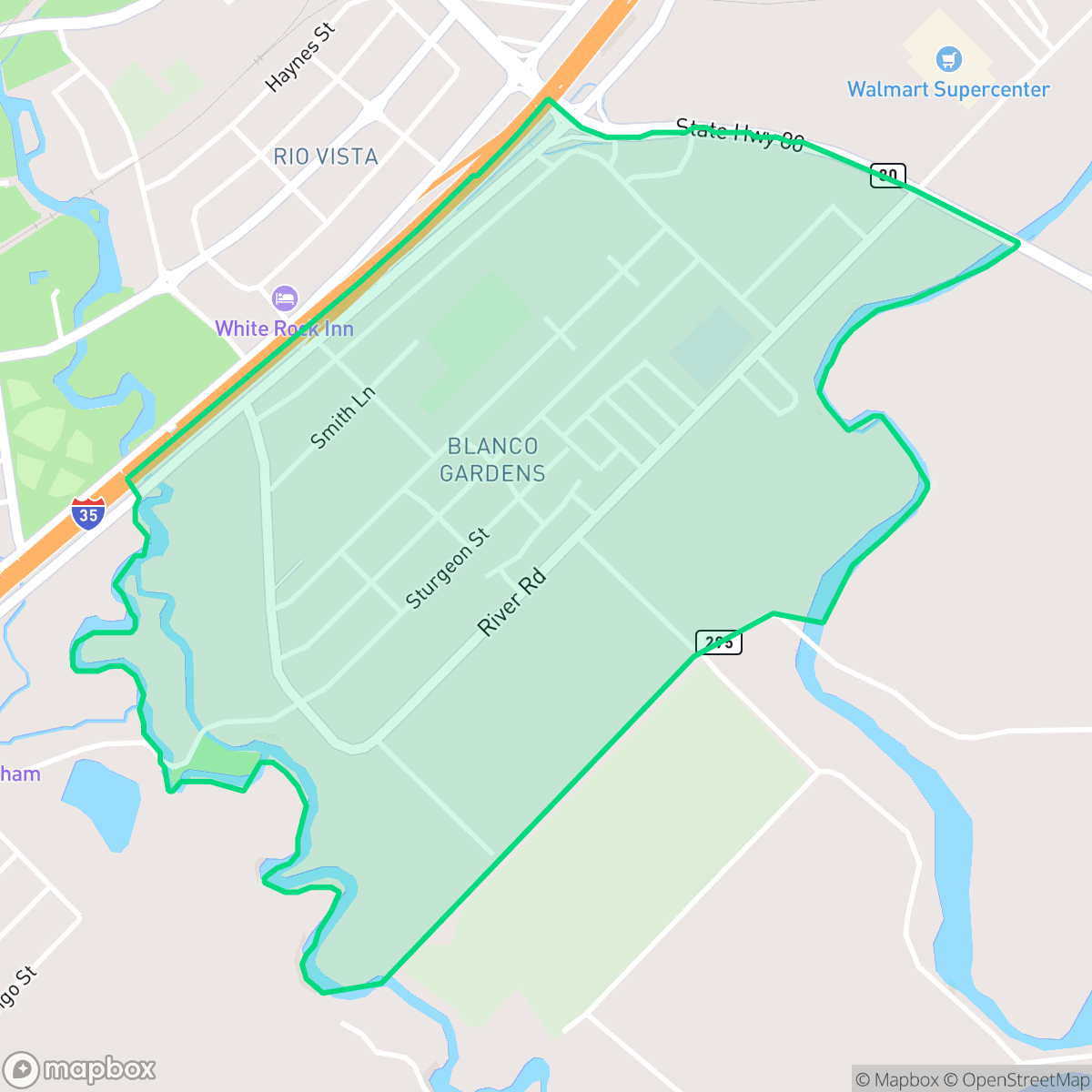
Blanco Gardens is a historically significant, tight-knit neighborhood in southeast San Marcos, Texas, bounded by Interstate 35, Highway 80, and the San Marcos River. Positioned where the Blanco and San Marcos Rivers meet, the flat, 275-acre low-lying neighborhood has a long, defining history of environmental resilience. It was severely impacted by the historic 2015 Memorial Day and All Saints Day floods, which inundated homes and prompted major federal disaster recovery initiatives. These events spurred the Blanco Riverine Flood Mitigation Project and the Blanco Gardens Drainage Improvements Project to construct protective floodwalls and relief channels along River Road. To preserve its unique local heritage, the city adopted the Blanco Gardens Neighborhood Area Plan in 2025, focusing on celebrating the area's cultural history, protecting its residential character, and supporting local hubs like the K.A.D. Korner Store.
The neighborhood is defined by its proximity to major transportation arteries and local waterways, creating a landscape that blends suburban residential zones with light industrial infrastructure. Residents have access to local social hubs and outdoor spaces, including nearby parks and dining establishments, though the overall aesthetic is characterized by a mix of small tract housing and mobile home parks. According to iHuus data, the area maintains a distinct suburban-industrial character that prioritizes functional access over visual uniformity.
Those considering this neighborhood should note the significant environmental and acoustic factors, including persistent road traffic noise and a high vulnerability to flooding. While the area provides ample room for pets to roam in open fields, prospective residents should weigh these benefits against the limited sidewalk connectivity and the ongoing financial and operational transitions within the local school district.
Neighborhood Scores Across 15 Qualities
Varying residential spacing provides a balance of closeness and separation between neighbors. This level of density is roughly consistent with the typical San Marcos layout, featuring a mix of more clustered mobile home sectors and more isolated lots.
Residential streets lack sidewalks, though wide roads and nearby shops allow for some pedestrian activity. Walking ease in this area is slightly below the San Marcos average according to iHuus data.
Standard tract housing and mobile home parks define the area's visual landscape. This landscape is less varied than the San Marcos city average, featuring modest yards and uniform rooflines.
Large open fields and nearby wooded creek areas provide ample space for pets. According to iHuus data, the neighborhood offers more accessible green space and safer walking paths than the San Marcos average.
Frequent open land and agricultural areas provide a more rural atmosphere than the typical San Marcos suburban landscape. Residents will encounter a mix of medium-density housing and vast undeveloped green buffers according to iHuus data.
Varied pockets of social hubs and dining options coexist with quieter, industrial, and rural landscapes. This mix of lively commercial spots and calm residential streets is roughly in line with the San Marcos city average, according to iHuus data.
Frequent auditory disturbances from nearby freeway and railroad proximity characterize this area. According to iHuus data, acoustic comfort in Blanco Gardens is lower than the San Marcos city average.
Air quality levels fluctuate between acceptable and unhealthy, presenting occasional concerns for sensitive groups. These conditions are largely consistent with the average found throughout San Marcos.
Residential areas sit adjacent to a large wastewater treatment facility and an electrical substation, resulting in more industrial activity than is typically found across San Marcos. According to iHuus data, the landscape includes a blend of quiet streets and active utility infrastructure.
Health insurance accessibility is lower here than the average for San Marcos. According to iHuus data, a minority of residents in this area are covered by health insurance plans.
Voting patterns and census indicators show a predominantly liberal political leaning that is more pronounced than the San Marcos city average.
Residents live alongside a varied demographic of young adults, families, and older adults; according to iHuus data, this age distribution is slightly more diverse than the San Marcos average.
Located within a designated flood zone, this area faces a significantly higher risk of flooding than the San Marcos average. Residents should be aware that flood insurance is typically a requirement for properties in this location.
Address-Level Insights for Blanco Gardens


iHuus Neighborhood Intelligence Insights
Get address-level neighborhood insights for Blanco Gardens
- Street-level scores — see how individual blocks compare, not just neighborhood averages
- Micro-zone boundaries — identify quiet pockets, flood boundaries, and walkable clusters before you visit
- 15 dimensions in full — walkability, noise, air quality, school quality, insurance coverage, population age profile, urban/rural index, and more
- Boundary risk alerts — know if your address sits near a block boundary where scores drop, the kind of detail no listing will ever mention
- School insights — individual school ratings and insights, not just district-level data
- Compare before you commit — side-by-side data across neighborhoods, down to block precision
No credit card required
Compare with Any Neighborhood
| Dimension | Blanco Gardens | Blanco River North |
|---|---|---|
| 🚶 Walkabilityavg 6.09 | ||
| 🔊 Acoustic Comfortavg 3.79 | ||
| 🤫 Privacy Indexavg 6.04 | ||
| 🎨 Visual Appealavg 6.1 | ||
| 🐕 Dog Friendlinessavg 6.89 | ||
| 🗺️ Urban-Rural Indexavg 7.6 | ||
| ✨ Neighborhood Vibeavg 5.43 | ||
| 🏥 Health Insurance Coverageavg 5.95 | ||
| 🌿 Air Qualityavg 6.09 | ||
| 🏭 Industrial Proximityavg 8.2 | ||
| 🌊 Flood Safetyavg 3.71 | ||
| 🗳️ Ideological Leanavg 8.3 | ||
| 👥 Population Age Profileavg 3.91 | ||
| 🔥 Fire Safety | ||
| 🏫 School Quality |
Blanco Gardens Rankings
School Districts Serving Blanco Gardens
School Insights for Blanco Gardens
Below average outcomes; significant attendance and academic challenges.
School Insights
See what's really behind every school rating near Blanco Gardens
- Individual school ratings — each school's own score with outcome context, not just a district average
- Enrollment & class size data — student-to-teacher ratio and how it compares to the state average
- Full demographics breakdown — ethnicity and gender composition for every school in the enrollment zone
- Every school in the district — all schools within the enrollment boundary ranked by rating, not just the closest one
- Grade levels & benchmarks — elementary through high school, with below/above state-average flags
No credit card required