Woodlawn Lake, San Antonio
Updated · 6,114 residents
Woodlawn Lake is a historic San Antonio neighborhood defined by its namesake lake, eclectic early 20th-century architecture, and a quiet, suburban atmosphere. While the area offers a peaceful residential environment with local dining options, residents should expect limited walkability and moderate noise levels from surrounding road traffic.
Key Highlights
About Woodlawn Lake
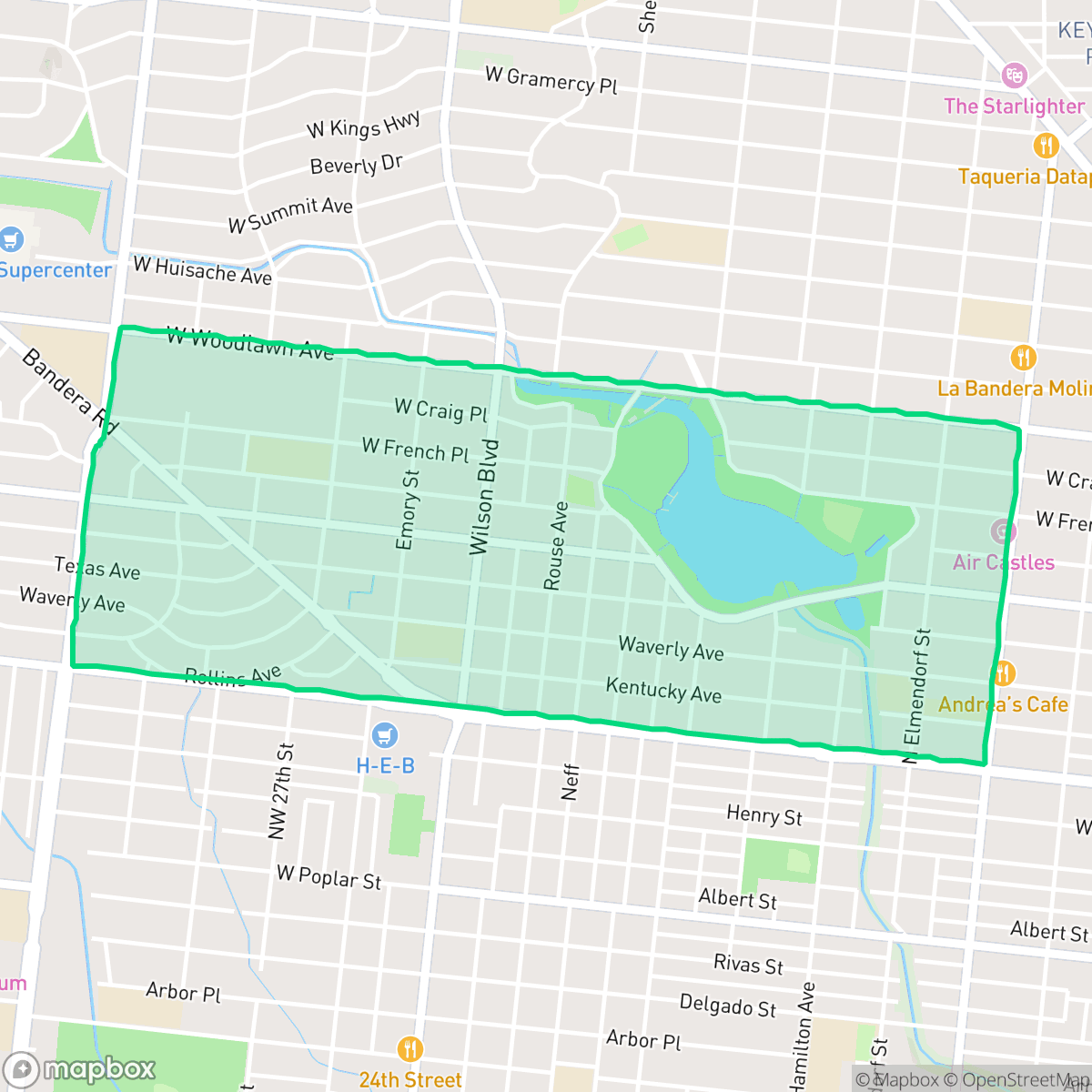
Developed in 1887 as "West End," one of San Antonio’s earliest streetcar suburbs, the Woodlawn Lake neighborhood began when developers transformed "Maverick’s Pasture" into a resort-style community. In 1889, they dammed Alazan Creek to create the central lake. Deeded to the city in 1918, the area was renamed Woodlawn Lake in 1920 by the West End Improvement Club. Designated a local historic district in 2000, the neighborhood features an eclectic mix of architectural styles, including 1920s bungalows, Arts and Crafts, and Spanish Revival homes. Its centerpiece, Woodlawn Lake Park, is anchored by a 1930s Mission Revival-style Island House, a miniature lake lighthouse, and the modern "Spineway" public art installation. The neighborhood is also defined by the nearby soaring domes of the Basilica of the National Shrine of the Little Flower.
The neighborhood maintains a dense, residential character defined by its grid-based street layout and proximity to local green spaces. Beyond its historic appeal, the area features a variety of small-scale commercial clusters that provide access to diverse local dining, including neighborhood taco shops and seafood spots. The community is primarily composed of single-story homes, creating a consistent visual landscape that balances residential density with a serene, suburban pace of life.
Prospective residents should consider that the area is best suited for those who prioritize a quiet, established environment over high-density urban amenities. While the neighborhood offers a distinct sense of place, it presents certain trade-offs, such as limited pedestrian infrastructure and moderate noise levels from local road traffic. Individuals interested in the area should note that while public school options vary, the local environment remains focused on a stable, long-term residential experience rather than a high-activity commercial center.
Neighborhood Scores Across 15 Qualities
Housing density is slightly higher than the San Antonio average, with detached homes featuring modest yards and small gaps between structures. Neighbors are often positioned in relatively close proximity, though some buffer space remains between most properties.
Low traffic on residential streets makes for a safe walking environment, though inconsistent sidewalk infrastructure means some blocks lack paved paths. This level of walkability is slightly below the San Antonio average according to iHuus data.
Residential lots are small and densely packed with uniform, modest rooflines. This area lacks the luxury amenities and expansive greenery found more frequently across the wider San Antonio area.
Direct access to riverside parks and canal paths offers significant space for pets, though residential street verges remain narrow. This level of accessibility is roughly comparable to the city average according to iHuus data.
Residential blocks feature a mix of single-family homes and small commercial structures. This area is slightly more developed than the city average, presenting a more suburban feel than the more open, semi-rural outskirts of San Antonio.
Serene streets and green spaces near the lake provide a steady but low-key atmosphere, matching the city average for activity levels. While diverse dining options are available nearby, most social and commercial services require a short drive.
Steady sounds from nearby busy streets create a consistent ambient hum. This level of acoustic activity is slightly higher than the San Antonio average, according to iHuus data.
Frequent unhealthy air quality levels pose a significant risk to sensitive groups. According to iHuus data, the air quality in this area is worse than the San Antonio average.
No warehouses, heavy industrial facilities, or hazard sites are present within the neighborhood. This area is notably cleaner of industrial activity than the San Antonio average, consisting primarily of residential spaces and light commercial storefronts.
Access to health insurance among residents is lower than the San Antonio average, according to iHuus data.
Voting patterns and census indicators reflect a distinctly liberal political leaning that is significantly more pronounced than the San Antonio average.
Residents live alongside a balanced mix of young professionals, families, and seniors. This demographic distribution is largely consistent with the broader San Antonio area according to iHuus data.
Flood risk in this area is significantly higher than the San Antonio average. Residents should prepare for elevated or potentially prohibitive insurance costs due to the neighborhood's location in a high-hazard zone.
Address-Level Insights for Woodlawn Lake


iHuus Neighborhood Intelligence Insights
Get address-level neighborhood insights for Woodlawn Lake
- Street-level scores — see how individual blocks compare, not just neighborhood averages
- Micro-zone boundaries — identify quiet pockets, flood boundaries, and walkable clusters before you visit
- 15 dimensions in full — walkability, noise, air quality, school quality, insurance coverage, population age profile, urban/rural index, and more
- Boundary risk alerts — know if your address sits near a block boundary where scores drop, the kind of detail no listing will ever mention
- School insights — individual school ratings and insights, not just district-level data
- Compare before you commit — side-by-side data across neighborhoods, down to block precision
No credit card required
Compare with Any Neighborhood
| Dimension | Woodlawn Lake | 145 Association |
|---|---|---|
| 🚶 Walkabilityavg 6.44 | ||
| 🔊 Acoustic Comfortavg 4.07 | ||
| 🤫 Privacy Indexavg 5.75 | ||
| 🎨 Visual Appealavg 6.11 | ||
| 🐕 Dog Friendlinessavg 5.91 | ||
| 🗺️ Urban-Rural Indexavg 6.87 | ||
| ✨ Neighborhood Vibeavg 4.35 | ||
| 🏥 Health Insurance Coverageavg 5.94 | ||
| 🌿 Air Qualityavg 2.27 | ||
| 🏭 Industrial Proximityavg 8.31 | ||
| 🌊 Flood Safetyavg 4.2 | ||
| 🗳️ Ideological Leanavg 7.37 | ||
| 👥 Population Age Profileavg 4.68 | ||
| 🔥 Fire Safety | ||
| 🏫 School Quality |
Woodlawn Lake Rankings
School Districts Serving Woodlawn Lake
School Insights for Woodlawn Lake
Below average outcomes; significant attendance and academic challenges.
School Insights
See what's really behind every school rating near Woodlawn Lake
- Individual school ratings — each school's own score with outcome context, not just a district average
- Enrollment & class size data — student-to-teacher ratio and how it compares to the state average
- Full demographics breakdown — ethnicity and gender composition for every school in the enrollment zone
- Every school in the district — all schools within the enrollment boundary ranked by rating, not just the closest one
- Grade levels & benchmarks — elementary through high school, with below/above state-average flags
No credit card required