Wheatley Heights, San Antonio
Updated · 1,231 residents
Wheatley Heights is a quiet, low-density community on San Antonio's East Side, defined by its extensive green spaces and the prominent Wheatley Heights Sports Complex. While the area offers a peaceful residential atmosphere with high dog-friendliness, residents experience notable noise from nearby road traffic and significant challenges regarding flood safety.
Key Highlights
About Wheatley Heights
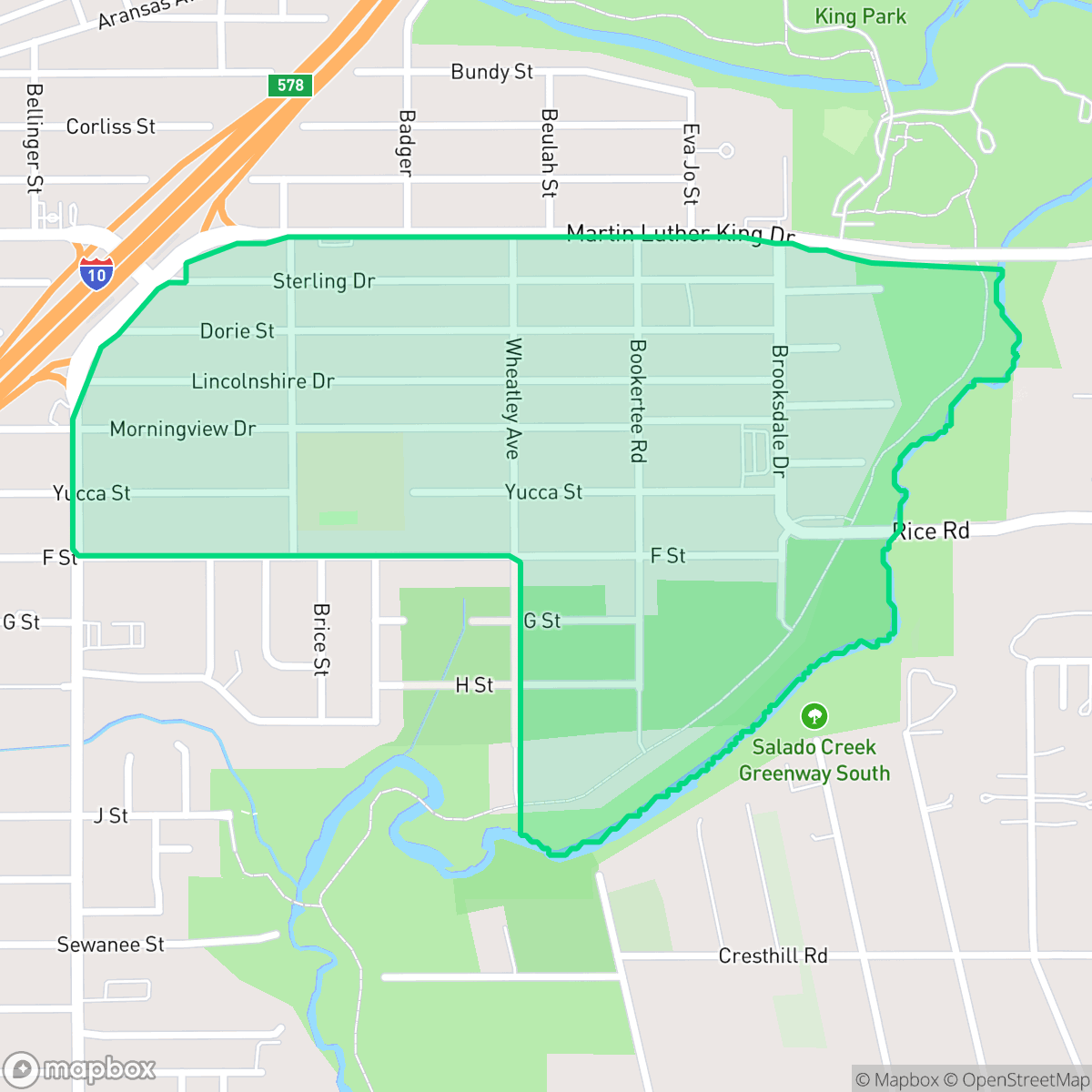
Located on San Antonio’s East Side, Wheatley Heights is a historic neighborhood with deep ties to the city’s Black and Mexican-American communities. The area underwent a major physical transformation following a devastating flood in October 1998, when the rain-swollen Salado Creek destroyed numerous homes and local landmarks, including the Wheatley Heights First Baptist Church. In the aftermath, the city executed extensive floodplain buyouts, purchasing and demolishing over 100 flood-prone residential properties. This reclaimed land was subsequently integrated into Martin Luther King Park and developed into the Wheatley Heights Sports Complex, a multi-million-dollar athletic facility that opened in 2012. Today, the neighborhood's heritage is also honored by the University Health Wheatley clinic, named after the historic African American poet Phillis Wheatley.
The area maintains a distinct, low-density character that stands out from more urbanized parts of San Antonio. It is primarily residential, featuring quiet streets and significant open space that supports outdoor activity, particularly for dog owners. The presence of the Wheatley Heights Sports Complex serves as a local anchor, providing athletic facilities that benefit the broader community, while the overall layout emphasizes a rural feel despite its proximity to the city center.
Prospective residents should consider specific trade-offs when evaluating the neighborhood. According to iHuus data, the area faces persistent challenges with road traffic noise and poor air quality, which may impact daily acoustic comfort. Furthermore, the neighborhood is situated in a high-risk zone for flooding, and local schools in the San Antonio Independent School District currently face significant academic and structural hurdles. The area is best suited for those seeking a quiet, low-density environment who are prepared to navigate these environmental and infrastructure-related considerations.
Neighborhood Scores Across 15 Qualities
Residential spacing provides a moderate level of separation between neighbors, which is slightly higher than the San Antonio average according to iHuus data.
Low traffic volume and quiet roads make for pleasant strolls, though the lack of sidewalks means pedestrians must share the street with vehicles. According to iHuus data, walkability in this area is slightly below the San Antonio average.
Residential scenery consists of traditional tract housing with uniform rooflines and modest yard spaces. This level of visual variety is slightly below the San Antonio average according to iHuus data.
Accessible green spaces and wide, traffic-safe paths provide more opportunities for pet owners than the San Antonio average. According to iHuus data, the area offers several interconnected routes for walking dogs away from heavy congestion.
Open land and scattered homes among woodlands characterize this area, offering a more rural atmosphere than the San Antonio average. According to iHuus data, the landscape features frequent open spaces and significant greenery.
Low-density housing and green spaces define this area, which offers a more subdued atmosphere than the San Antonio average. While essential services and local eateries are available, the neighborhood is primarily characterized by quiet, suburban streets and limited walking-distance retail options.
Local traffic from nearby busy streets creates a consistent level of sound. This acoustic profile is slightly higher than the San Antonio average, according to iHuus data.
Frequent unhealthy air quality levels pose significant risks to sensitive groups, a condition that is slightly worse than the San Antonio average according to iHuus data.
Industrial activity is virtually non-existent here, as the area consists of residential streets and green spaces without the presence of warehouses or heavy manufacturing. This lack of industrial proximity is notably higher than the San Antonio average, according to iHuus data.
Health insurance coverage among residents is lower than the San Antonio average. According to iHuus data, a significant portion of the population lacks employer-sponsored or private coverage.
Voting patterns and census indicators show a significantly more liberal leaning than the San Antonio average. According to iHuus data, the community demonstrates much stronger liberal political alignments than the rest of the city.
A diverse range of age groups inhabits the area, ranging from young adults to older residents. This demographic distribution is largely consistent with the broader San Antonio area, according to iHuus data.
Properties in this area are situated within a known floodplain, making flood insurance typically a requirement for residents. According to iHuus data, the risk of flooding in Wheatley Heights is notably higher than the San Antonio average.
Address-Level Insights for Wheatley Heights


iHuus Neighborhood Intelligence Insights
Get address-level neighborhood insights for Wheatley Heights
- Street-level scores — see how individual blocks compare, not just neighborhood averages
- Micro-zone boundaries — identify quiet pockets, flood boundaries, and walkable clusters before you visit
- 15 dimensions in full — walkability, noise, air quality, school quality, insurance coverage, population age profile, urban/rural index, and more
- Boundary risk alerts — know if your address sits near a block boundary where scores drop, the kind of detail no listing will ever mention
- School insights — individual school ratings and insights, not just district-level data
- Compare before you commit — side-by-side data across neighborhoods, down to block precision
No credit card required
Compare with Any Neighborhood
| Dimension | Wheatley Heights | 145 Association |
|---|---|---|
| 🚶 Walkabilityavg 6.44 | ||
| 🔊 Acoustic Comfortavg 4.07 | ||
| 🤫 Privacy Indexavg 5.75 | ||
| 🎨 Visual Appealavg 6.11 | ||
| 🐕 Dog Friendlinessavg 5.91 | ||
| 🗺️ Urban-Rural Indexavg 6.87 | ||
| ✨ Neighborhood Vibeavg 4.35 | ||
| 🏥 Health Insurance Coverageavg 5.94 | ||
| 🌿 Air Qualityavg 2.27 | ||
| 🏭 Industrial Proximityavg 8.31 | ||
| 🌊 Flood Safetyavg 4.2 | ||
| 🗳️ Ideological Leanavg 7.37 | ||
| 👥 Population Age Profileavg 4.68 | ||
| 🔥 Fire Safety | ||
| 🏫 School Quality |
Wheatley Heights Rankings
School Districts Serving Wheatley Heights
School Insights for Wheatley Heights
Below average outcomes; significant attendance and academic challenges.
School Insights
See what's really behind every school rating near Wheatley Heights
- Individual school ratings — each school's own score with outcome context, not just a district average
- Enrollment & class size data — student-to-teacher ratio and how it compares to the state average
- Full demographics breakdown — ethnicity and gender composition for every school in the enrollment zone
- Every school in the district — all schools within the enrollment boundary ranked by rating, not just the closest one
- Grade levels & benchmarks — elementary through high school, with below/above state-average flags
No credit card required