Vance Jackson, San Antonio
Updated · 18,941 residents
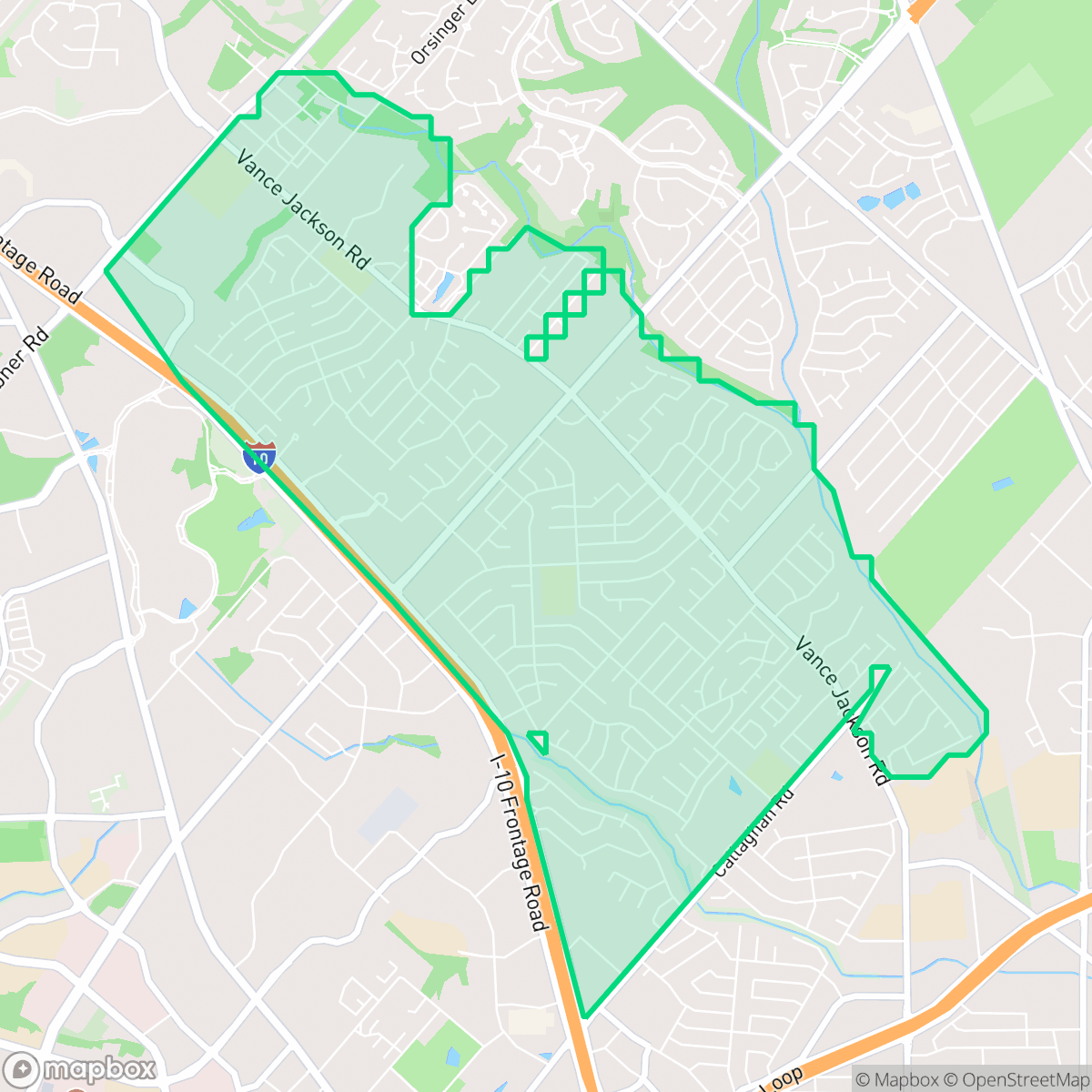
Vance Jackson is a diverse, established urban enclave in San Antonio known for its mix of single-family homes and mid-rise apartment complexes. The area offers a moderate level of walkability and features a mature tree canopy that provides shade for residents. While the neighborhood is largely car-dependent, it maintains a vibrant local dining scene and proximity to key community social hubs.
Key Highlights
About Vance Jackson
The Vance Jackson neighborhood in San Antonio, TX, is named after the Vance and Jackson families, who owned adjacent ranches in the area during the early 1900s. Specifically, its namesake road honors William Vance, a prominent local merchant who owned downtown's historic Vance House, and William Houston Jackson, who established a ranch on the Emmanuel Leal grant in 1849. Initially a rural expanse dominated by farming, Vance Jackson underwent a major transformation after World War II, rapidly transitioning into a suburban residential community to accommodate San Antonio's growing population. Today, the neighborhood is a diverse, established urban enclave featuring single-family homes and mid-rise apartment complexes largely built between 1940 and 1999.
The neighborhood functions as a dense suburban landscape, characterized by a mix of mid-century single-family homes and apartment clusters. It maintains a consistent visual appeal through mature landscaping and wide setbacks, which contribute to a higher-than-average score for aesthetic quality. Residents have access to a variety of local dining options, including international cuisines and established regional eateries, alongside social anchors such as St. Matthew Catholic Church. The area benefits from a lack of industrial hazards, making it a stable environment for those seeking a quiet, residential setting within the broader city grid. According to iHuus data, the neighborhood provides a balanced mix of residential streets and green spaces that exceeds the city average for visual appeal. Prospective residents should note that while the neighborhood provides a pleasant, tree-lined environment, it remains primarily car-dependent despite its moderate walkability scores. Acoustic comfort is influenced by road traffic, which is a common factor in this part of San Antonio. Families are served by a mix of schools within the North East and Northside Independent School Districts, as well as specialized options like KIPP Somos Collegiate. The area is best suited for those who prioritize established residential character and access to diverse local services over a highly walkable urban lifestyle.
Neighborhood Scores Across 15 Qualities
Residential spacing varies significantly across the area, ranging from dense apartment clusters to detached homes with modest yards. According to iHuus data, this level of privacy is roughly in line with the San Antonio average.
Pedestrian movement is supported by continuous sidewalks and low-traffic loops in many areas, though highway barriers and large parking lots can fragment the network. According to iHuus data, walkability in this area is slightly above the city average.
Large residential footprints, manicured yards, and private pools contribute to a visual landscape that is more polished than the San Antonio average. According to iHuus data, the presence of premium amenities and well-maintained landscaping creates a high level of curb appeal throughout the area.
Wide, tree-lined verges and shaded grassy areas provide pleasant routes for pet owners. According to iHuus data, these walkable green spaces offer slightly better amenities for dogs than the San Antonio average.
Open land and scattered homes amidst woodlands provide a semi-rural feel that is slightly more expansive than the San Antonio average. This landscape features a mix of dense suburban street grids and mature tree canopies, according to iHuus data.
A steady mix of residential streets and diverse dining options provides a more active atmosphere than the San Antonio average. While certain pockets offer local social hubs, much of the area remains car-dependent due to the spread of services and industrial units.
Steady hums from nearby busy streets contribute to ambient noise levels that are slightly higher than the San Antonio average, according to iHuus data.
Frequent unhealthy air quality levels pose a significant risk to sensitive groups. According to iHuus data, the air quality in Vance Jackson is slightly worse than the San Antonio average.
Residential and light commercial zones dominate this area with a notable absence of warehouses, shipping facilities, or heavy industrial hazards. This lack of industrial activity makes the neighborhood significantly cleaner of industrial proximity than the San Antonio average, according to iHuus data.
Health insurance coverage among residents is higher than the San Antonio average, according to iHuus data.
Political leanings in this area are predominantly liberal, which is very similar to the broader San Antonio area according to iHuus data.
Residents live alongside a balanced mix of young adults, families, and older individuals. This demographic distribution is largely consistent with the broader San Antonio area, according to iHuus data.
Flood risk in this area is slightly higher than the San Antonio average, though current FEMA studies for this specific location remain incomplete. Residents should exercise standard caution during heavy rain events as official detailed flood mapping is still pending.
Address-Level Insights for Vance Jackson


iHuus Neighborhood Intelligence Insights
Get address-level neighborhood insights for Vance Jackson
- Street-level scores — see how individual blocks compare, not just neighborhood averages
- Micro-zone boundaries — identify quiet pockets, flood boundaries, and walkable clusters before you visit
- 15 dimensions in full — walkability, noise, air quality, school quality, insurance coverage, population age profile, urban/rural index, and more
- Boundary risk alerts — know if your address sits near a block boundary where scores drop, the kind of detail no listing will ever mention
- School insights — individual school ratings and insights, not just district-level data
- Compare before you commit — side-by-side data across neighborhoods, down to block precision
No credit card required
Compare with Any Neighborhood
| Dimension | Vance Jackson | 145 Association |
|---|---|---|
| 🚶 Walkabilityavg 6.44 | ||
| 🔊 Acoustic Comfortavg 4.07 | ||
| 🤫 Privacy Indexavg 5.75 | ||
| 🎨 Visual Appealavg 6.11 | ||
| 🐕 Dog Friendlinessavg 5.91 | ||
| 🗺️ Urban-Rural Indexavg 6.87 | ||
| ✨ Neighborhood Vibeavg 4.35 | ||
| 🏥 Health Insurance Coverageavg 5.94 | ||
| 🌿 Air Qualityavg 2.27 | ||
| 🏭 Industrial Proximityavg 8.31 | ||
| 🌊 Flood Safetyavg 4.2 | ||
| 🗳️ Ideological Leanavg 7.37 | ||
| 👥 Population Age Profileavg 4.68 | ||
| 🔥 Fire Safety | ||
| 🏫 School Quality |
Vance Jackson Rankings
School Districts Serving Vance Jackson
School Insights for Vance Jackson
Below average outcomes; significant attendance and academic challenges.
School Insights
See what's really behind every school rating near Vance Jackson
- Individual school ratings — each school's own score with outcome context, not just a district average
- Enrollment & class size data — student-to-teacher ratio and how it compares to the state average
- Full demographics breakdown — ethnicity and gender composition for every school in the enrollment zone
- Every school in the district — all schools within the enrollment boundary ranked by rating, not just the closest one
- Grade levels & benchmarks — elementary through high school, with below/above state-average flags
No credit card required