University Park, San Antonio
Updated · 7,528 residents
University Park is a quiet, dense suburban community defined by its proximity to St. Mary’s University and a collection of modest post-war homes. According to iHuus data, the area offers a low-key atmosphere with limited walkability and few businesses within easy reach of residential streets.
Key Highlights
About University Park
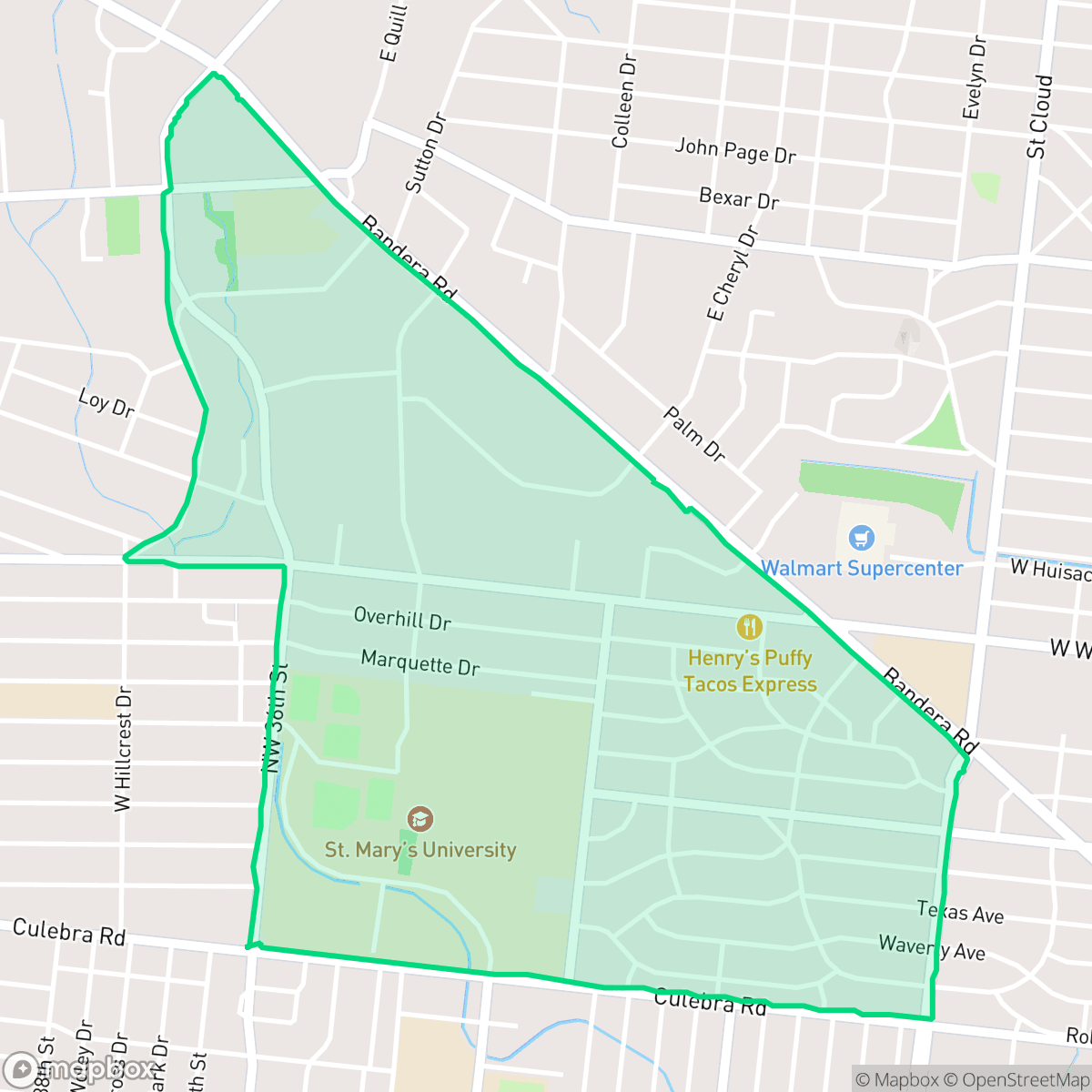
Historically known as "Third World S.A." prior to a 2010 revitalization initiative, the University Park neighborhood in San Antonio is deeply intertwined with St. Mary’s University, the oldest Catholic university in Texas. Developed as one of the city's earliest suburban areas, the neighborhood's housing stock predominantly dates to the post-World War II era, characterized by modest, single-story wood-framed homes. The community's cultural identity is anchored by its strong academic ties and local traditions, most notably hosting the annual Fiesta Oyster Bake on the university campus. Popular local gathering spots like Barrio Barista further define the neighborhood's welcoming, student-friendly, and multi-generational character.
The neighborhood maintains a dense suburban structure, characterized by its mix of single-family residences and apartment blocks. While the area benefits from a relatively quiet acoustic environment, the presence of large commercial warehouses and busy arteries nearby influences the overall urban-rural balance. Residents have access to local dining options, though the lack of high-density commercial centers means that most daily errands require a vehicle. The area is marked by a consistent, modest aesthetic that reflects its post-war development history.
Prospective residents should note that the area features inconsistent sidewalk coverage, which can limit pedestrian mobility and dog friendliness. The local school district, San Antonio ISD, is currently undergoing significant structural changes, and families should investigate specific campus performance. With limited public green space and a focus on functional residential living, the neighborhood serves as an accessible choice for those prioritizing proximity to academic institutions over luxury amenities, as noted in iHuus analysis.
Neighborhood Scores Across 15 Qualities
Residential structures are placed with moderate spacing, offering a sense of separation that is slightly higher than the San Antonio average. According to iHuus data, many homes sit on a dense suburban grid where neighbors remain relatively close to one another.
Quiet, low-traffic streets allow for safe walking, though the sidewalk network is inconsistent and lacks continuity compared to the San Antonio average. Many residential blocks feature missing or obscured pedestrian paths, particularly along higher-traffic corridors.
Standard tract housing and simple apartment blocks define the area, featuring uniform rooflines and small yards. According to iHuus data, the visual variety and presence of luxury amenities are lower than the San Antonio average.
Public green space and wide sidewalk verges are scarce, making dog walking more reliant on private yards or nearby campus grounds. According to iHuus data, the available space for outdoor pet activity is below the San Antonio average.
Residential layouts consist primarily of dense suburban grids and single-family homes, though the area retains a slightly more open feel than the San Antonio average. Mixed-use strips and institutional facilities are interspersed with established residential blocks throughout the neighborhood.
Residential streets offer a calm, suburban atmosphere with a low density of nearby commerce. While various dining options are scattered throughout the area, most services require a drive as walking access to businesses is limited compared to the San Antonio average.
Local traffic from a nearby busy street creates a consistent level of noise. This ambient sound is slightly higher than the typical experience found elsewhere in San Antonio.
Frequent unhealthy air quality levels pose significant risks to sensitive groups. This area experiences lower air quality than the San Antonio average, according to iHuus data.
Residential and recreational spaces dominate the landscape with an absence of heavy industrial facilities. This area maintains a cleaner profile than the San Antonio average, as no warehouses or industrial hazards were detected in the neighborhood according to iHuus data.
Health insurance coverage among residents is notably lower than the San Antonio average. This lack of coverage may present challenges for accessing medical services without out of pocket costs.
Voting patterns and census indicators show a predominantly liberal leaning that is notably higher than the San Antonio average. This political profile is reflected in the area's community engagement and demographic trends according to iHuus data.
Residents live alongside a balanced mix of young adults, families, and older populations. This demographic spread is largely consistent with the broader San Antonio area, according to iHuus data.
Properties in this area are situated within a known floodplain, which makes the area more susceptible to flooding than the San Antonio average. According to iHuus data, residents should prepare for the likely requirement of flood insurance.
Address-Level Insights for University Park


iHuus Neighborhood Intelligence Insights
Get address-level neighborhood insights for University Park
- Street-level scores — see how individual blocks compare, not just neighborhood averages
- Micro-zone boundaries — identify quiet pockets, flood boundaries, and walkable clusters before you visit
- 15 dimensions in full — walkability, noise, air quality, school quality, insurance coverage, population age profile, urban/rural index, and more
- Boundary risk alerts — know if your address sits near a block boundary where scores drop, the kind of detail no listing will ever mention
- School insights — individual school ratings and insights, not just district-level data
- Compare before you commit — side-by-side data across neighborhoods, down to block precision
No credit card required
Compare with Any Neighborhood
| Dimension | University Park | 145 Association |
|---|---|---|
| 🚶 Walkabilityavg 6.44 | ||
| 🔊 Acoustic Comfortavg 4.07 | ||
| 🤫 Privacy Indexavg 5.75 | ||
| 🎨 Visual Appealavg 6.11 | ||
| 🐕 Dog Friendlinessavg 5.91 | ||
| 🗺️ Urban-Rural Indexavg 6.87 | ||
| ✨ Neighborhood Vibeavg 4.35 | ||
| 🏥 Health Insurance Coverageavg 5.94 | ||
| 🌿 Air Qualityavg 2.27 | ||
| 🏭 Industrial Proximityavg 8.31 | ||
| 🌊 Flood Safetyavg 4.2 | ||
| 🗳️ Ideological Leanavg 7.37 | ||
| 👥 Population Age Profileavg 4.68 | ||
| 🔥 Fire Safety | ||
| 🏫 School Quality |
University Park Rankings
School Districts Serving University Park
School Insights for University Park
Below average outcomes; significant attendance and academic challenges.
School Insights
See what's really behind every school rating near University Park
- Individual school ratings — each school's own score with outcome context, not just a district average
- Enrollment & class size data — student-to-teacher ratio and how it compares to the state average
- Full demographics breakdown — ethnicity and gender composition for every school in the enrollment zone
- Every school in the district — all schools within the enrollment boundary ranked by rating, not just the closest one
- Grade levels & benchmarks — elementary through high school, with below/above state-average flags
No credit card required