United Homeowners, San Antonio
Updated · 1,176 residents
United Homeowners is a quiet, mid-century residential enclave on San Antonio's East Side characterized by its brick homes and strong community advocacy. While the area offers a peaceful acoustic environment, it remains heavily influenced by its proximity to industrial logistics hubs and chemical storage facilities. Residents benefit from a dedicated local association, though the neighborhood faces challenges regarding air quality and limited local commercial amenities.
Key Highlights
About United Homeowners
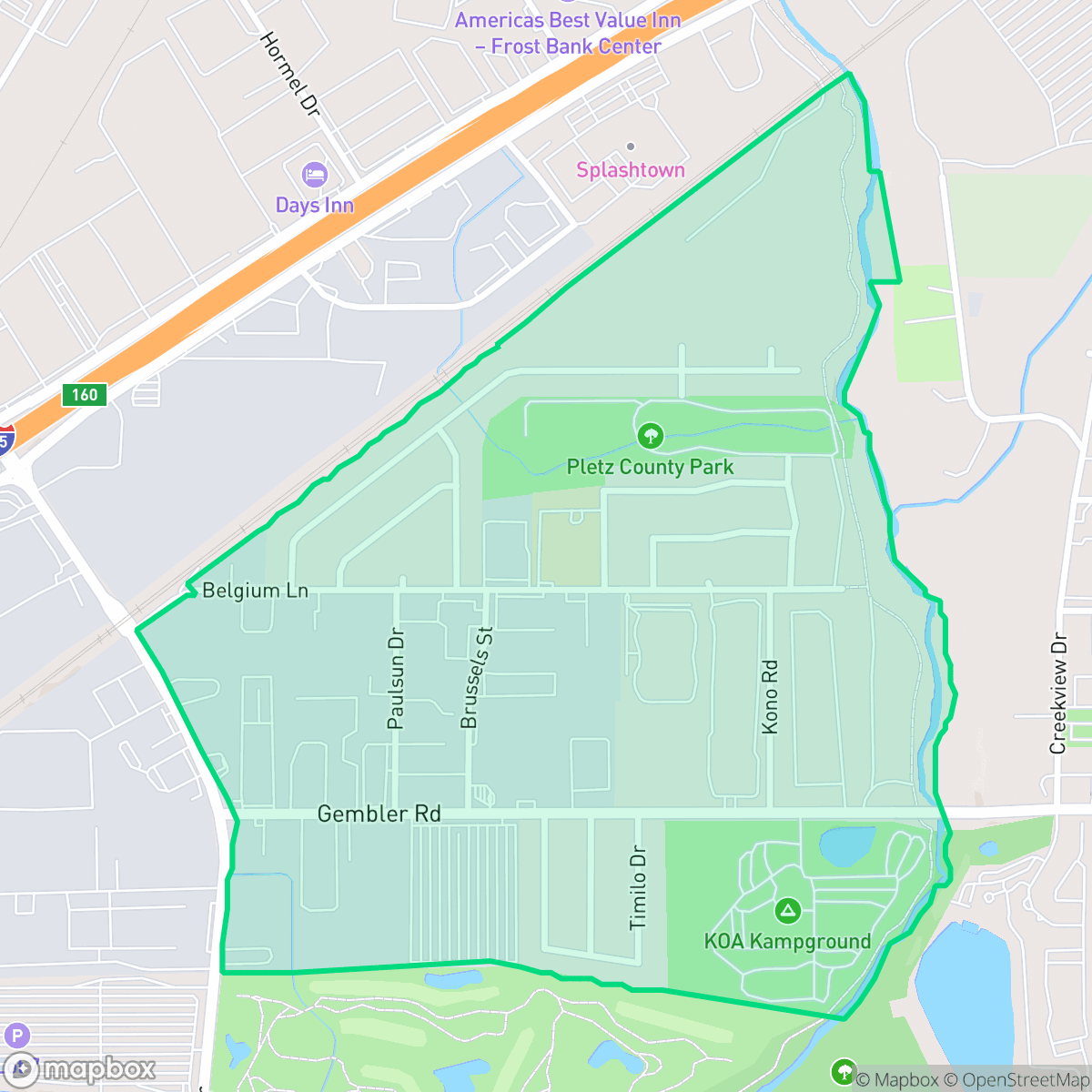
Developed in the late 1950s and early 1960s on San Antonio's East Side, the United Homeowners neighborhood—encompassing the Willowwood and Meadowview subdivisions—was established to provide high-quality housing for African American military and civil service families who had newly gained access to home mortgage loans. Because of its well-kept brick-and-mortar homes featuring driveways and garages, the neighborhood earned the historic local nickname "the Black Alamo Heights". Under the guidance of the United Homeowners Improvement Association, residents have actively preserved their mid-century residential character. This dedication is highlighted by their enforcement of historic deed restrictions and a successful 2025 campaign lobbying the San Antonio City Council to rezone 470 surrounding acres from heavy industrial to mixed-use, mitigating decades of commercial truck traffic and pollution near the Frost Bank Center.
The neighborhood is defined by its mid-century architectural roots and a layout that emphasizes residential stability over commercial convenience. The area maintains a relatively quiet acoustic profile compared to the city average, providing a calm atmosphere for its residents. However, the landscape is heavily influenced by its position within an industrial corridor, featuring significant logistics centers and storage facilities that contribute to ongoing air quality concerns. The local infrastructure reflects a mix of suburban residential tracts and industrial zones, resulting in limited walkability and few immediate commercial services.
For prospective residents, the area is best suited for those prioritizing a strong sense of community and historic residential character over proximity to retail or nightlife. While the local school district is undergoing significant structural changes, Cameron Elementary provides a high-performing option for families. Individuals considering this area should weigh the benefits of a stable, organized community against the realities of living near major industrial operations and the associated environmental impacts.
Neighborhood Scores Across 15 Qualities
Large lots with significant separation between homes provide a higher level of privacy than the San Antonio average. According to iHuus data, this spatial arrangement reduces immediate proximity to neighbors.
Quiet streets allow for easy strolling, but the lack of sidewalks makes walking less convenient than in most other parts of San Antonio. According to iHuus data, the area is less walkable than the city average.
Residential views consist of typical tract housing with uniform rooflines and modest yards. This level of visual variety is roughly in line with the San Antonio average, according to iHuus data.
Connected green spaces and wide, traffic-safe paths make this area more dog-friendly than the San Antonio average, according to iHuus data.
Frequent open land and scattered homes amidst woodland or fields define the area, offering a slightly more rural feel than the San Antonio average. According to iHuus data, the landscape consists of a mix of low-density industrial zones and modest residential clusters.
Primarily residential and industrial in character, this area lacks significant commercial activity and feels much more tranquil than the San Antonio average. Very few local destinations or dining options exist within the neighborhood, making it a car-dependent landscape.
A steady hum of local traffic from nearby busy streets defines the soundscape. This level of acoustic activity is notably higher than the San Antonio average, according to iHuus data.
Frequent unhealthy air quality levels pose a significant risk to sensitive groups; according to iHuus data, these conditions are slightly worse than the San Antonio average.
Heavy logistics hubs, rail lines, and large-scale warehousing are located near the neighborhood, resulting in much higher levels of truck traffic and noise than typical for San Antonio. This area contains significant industrial infrastructure, including chemical storage and large commercial operations, according to iHuus data.
Health insurance coverage is significantly lower than the San Antonio average. Residents may face greater difficulty accessing employer-sponsored or private medical plans according to iHuus data.
Voting patterns and census indicators reflect a significantly more liberal leaning than the San Antonio average, according to iHuus data.
A diverse range of age groups resides here, including young adults, families, and older residents. This demographic distribution is slightly lower than the San Antonio average according to iHuus data.
Properties within this area are situated inside a designated floodplain, which implies a significantly higher risk of flooding compared to the San Antonio average. Residents should be aware that flood insurance is typically required for homes in this neighborhood according to iHuus data.
Address-Level Insights for United Homeowners


iHuus Neighborhood Intelligence Insights
Get address-level neighborhood insights for United Homeowners
- Street-level scores — see how individual blocks compare, not just neighborhood averages
- Micro-zone boundaries — identify quiet pockets, flood boundaries, and walkable clusters before you visit
- 15 dimensions in full — walkability, noise, air quality, school quality, insurance coverage, population age profile, urban/rural index, and more
- Boundary risk alerts — know if your address sits near a block boundary where scores drop, the kind of detail no listing will ever mention
- School insights — individual school ratings and insights, not just district-level data
- Compare before you commit — side-by-side data across neighborhoods, down to block precision
No credit card required
Compare with Any Neighborhood
| Dimension | United Homeowners | 145 Association |
|---|---|---|
| 🚶 Walkabilityavg 6.44 | ||
| 🔊 Acoustic Comfortavg 4.07 | ||
| 🤫 Privacy Indexavg 5.75 | ||
| 🎨 Visual Appealavg 6.11 | ||
| 🐕 Dog Friendlinessavg 5.91 | ||
| 🗺️ Urban-Rural Indexavg 6.87 | ||
| ✨ Neighborhood Vibeavg 4.35 | ||
| 🏥 Health Insurance Coverageavg 5.94 | ||
| 🌿 Air Qualityavg 2.27 | ||
| 🏭 Industrial Proximityavg 8.31 | ||
| 🌊 Flood Safetyavg 4.2 | ||
| 🗳️ Ideological Leanavg 7.37 | ||
| 👥 Population Age Profileavg 4.68 | ||
| 🔥 Fire Safety | ||
| 🏫 School Quality |
United Homeowners Rankings
School Districts Serving United Homeowners
School Insights for United Homeowners
Below average outcomes; significant attendance and academic challenges.
School Insights
See what's really behind every school rating near United Homeowners
- Individual school ratings — each school's own score with outcome context, not just a district average
- Enrollment & class size data — student-to-teacher ratio and how it compares to the state average
- Full demographics breakdown — ethnicity and gender composition for every school in the enrollment zone
- Every school in the district — all schools within the enrollment boundary ranked by rating, not just the closest one
- Grade levels & benchmarks — elementary through high school, with below/above state-average flags
No credit card required