Tobin Hill, San Antonio
Updated · 4,794 residents
Tobin Hill is a vibrant, centrally located neighborhood known for its high-energy atmosphere and proximity to major culinary and entertainment hubs like the Pearl District. While the area offers high walkability and a progressive community spirit, residents should be prepared for significant noise from road traffic and limited privacy.
Key Highlights
About Tobin Hill
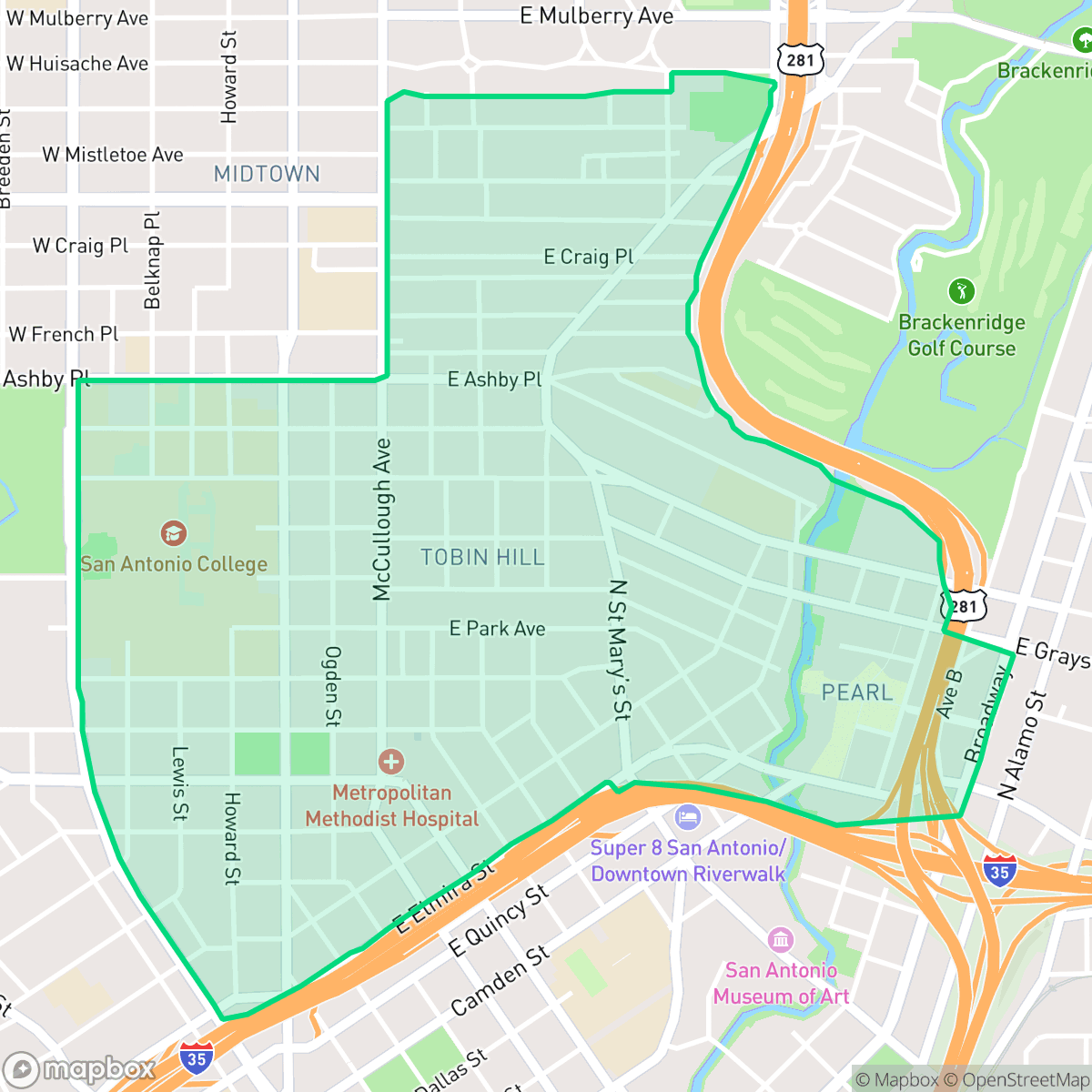
Located just north of downtown San Antonio, Tobin Hill emerged in the late 19th century on land subdivided from the 1876 Gillum Addition. It was named after William G. Tobin, who built an estate here in 1883, followed by several family members. The introduction of mule-drawn streetcars in 1878 and electric trolleys in 1890 accelerated growth, resulting in a diverse architectural mix of Victorian mansions, Craftsman bungalows, and American Foursquare homes. Designated a historic district in 2008, the neighborhood features Belknap Place, home to the oldest existing concrete pavement in Texas (1914). Tobin Hill is also defined by the historic Pearl Brewery (established 1886), now a major mixed-use hub, the vibrant St. Mary’s Strip entertainment corridor, and the historic LGBTQ+ cultural hub along North Main Avenue.
The neighborhood serves as a central hub for San Antonio culture, blending residential life with active commercial corridors. It maintains a distinct identity defined by its high level of social engagement and a notable progressive ideological lean. Residents enjoy convenient access to diverse local dining options and a lively social scene, though the area faces challenges related to urban density. The proximity to major thoroughfares contributes to elevated noise levels, and the lack of natural privacy is a common trade-off for living in such a connected, high-traffic environment.
Prospective residents should carefully consider the infrastructure and environmental factors of the area. While the neighborhood boasts excellent access to specialized educational institutions like Travis Early College High School, it is situated within a district currently undergoing significant academic restructuring. Furthermore, the area is prone to flood risks and experiences lower air quality compared to the city average. It is best suited for individuals who prioritize convenience, social activity, and urban accessibility over quiet, secluded living.
Neighborhood Scores Across 15 Qualities
Residential structures often sit in close proximity with limited buffer between neighbors. This level of density is slightly higher than the San Antonio average, according to iHuus data.
Pedestrian navigation is easy thanks to a consistent grid of sidewalks and safe residential crossings. This level of walkability is notably higher than the San Antonio average, particularly near the university campus infrastructure.
Residential streets feature typical boxy rooflines and modest yards, though some areas contain larger homes with manicured landscaping and private pools. This visual character is slightly above the San Antonio average according to iHuus data.
Large parks and sports fields in the southern quadrant offer excellent exercise opportunities for pets. While some areas feature narrow sidewalks and highway barriers, the neighborhood remains slightly more dog friendly than the San Antonio average according to iHuus data.
Residential blocks feature a dense mix of low-rise housing and commercial buildings, providing a more urban feel than the city average. According to iHuus data, the area is characterized by a developed street grid rather than open land or woodland.
Frequent concentrations of local dining, coffee shops, and community landmarks create a noticeably more lively atmosphere than the San Antonio average. While some areas offer high-energy urban blocks, much of the neighborhood consists of suburban streets where enjoying these social hubs typically requires a car.
Steady traffic sounds from nearby busy streets are common here, which is roughly in line with the typical noise levels found across San Antonio.
Frequent unhealthy air quality levels pose a significant risk to sensitive groups. According to iHuus data, the air quality in Tobin Hill is slightly worse than the San Antonio average.
Primarily residential and institutional land uses define the area, offering a quiet environment with very little heavy industry. According to iHuus data, the neighborhood is slightly better positioned than the San Antonio average regarding proximity to industrial zones.
Health insurance access is notably higher in Tobin Hill than the San Antonio average. According to iHuus data, a significant majority of the local population maintains coverage.
Voting patterns and census indicators in Tobin Hill reflect a significantly more liberal leaning than the San Antonio average, according to iHuus data.
A balanced mix of young adults, families, and seniors characterizes the area. According to iHuus data, this demographic spread is slightly more varied than the typical San Antonio profile.
Properties in this area are situated within a high-risk floodplain, making flood insurance a typical requirement for residents. According to iHuus data, the susceptibility to flooding here is notably higher than the San Antonio average.
Address-Level Insights for Tobin Hill


iHuus Neighborhood Intelligence Insights
Get address-level neighborhood insights for Tobin Hill
- Street-level scores — see how individual blocks compare, not just neighborhood averages
- Micro-zone boundaries — identify quiet pockets, flood boundaries, and walkable clusters before you visit
- 15 dimensions in full — walkability, noise, air quality, school quality, insurance coverage, population age profile, urban/rural index, and more
- Boundary risk alerts — know if your address sits near a block boundary where scores drop, the kind of detail no listing will ever mention
- School insights — individual school ratings and insights, not just district-level data
- Compare before you commit — side-by-side data across neighborhoods, down to block precision
No credit card required
Compare with Any Neighborhood
| Dimension | Tobin Hill | 145 Association |
|---|---|---|
| 🚶 Walkabilityavg 6.44 | ||
| 🔊 Acoustic Comfortavg 4.07 | ||
| 🤫 Privacy Indexavg 5.75 | ||
| 🎨 Visual Appealavg 6.11 | ||
| 🐕 Dog Friendlinessavg 5.91 | ||
| 🗺️ Urban-Rural Indexavg 6.87 | ||
| ✨ Neighborhood Vibeavg 4.35 | ||
| 🏥 Health Insurance Coverageavg 5.94 | ||
| 🌿 Air Qualityavg 2.27 | ||
| 🏭 Industrial Proximityavg 8.31 | ||
| 🌊 Flood Safetyavg 4.2 | ||
| 🗳️ Ideological Leanavg 7.37 | ||
| 👥 Population Age Profileavg 4.68 | ||
| 🔥 Fire Safety | ||
| 🏫 School Quality |
Tobin Hill Rankings
School Districts Serving Tobin Hill
School Insights for Tobin Hill
Below average outcomes; significant attendance and academic challenges.
School Insights
See what's really behind every school rating near Tobin Hill
- Individual school ratings — each school's own score with outcome context, not just a district average
- Enrollment & class size data — student-to-teacher ratio and how it compares to the state average
- Full demographics breakdown — ethnicity and gender composition for every school in the enrollment zone
- Every school in the district — all schools within the enrollment boundary ranked by rating, not just the closest one
- Grade levels & benchmarks — elementary through high school, with below/above state-average flags
No credit card required