Thunderbird Hills, San Antonio
Updated · 9,624 residents
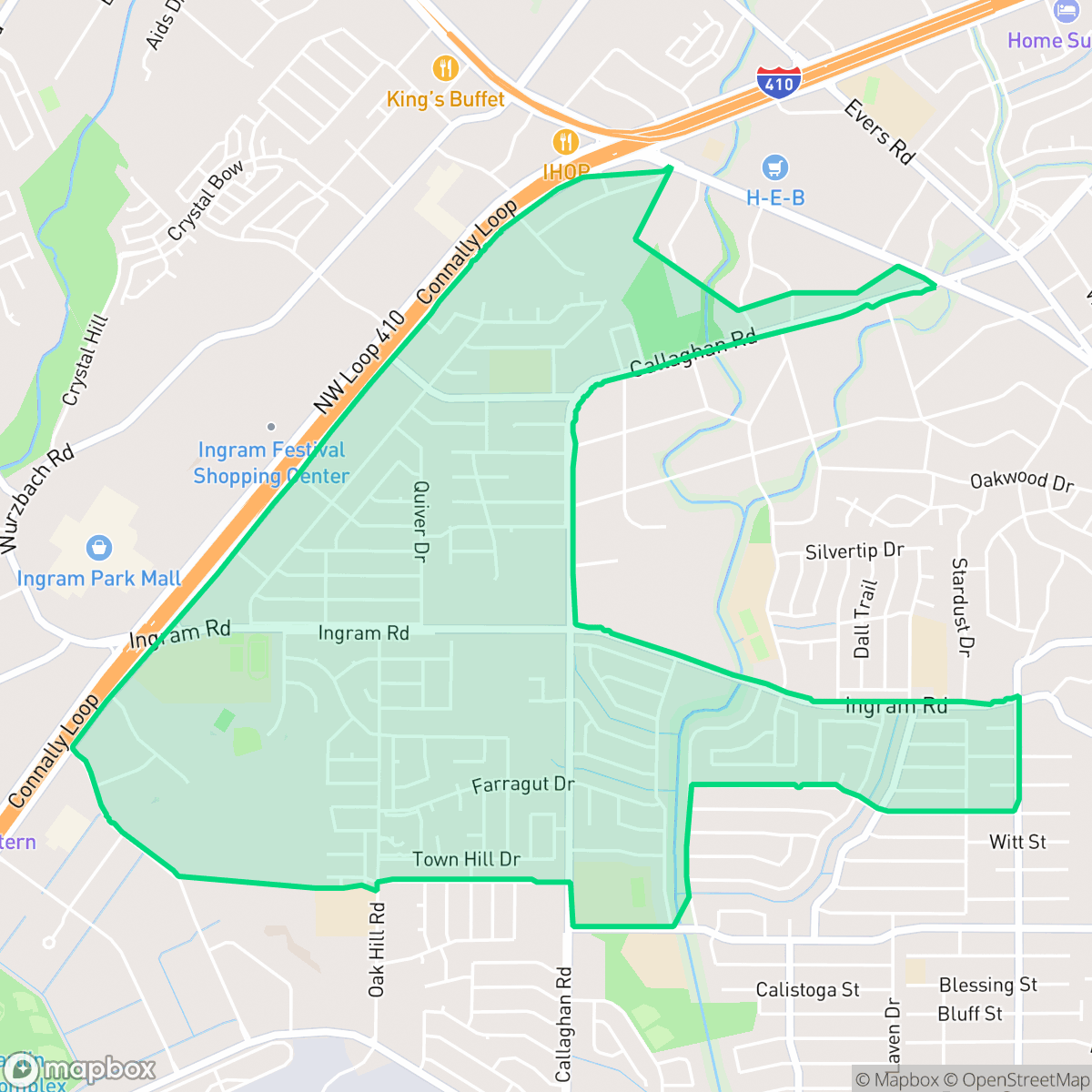
Thunderbird Hills is an established Northwest San Antonio community defined by its mid-century stone-clad ranch homes and quiet, suburban atmosphere. While the area offers a walkable residential layout, it remains car-dependent for most daily errands due to its proximity to major highway corridors.
Key Highlights
About Thunderbird Hills
Nestled just inside Interstate 410 on San Antonio’s near Northwest Side, Thunderbird Hills is an established neighborhood developed from the late 1960s through the early 1980s. The community is characterized by its unique, stone-clad ranch-style homes, many of which remain occupied by original owners or their descendants. A central hub of the neighborhood is Jane Dubel Park (formerly Thunderbird Hills Park), named in honor of one of the neighborhood association’s founding mothers who spearheaded its creation. The community's history is also reflected in its local institutions, such as Lawrence Powell Elementary School, named after an original neighborhood resident. Today, Thunderbird Hills retains its quiet, close-knit suburban character while offering convenient access to the surrounding city.
The neighborhood features a mix of single-family residences and apartment complexes, contributing to a dense suburban environment. Residents benefit from integrated green spaces and local parks, though the overall acoustic environment is influenced by consistent road traffic noise from nearby highway systems. According to iHuus data, the area maintains a moderate level of urban-rural integration, balancing residential streets with pockets of light commercial activity that provide essential services.
Prospective residents should consider that the area is primarily car-oriented, as major retail and dining hubs are often separated from residential blocks by significant traffic barriers. While the neighborhood provides access to the Northside Independent School District, families should be aware of varying school ratings and environmental factors, including air quality and flood safety considerations. It is best suited for those seeking an established, budget-conscious suburban setting with straightforward access to the San Antonio interstate loop.
Neighborhood Scores Across 15 Qualities
Neighboring structures feature varying distances, with some single-family homes located quite close to others and some apartment complexes situated near residential streets. This density level is roughly in line with the San Antonio average, according to iHuus data.
Sidewalks are present on many residential streets and near local schools, though large commercial lots and highway proximity create some barriers for pedestrians. This level of walkability is roughly in line with the San Antonio average, according to iHuus data.
Standard tract housing and apartment complexes define the landscape, featuring uniform rooflines and modest yards. This area presents a visual character slightly below the San Antonio average according to iHuus data.
Wide residential verges and access to a large central greenway provide reliable routes for dog walking. According to iHuus data, these features offer slightly less pet-friendly infrastructure than the San Antonio average.
Residential areas feature a mix of single-family homes and apartment complexes integrated with large-scale retail and school campuses. This landscape offers slightly more open land and natural tracts than the typical San Antonio urban density.
Suburban streets and light industrial corridors create a steady but low-key rhythm, with most dining and essential services requiring a vehicle to access. This atmosphere is roughly in line with the typical activity levels found throughout San Antonio.
Steady traffic sounds from a nearby busy street are present, though the acoustic level is slightly more noticeable than the San Antonio average according to iHuus data.
Frequent unhealthy air quality levels pose a significant risk to sensitive groups. According to iHuus data, air conditions in this area are worse than the San Antonio average.
Largely residential and light commercial, this area lacks heavy industrial presence and significant freight traffic. While the neighborhood is slightly more exposed to industrial proximity than the San Antonio average, there is no visible heavy industry or large-scale warehousing nearby.
Health insurance enrollment in this area is slightly lower than the San Antonio average, according to iHuus data.
Voting patterns and census indicators in this area reflect a significantly more liberal leaning than the San Antonio average, according to iHuus data.
Residents live alongside a balanced mix of young adults, families, and older populations. This demographic spread is slightly more varied than the average seen across San Antonio, according to iHuus data.
Flood risk levels in this area are currently undetermined because detailed FEMA studies have not been completed for this location. This level of uncertainty is roughly in line with the average risk found across San Antonio.
Address-Level Insights for Thunderbird Hills


iHuus Neighborhood Intelligence Insights
Get address-level neighborhood insights for Thunderbird Hills
- Street-level scores — see how individual blocks compare, not just neighborhood averages
- Micro-zone boundaries — identify quiet pockets, flood boundaries, and walkable clusters before you visit
- 15 dimensions in full — walkability, noise, air quality, school quality, insurance coverage, population age profile, urban/rural index, and more
- Boundary risk alerts — know if your address sits near a block boundary where scores drop, the kind of detail no listing will ever mention
- School insights — individual school ratings and insights, not just district-level data
- Compare before you commit — side-by-side data across neighborhoods, down to block precision
No credit card required
Compare with Any Neighborhood
| Dimension | Thunderbird Hills | 145 Association |
|---|---|---|
| 🚶 Walkabilityavg 6.44 | ||
| 🔊 Acoustic Comfortavg 4.07 | ||
| 🤫 Privacy Indexavg 5.75 | ||
| 🎨 Visual Appealavg 6.11 | ||
| 🐕 Dog Friendlinessavg 5.91 | ||
| 🗺️ Urban-Rural Indexavg 6.87 | ||
| ✨ Neighborhood Vibeavg 4.35 | ||
| 🏥 Health Insurance Coverageavg 5.94 | ||
| 🌿 Air Qualityavg 2.27 | ||
| 🏭 Industrial Proximityavg 8.31 | ||
| 🌊 Flood Safetyavg 4.2 | ||
| 🗳️ Ideological Leanavg 7.37 | ||
| 👥 Population Age Profileavg 4.68 | ||
| 🔥 Fire Safety | ||
| 🏫 School Quality |
Thunderbird Hills Rankings
School Districts Serving Thunderbird Hills
School Insights for Thunderbird Hills
Below average outcomes; significant attendance and academic challenges.
School Insights
See what's really behind every school rating near Thunderbird Hills
- Individual school ratings — each school's own score with outcome context, not just a district average
- Enrollment & class size data — student-to-teacher ratio and how it compares to the state average
- Full demographics breakdown — ethnicity and gender composition for every school in the enrollment zone
- Every school in the district — all schools within the enrollment boundary ranked by rating, not just the closest one
- Grade levels & benchmarks — elementary through high school, with below/above state-average flags
No credit card required