Thousand Oaks, San Antonio
Updated · 3,598 residents
Thousand Oaks is a quiet, tree-lined suburb in northeast San Antonio characterized by its mature oak canopy and proximity to the expansive McAllister Park. While the area offers a highly walkable residential environment with excellent dog-friendly spaces, residents should be aware of elevated road noise levels and potential flood risks.
Key Highlights
About Thousand Oaks
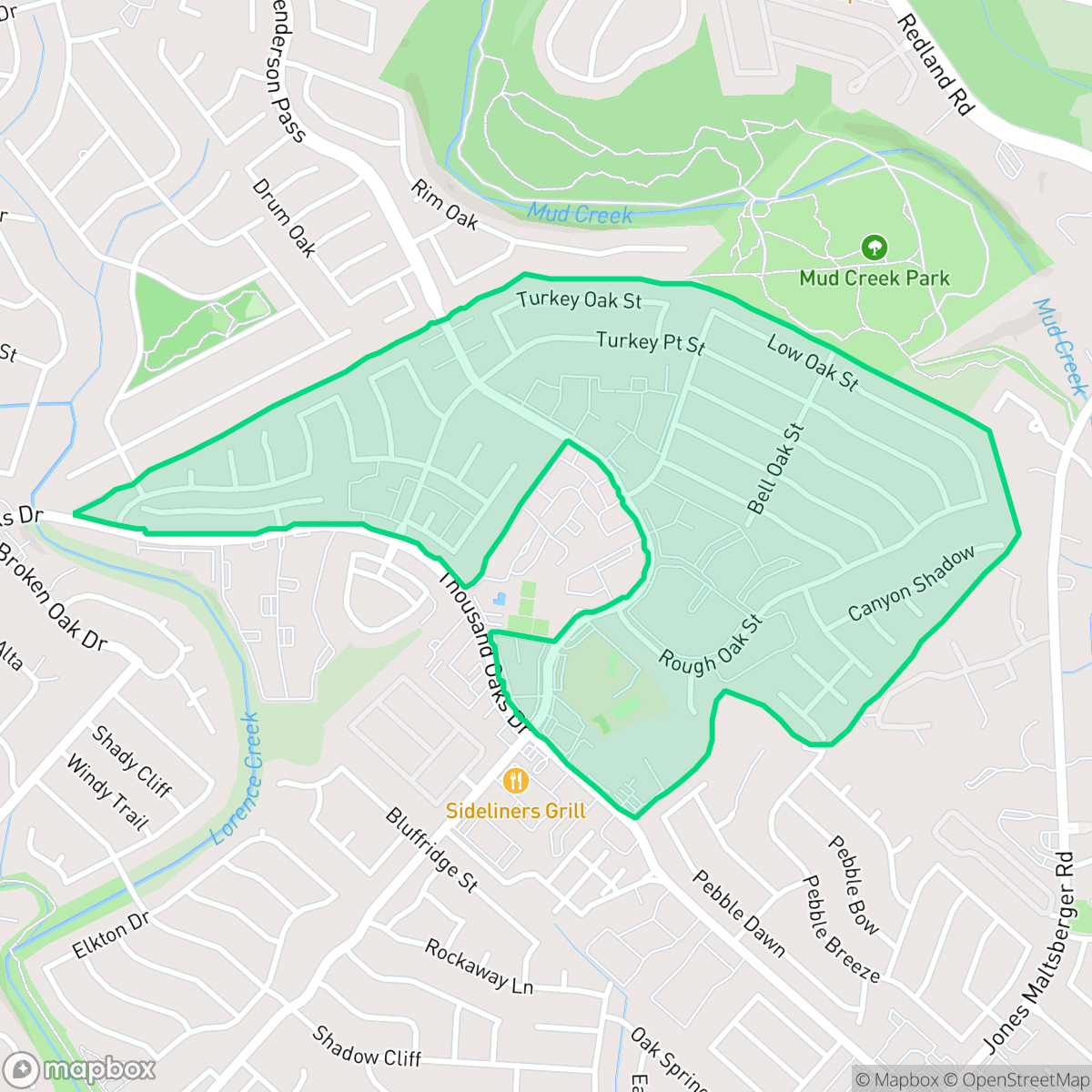
The Thousand Oaks neighborhood in northeast San Antonio, Texas, sits on land deeply rooted in post-emancipation African American history. In the late 19th century, this area was part of the Wetmore settlement, where formerly enslaved Black farmers and ranchers collectively owned more than 1,200 acres of land. A prominent local landmark of this era is the Griffin Family Cemetery, established around 1900 on 300 acres purchased by Ellis Griffin in 1896. Today, the cemetery is preserved near the intersection of Thousand Oaks Drive and Tavern Oaks Street. The modern residential neighborhood developed primarily between 1970 and 1999, characterized by its abundant mature oak trees, a unique layout of connected townhomes, and its proximity to the sprawling McAllister Park.
This neighborhood features a dense suburban layout that blends single-family homes with multi-story apartment complexes, creating a visually appealing environment defined by its greenery and mature trees. The area is highly regarded for its pedestrian-friendly streets and consistent sidewalk network, which makes it a practical choice for those who enjoy outdoor exercise or walking pets. Families are particularly drawn to the location due to its position within the North East Independent School District, which maintains a strong reputation for academic performance and college readiness programs.
Prospective residents should consider a few trade-offs, as the area experiences higher than average road traffic noise and faces challenges regarding air quality and flood safety. While the neighborhood provides a peaceful residential atmosphere, it lacks a high density of commercial businesses within immediate walking distance. It is best suited for individuals or families who prioritize access to top-tier public schools and nearby recreational hubs like McAllister Park over proximity to urban nightlife or commercial centers.
Neighborhood Scores Across 15 Qualities
Residential spacing provides a moderate level of separation between neighbors, which is slightly higher than the San Antonio average. According to iHuus data, the area features a mix of multi-family units and detached homes with varying wooded buffers.
Sidewalks are well established along main arteries and residential streets, providing a safer environment for walking than the San Antonio average. Low traffic volumes and integrated crossings further support ease of movement, though dense tree canopy sometimes obscures the walkway paths.
Large homes, private pools, and well-maintained landscaping characterize the area. According to iHuus data, the visual quality of the neighborhood is significantly higher than the San Antonio average.
Abundant tree canopy and a central wooded greenbelt provide expansive, shaded areas for pet exercise. According to iHuus data, the presence of wide roadside verges and connected green spaces makes this area significantly more dog friendly than the San Antonio average.
Frequent open land and significant vegetation coverage provide a semi-rural feel that is slightly more open than the San Antonio average. Residents will find a landscape characterized by scattered homes, woodlands, and a mix of suburban sprawl and medium-density apartment complexes.
Steady local activity is balanced by serene green spaces and low-density residential streets. This area offers a slightly more active mix of essential services and dining than the San Antonio average, though most amenities still require a car to reach.
Frequent noise from nearby major roadways and transit routes is common here. According to iHuus data, acoustic levels are higher than the San Antonio average.
Frequent unhealthy air quality levels pose significant risks to sensitive groups; this neighborhood experiences air quality that is slightly worse than the San Antonio average, according to iHuus data.
Industrial activity and large warehouses are absent from this area. According to iHuus data, the neighborhood contains only residential and light commercial zones, making it significantly cleaner than the San Antonio average in terms of industrial proximity.
Health insurance access is significantly higher than the San Antonio average, according to iHuus data. Residents in this area benefit from much broader coverage rates than the citywide norm.
Political leanings in this area are more evenly split between conservative and liberal residents than the broader San Antonio area. According to iHuus data, the neighborhood lacks the strong partisan tilt seen in much of the city.
A diverse range of age groups lives here, providing a more balanced demographic spread than the San Antonio average. According to iHuus data, this distribution includes a steady mix of young professionals, families, and older adults.
Flood risk in this area remains difficult to assess because official federal studies are currently incomplete. According to iHuus data, the level of risk is roughly in line with the San Antonio average.
Address-Level Insights for Thousand Oaks


iHuus Neighborhood Intelligence Insights
Get address-level neighborhood insights for Thousand Oaks
- Street-level scores — see how individual blocks compare, not just neighborhood averages
- Micro-zone boundaries — identify quiet pockets, flood boundaries, and walkable clusters before you visit
- 15 dimensions in full — walkability, noise, air quality, school quality, insurance coverage, population age profile, urban/rural index, and more
- Boundary risk alerts — know if your address sits near a block boundary where scores drop, the kind of detail no listing will ever mention
- School insights — individual school ratings and insights, not just district-level data
- Compare before you commit — side-by-side data across neighborhoods, down to block precision
No credit card required
Compare with Any Neighborhood
| Dimension | Thousand Oaks | 145 Association |
|---|---|---|
| 🚶 Walkabilityavg 6.44 | ||
| 🔊 Acoustic Comfortavg 4.07 | ||
| 🤫 Privacy Indexavg 5.75 | ||
| 🎨 Visual Appealavg 6.11 | ||
| 🐕 Dog Friendlinessavg 5.91 | ||
| 🗺️ Urban-Rural Indexavg 6.87 | ||
| ✨ Neighborhood Vibeavg 4.35 | ||
| 🏥 Health Insurance Coverageavg 5.94 | ||
| 🌿 Air Qualityavg 2.27 | ||
| 🏭 Industrial Proximityavg 8.31 | ||
| 🌊 Flood Safetyavg 4.2 | ||
| 🗳️ Ideological Leanavg 7.37 | ||
| 👥 Population Age Profileavg 4.68 | ||
| 🔥 Fire Safety | ||
| 🏫 School Quality |
Thousand Oaks Rankings
School Districts Serving Thousand Oaks
School Insights for Thousand Oaks
Below average outcomes; significant attendance and academic challenges.
School Insights
See what's really behind every school rating near Thousand Oaks
- Individual school ratings — each school's own score with outcome context, not just a district average
- Enrollment & class size data — student-to-teacher ratio and how it compares to the state average
- Full demographics breakdown — ethnicity and gender composition for every school in the enrollment zone
- Every school in the district — all schools within the enrollment boundary ranked by rating, not just the closest one
- Grade levels & benchmarks — elementary through high school, with below/above state-average flags
No credit card required