Thompson Community, San Antonio
Updated · 7,171 residents
The Thompson Community is a quiet, industrial-adjacent neighborhood southwest of downtown San Antonio that maintains a distinct working-class character. While it offers modest, detached single-family housing, residents should expect significant road noise and limited walkability due to sparse pedestrian infrastructure.
Key Highlights
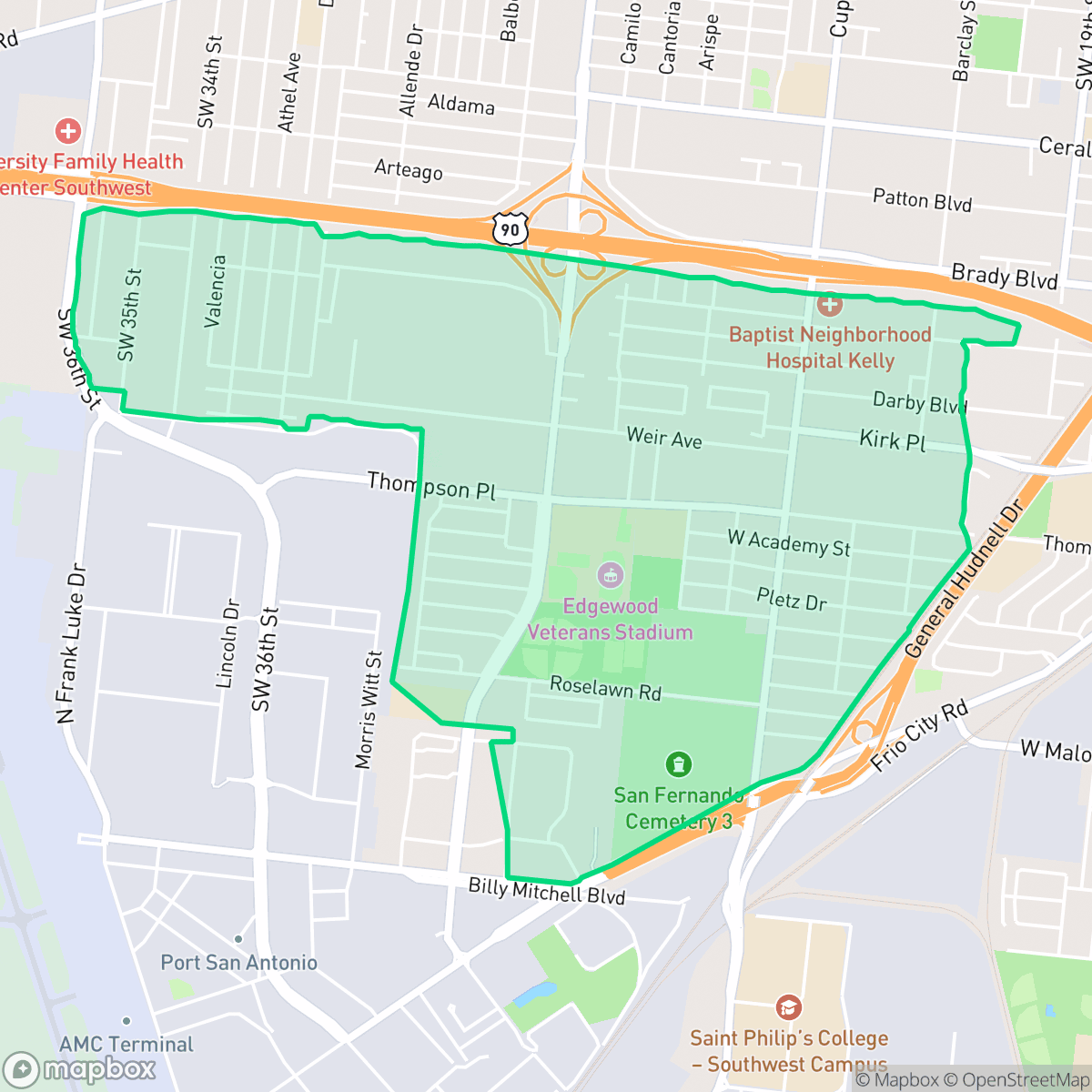
About Thompson Community
Located six miles southwest of downtown San Antonio, the Thompson Community’s history is deeply intertwined with the military. Originally rich farmland, the area was transformed in 1917 when the government purchased land to establish Camp Kelly (later Kelly Air Force Base). The neighborhood, named after its primary thoroughfare Thompson Place, developed rapidly during the 1940s, 50s, and 60s to house military personnel and civilian base workers. The closure of Kelly AFB in the 1990s severely impacted the local economy, but the community has experienced a slow revival linked to Port San Antonio. Culturally, Thompson is defined by its strong working-class roots, military pride, and local institutions like John F. Kennedy High School, Frank Mata Memorial Stadium, and Rocky’s Taco House on Cupples Road.
The area is defined by a low-density suburban layout, where residential blocks sit in close proximity to major highway interchanges and large-scale logistics warehouses. This industrial footprint contributes to a notably high ambient noise level, primarily driven by truck traffic and highway activity. While the neighborhood provides a sense of seclusion, the lack of extensive local amenities or public parks means residents often rely on personal vehicles for daily needs. According to iHuus data, the area faces specific challenges regarding flood safety and air quality, which are important considerations for prospective residents.
The neighborhood is best suited for those seeking proximity to major transit corridors and the employment hubs of Port San Antonio. Families and individuals may find the local school options inconsistent, as the area is served by districts currently navigating significant structural changes. While the community offers a stable, quiet environment, the trade-offs include a lack of pedestrian-friendly infrastructure and a reliance on neighboring areas for comprehensive commercial services.
Neighborhood Scores Across 15 Qualities
Residential lots offer a moderate amount of separation between neighbors. According to iHuus data, this level of privacy is slightly higher than the San Antonio average.
Low traffic volumes on residential streets allow for safe walking, though missing or inconsistent sidewalks make the area less walkable than the San Antonio average. Some areas near high traffic highway interchanges may feel less secure for pedestrians.
Uniform rooflines and small yards characterize this area. The visual landscape is less varied than the San Antonio average, as many properties feature modest footprints and minimal landscaping.
Greenery is mostly restricted to private backyards, and the lack of public parks or wide street verges makes walking dogs more difficult than in other parts of San Antonio. According to iHuus data, the area features narrow sidewalks and limited shared outdoor spaces for pets.
Frequent open land and scattered homes provide a semi-rural character that is slightly less dense than the San Antonio average. According to iHuus data, the area features a mix of residential blocks interspersed with large-scale warehouses and industrial corridors.
Low levels of activity and a reliance on car travel define this area, which feels more subdued than the typical San Antonio neighborhood. Residents will find a quiet, suburban atmosphere shaped by industrial corridors and essential local services, though social variety is lower than the city average.
Frequent noise from nearby freeways and railroad tracks makes this area significantly louder than the San Antonio average. According to iHuus data, residents can expect persistent acoustic disturbances throughout the day.
Frequent unhealthy air quality levels present a significant risk to sensitive groups. According to iHuus data, air quality in this area is slightly worse than the San Antonio average.
Occasional light commercial activity and nearby warehouses create more industrial presence than the San Antonio average. Some residents may experience intermittent noise from nearby logistics hubs and truck traffic.
Health insurance coverage among residents is lower than the San Antonio average. This gap in coverage may impact local access to certain healthcare services, according to iHuus data.
Voting patterns and census indicators in Thompson Community reflect a much more liberal leaning than the San Antonio average, according to iHuus data.
A balanced mix of young adults, families, and older residents characterizes the area, reflecting a demographic profile very similar to the San Antonio average.
Property is located within a designated 100-year floodplain, which represents a significantly higher flood risk than the San Antonio average. According to iHuus data, residents should expect that flood insurance is typically required for homes in this area.
Address-Level Insights for Thompson Community


iHuus Neighborhood Intelligence Insights
Get address-level neighborhood insights for Thompson Community
- Street-level scores — see how individual blocks compare, not just neighborhood averages
- Micro-zone boundaries — identify quiet pockets, flood boundaries, and walkable clusters before you visit
- 15 dimensions in full — walkability, noise, air quality, school quality, insurance coverage, population age profile, urban/rural index, and more
- Boundary risk alerts — know if your address sits near a block boundary where scores drop, the kind of detail no listing will ever mention
- School insights — individual school ratings and insights, not just district-level data
- Compare before you commit — side-by-side data across neighborhoods, down to block precision
No credit card required
Compare with Any Neighborhood
| Dimension | Thompson Community | 145 Association |
|---|---|---|
| 🚶 Walkabilityavg 6.44 | ||
| 🔊 Acoustic Comfortavg 4.07 | ||
| 🤫 Privacy Indexavg 5.75 | ||
| 🎨 Visual Appealavg 6.11 | ||
| 🐕 Dog Friendlinessavg 5.91 | ||
| 🗺️ Urban-Rural Indexavg 6.87 | ||
| ✨ Neighborhood Vibeavg 4.35 | ||
| 🏥 Health Insurance Coverageavg 5.94 | ||
| 🌿 Air Qualityavg 2.27 | ||
| 🏭 Industrial Proximityavg 8.31 | ||
| 🌊 Flood Safetyavg 4.2 | ||
| 🗳️ Ideological Leanavg 7.37 | ||
| 👥 Population Age Profileavg 4.68 | ||
| 🔥 Fire Safety | ||
| 🏫 School Quality |
Thompson Community Rankings
School Districts Serving Thompson Community
School Insights for Thompson Community
Below average outcomes; significant attendance and academic challenges.
School Insights
See what's really behind every school rating near Thompson Community
- Individual school ratings — each school's own score with outcome context, not just a district average
- Enrollment & class size data — student-to-teacher ratio and how it compares to the state average
- Full demographics breakdown — ethnicity and gender composition for every school in the enrollment zone
- Every school in the district — all schools within the enrollment boundary ranked by rating, not just the closest one
- Grade levels & benchmarks — elementary through high school, with below/above state-average flags
No credit card required