The Springs at Stone Oak-Stone Oak, San Antonio
Updated · 111 residents
The Springs at Stone Oak is a gated, low-density enclave characterized by traditional brick architecture and quiet, manicured streets. While the area offers high levels of privacy and a strong sense of community, residents should expect notable noise from surrounding road traffic and limited walkability.
Key Highlights
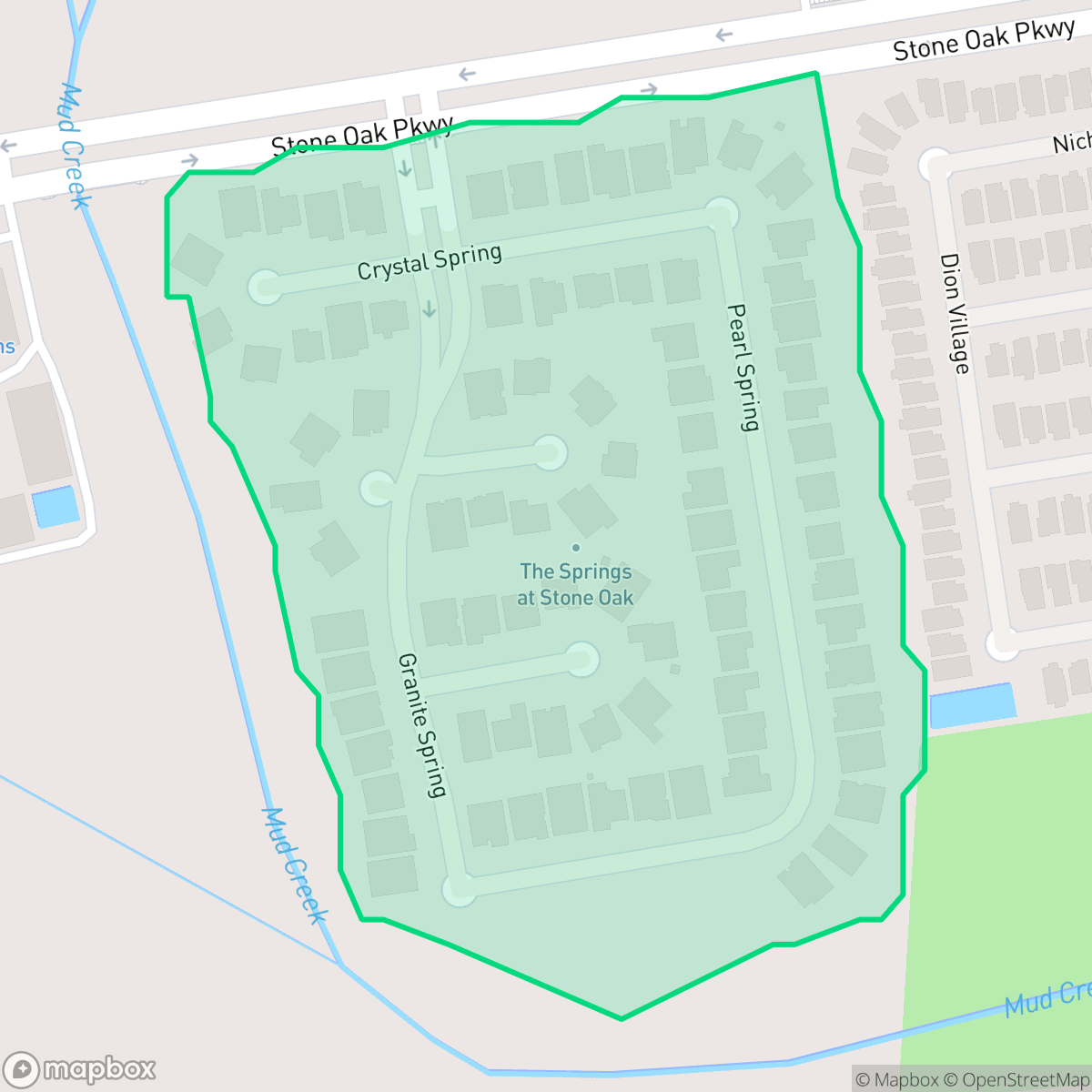
About The Springs at Stone Oak-Stone Oak
The Springs at Stone Oak is a gated residential enclave within the larger Stone Oak master-planned community in far north San Antonio. The broader Stone Oak area originated in 1985 when a development group led by Dan Parman purchased 5,000 acres of rural ranchland to establish Bexar County’s first master-planned district. Within this master plan, The Springs at Stone Oak was developed by Ryland Homes and David Weekley Homes, who opened their model homes in the subdivision in 1998. The gated community of 86 homesites was fully built out by 2002. Characterized by traditional Texas-style brick architecture and manicured landscaping, the neighborhood offers a quiet suburban atmosphere with close proximity to local landmarks like the Parman Library and Canyon Springs Golf Club.
The neighborhood functions as a secluded residential pocket within the broader Stone Oak master-planned community. Its layout emphasizes privacy and visual appeal, with well-maintained green spaces and a suburban atmosphere that leans toward a rural feel. Residents benefit from high rates of health insurance coverage and proximity to local resources like the Parman Library and Canyon Springs Golf Club.
Prospective residents should consider the trade-offs associated with this location. While the area is highly dog-friendly and safe from flooding, it experiences significant acoustic impacts from nearby road traffic. Daily errands typically require a vehicle due to limited walkability, and the neighborhood is best suited for those who prioritize a quiet, gated environment over immediate access to dense urban amenities.
Neighborhood Scores Across 15 Qualities
Large residential lots provide significant separation between homes, offering more privacy than the typical San Antonio neighborhood. According to iHuus data, this area maintains a higher degree of seclusion than the city average.
Pedestrian access is well-supported by sidewalks and safe crossings, making this area more walkable than the San Antonio average according to iHuus data.
Spacious driveways and large-scale residential architecture contribute to a high level of visual interest. According to iHuus data, the area features more frequent upscale amenities and larger lot sizes than the San Antonio average.
Connected green spaces and wide, traffic-free paths provide an environment significantly more suitable for pet owners than the San Antonio average. According to iHuus data, the area offers ample opportunities for safe walking and exercise.
Open land and scattered homes amidst woodland characterize the area, providing a landscape that is slightly more rural than the typical San Antonio setting according to iHuus data.
A peaceful suburban atmosphere prevails here, characterized by low-density spaces and steady access to local wellness services. According to iHuus data, the level of activity and local amenities is roughly comparable to the San Antonio average.
A steady hum of local traffic persists due to the proximity of a busy street. This level of acoustic activity is slightly higher than the San Antonio average, according to iHuus data.
Frequent unhealthy air quality levels pose significant risks to sensitive groups. According to iHuus data, the air quality in this area is slightly worse than the San Antonio average.
Industrial activity is nonexistent within the area, providing a landscape free of warehouses or manufacturing facilities. This lack of industrial proximity is notably higher than the San Antonio average, according to iHuus data.
Health insurance coverage among residents is higher than the San Antonio average, according to iHuus data.
Conservative voters represent the majority of the population here, reflecting a political landscape that is notably more conservative than the San Antonio average.
Residents live alongside a balanced mix of young adults, families, and seniors. According to iHuus data, the age distribution is slightly more centered around middle-aged populations than the San Antonio average.
Residual flood risk exists within this area as it sits within a 500-year floodplain; however, safety levels remain notably higher than the San Antonio average according to iHuus data.
Address-Level Insights for The Springs at Stone Oak-Stone Oak


iHuus Neighborhood Intelligence Insights
Get address-level neighborhood insights for The Springs at Stone Oak-Stone Oak
- Street-level scores — see how individual blocks compare, not just neighborhood averages
- Micro-zone boundaries — identify quiet pockets, flood boundaries, and walkable clusters before you visit
- 15 dimensions in full — walkability, noise, air quality, school quality, insurance coverage, population age profile, urban/rural index, and more
- Boundary risk alerts — know if your address sits near a block boundary where scores drop, the kind of detail no listing will ever mention
- School insights — individual school ratings and insights, not just district-level data
- Compare before you commit — side-by-side data across neighborhoods, down to block precision
No credit card required
Compare with Any Neighborhood
| Dimension | The Springs at Stone Oak-Stone Oak | 145 Association |
|---|---|---|
| 🚶 Walkabilityavg 6.44 | ||
| 🔊 Acoustic Comfortavg 4.07 | ||
| 🤫 Privacy Indexavg 5.75 | ||
| 🎨 Visual Appealavg 6.11 | ||
| 🐕 Dog Friendlinessavg 5.91 | ||
| 🗺️ Urban-Rural Indexavg 6.87 | ||
| ✨ Neighborhood Vibeavg 4.35 | ||
| 🏥 Health Insurance Coverageavg 5.94 | ||
| 🌿 Air Qualityavg 2.27 | ||
| 🏭 Industrial Proximityavg 8.31 | ||
| 🌊 Flood Safetyavg 4.2 | ||
| 🗳️ Ideological Leanavg 7.37 | ||
| 👥 Population Age Profileavg 4.68 | ||
| 🔥 Fire Safety | ||
| 🏫 School Quality |
The Springs at Stone Oak-Stone Oak Rankings
School Districts Serving The Springs at Stone Oak-Stone Oak
School Insights for The Springs at Stone Oak-Stone Oak
Below average outcomes; significant attendance and academic challenges.
School Insights
See what's really behind every school rating near The Springs at Stone Oak-Stone Oak
- Individual school ratings — each school's own score with outcome context, not just a district average
- Enrollment & class size data — student-to-teacher ratio and how it compares to the state average
- Full demographics breakdown — ethnicity and gender composition for every school in the enrollment zone
- Every school in the district — all schools within the enrollment boundary ranked by rating, not just the closest one
- Grade levels & benchmarks — elementary through high school, with below/above state-average flags
No credit card required