Sunshine Estates, San Antonio
Updated · 3,335 residents
Sunshine Estates is a quiet, residential enclave in central San Antonio known for its well-preserved mid-century ranch homes and tree-lined streets. The area offers a stable, suburban environment with low traffic noise and a strong sense of privacy, though residents should expect limited walkability and few local businesses within immediate reach.
Key Highlights
About Sunshine Estates
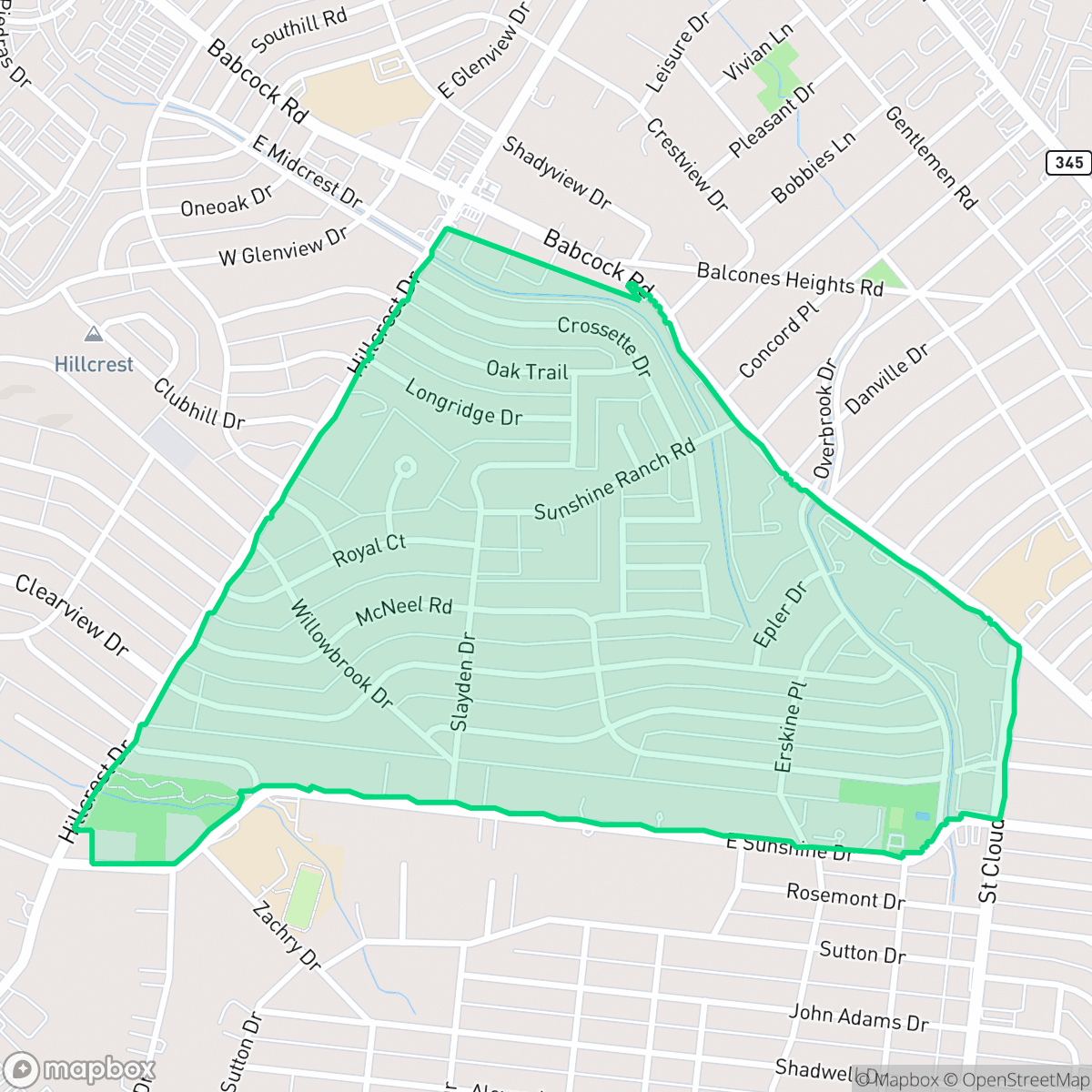
Tucked away in central San Antonio, Sunshine Estates is a quiet, well-established residential enclave developed primarily between the 1940s and 1960s. The neighborhood is highly regarded for its strong mid-century modern architectural identity, featuring classic 1950s ranch homes and mid-century designs characterized by original details like interior brick planters, clerestory windows, and traditional tiled bathrooms. Positioned between Thomas Jefferson High School and the Wonderland of the Americas mall (historically known to locals as "Crossroads"), Sunshine Estates has long maintained a tight-knit community feel. Its tree-lined streets and central location have preserved its mid-century charm, drawing residents who value the preservation of its original, groovy mid-century character.
The neighborhood serves as a tranquil pocket of San Antonio, characterized by its consistent mid-century architectural aesthetic and low-density residential layout. It benefits from a lack of heavy industrial activity and maintains a relatively peaceful atmosphere with low road noise levels. Residents enjoy a central position that provides straightforward access to major city landmarks, while the streets themselves remain largely shielded from the bustle of the urban core.
Potential residents should note that the area is primarily a driving-dependent environment with limited pedestrian infrastructure and few amenities within walking distance. While the neighborhood offers a high degree of flood safety and residential privacy, prospective families should consider the current state of the San Antonio Independent School District, which is navigating significant structural and academic transitions. According to iHuus data, the area is best suited for those who value a quiet, established suburban lifestyle and are comfortable with a commute for most daily services and recreational needs.
Neighborhood Scores Across 15 Qualities
Residential structures feature moderate density with varying distances between neighbors, offering slightly more separation than the San Antonio average. Most homes maintain clear boundaries through backyard fencing and consistent spacing between dwellings.
Low traffic volumes on residential streets provide a safe environment for walking, although the lack of continuous sidewalks makes it less walkable than the San Antonio average.
Standard tract housing and apartment blocks define the local landscape, offering modest yards and typical middle-class density. This level of visual variety is roughly in line with the San Antonio average according to iHuus data.
Public park access and wide green verges are scarce in this area, with most greenery restricted to private fenced backyards. According to iHuus data, the availability of shared outdoor space for pets is below the San Antonio average.
Residential layouts feature a blend of single-family homes and multi-story apartment clusters. This area is slightly less open than the San Antonio average, providing a denser suburban feel compared to more rural parts of the city.
Primarily a suburban landscape, this area offers a tranquil atmosphere with limited local commercial activity. Most daily errands and dining options require a vehicle, as the level of neighborhood liveliness sits slightly below the San Antonio average.
Steady sounds from nearby busy streets are noticeable, though acoustic levels remain slightly more tranquil than the San Antonio average according to iHuus data.
Frequent unhealthy air quality levels pose significant risks to sensitive groups; according to iHuus data, conditions here are worse than the San Antonio average.
Residential and light commercial uses dominate the area, with a notable absence of heavy industrial sites or large warehouses. This lack of industrial presence makes the neighborhood even quieter regarding heavy vehicle traffic than the San Antonio average, according to iHuus data.
Health insurance access among residents is lower than the San Antonio average, according to iHuus data. This indicates a higher proportion of uninsured individuals living within the area.
Voting patterns and census indicators show a distinctly liberal leaning that is notably more pronounced than the San Antonio average, according to iHuus data.
Residents live alongside a balanced mix of young adults, families, and older individuals. This demographic variety is slightly higher than the San Antonio average, according to iHuus data.
Flood risk in this area remains uncertain because official federal studies are currently incomplete. According to iHuus data, the level of risk is comparable to the rest of San Antonio.
Address-Level Insights for Sunshine Estates


iHuus Neighborhood Intelligence Insights
Get address-level neighborhood insights for Sunshine Estates
- Street-level scores — see how individual blocks compare, not just neighborhood averages
- Micro-zone boundaries — identify quiet pockets, flood boundaries, and walkable clusters before you visit
- 15 dimensions in full — walkability, noise, air quality, school quality, insurance coverage, population age profile, urban/rural index, and more
- Boundary risk alerts — know if your address sits near a block boundary where scores drop, the kind of detail no listing will ever mention
- School insights — individual school ratings and insights, not just district-level data
- Compare before you commit — side-by-side data across neighborhoods, down to block precision
No credit card required
Compare with Any Neighborhood
| Dimension | Sunshine Estates | 145 Association |
|---|---|---|
| 🚶 Walkabilityavg 6.44 | ||
| 🔊 Acoustic Comfortavg 4.07 | ||
| 🤫 Privacy Indexavg 5.75 | ||
| 🎨 Visual Appealavg 6.11 | ||
| 🐕 Dog Friendlinessavg 5.91 | ||
| 🗺️ Urban-Rural Indexavg 6.87 | ||
| ✨ Neighborhood Vibeavg 4.35 | ||
| 🏥 Health Insurance Coverageavg 5.94 | ||
| 🌿 Air Qualityavg 2.27 | ||
| 🏭 Industrial Proximityavg 8.31 | ||
| 🌊 Flood Safetyavg 4.2 | ||
| 🗳️ Ideological Leanavg 7.37 | ||
| 👥 Population Age Profileavg 4.68 | ||
| 🔥 Fire Safety | ||
| 🏫 School Quality |
Sunshine Estates Rankings
School Districts Serving Sunshine Estates
School Insights for Sunshine Estates
Below average outcomes; significant attendance and academic challenges.
School Insights
See what's really behind every school rating near Sunshine Estates
- Individual school ratings — each school's own score with outcome context, not just a district average
- Enrollment & class size data — student-to-teacher ratio and how it compares to the state average
- Full demographics breakdown — ethnicity and gender composition for every school in the enrollment zone
- Every school in the district — all schools within the enrollment boundary ranked by rating, not just the closest one
- Grade levels & benchmarks — elementary through high school, with below/above state-average flags
No credit card required