Sunny Slope, San Antonio
Updated · 4,438 residents
Sunny Slope is a quiet, suburban community in San Antonio characterized by a mix of mid-century homes and diverse residential architecture. While the area offers a peaceful environment with moderate acoustic comfort, residents face challenges regarding walkability and limited local amenities.
Key Highlights
About Sunny Slope
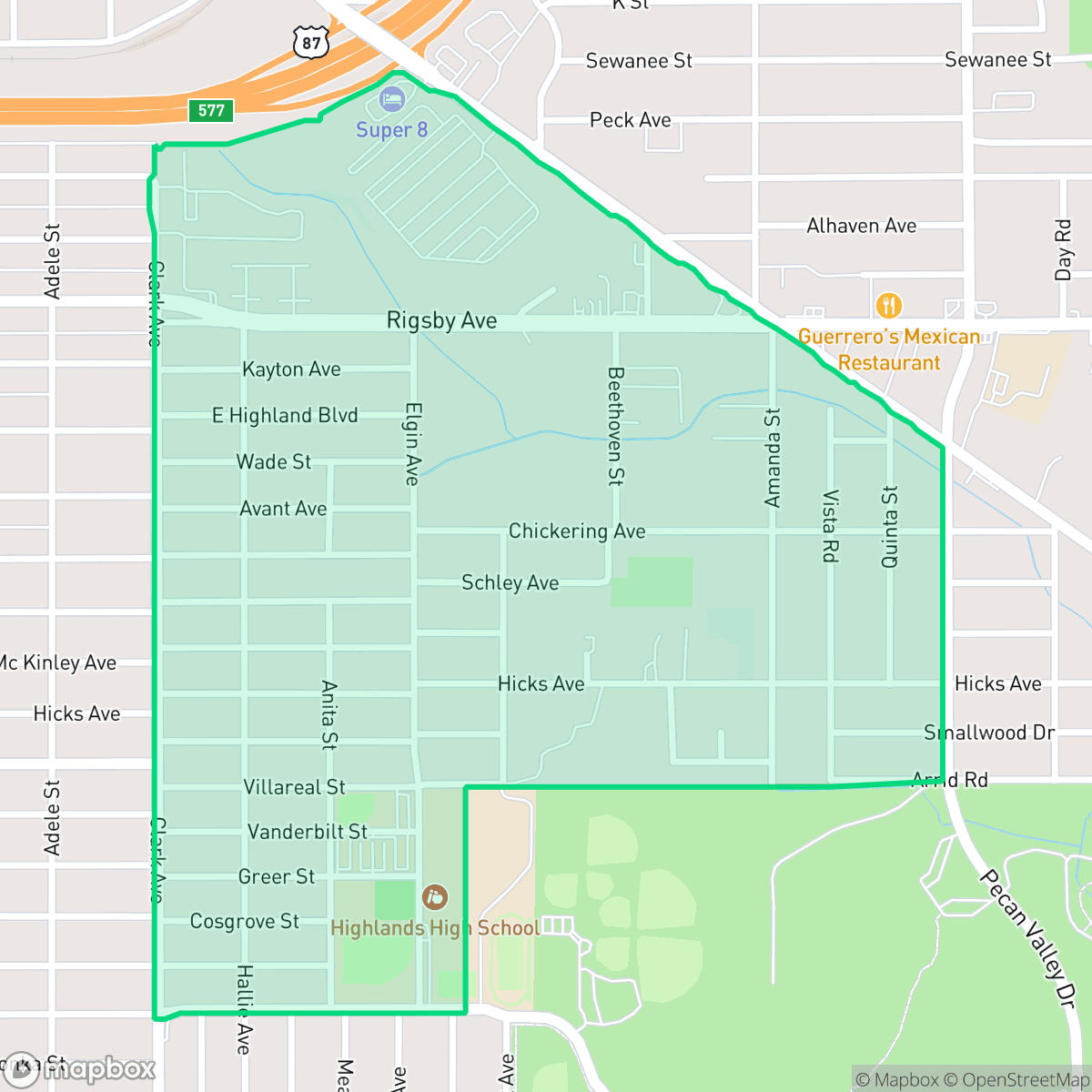
Located in San Antonio's Southeast Community Area, Sunny Slope (historically associated with Pasadena Heights) was platted around the turn of the 20th century, appearing on city maps as early as 1900. The neighborhood was officially annexed into the San Antonio city limits during the 1940s. Today, Sunny Slope is characterized by a diverse residential architectural stock, featuring classic pre-1960 homes alongside single-family detached houses built primarily between the 1960s and 1980s. Situated between Highland Hills and Pecan Valley, the quiet neighborhood maintains a strong local identity, with residents traditionally rallying around nearby community landmarks such as Highlands High School.
This neighborhood functions as a dense suburban enclave that balances residential life with nearby industrial and commercial activity. The area features a variety of housing types, ranging from older, established residences to homes built through the 1980s. According to iHuus data, the community benefits from a relatively quiet acoustic environment, with noise levels averaging 55 decibels, making it a calmer alternative to more central, high-traffic parts of the city. The presence of Highlands High School serves as a central anchor for the community, providing an educational focal point within the district. Prospective residents should note that the area presents specific trade-offs, particularly regarding infrastructure and environmental factors. Walkability is limited by inconsistent sidewalk coverage, and the neighborhood faces significant challenges related to flood safety and air quality. While it remains a budget-conscious option, the area is best suited for those who prioritize a quiet, suburban setting and are comfortable with the necessity of vehicle travel for daily errands.
Neighborhood Scores Across 15 Qualities
Housing density is slightly higher than the San Antonio average, featuring standard suburban lot sizes with limited buffer between neighbors. Some areas within Sunny Slope offer more space due to larger undeveloped lots, according to iHuus data.
Pedestrian movement is limited by a lack of consistent sidewalks and the presence of dirt shoulders on many residential streets. While the low traffic volume makes for a quiet walking environment, the connectivity is below the San Antonio average according to iHuus data.
Uniform tract housing and small lots define the area, which offers less visual variety than the San Antonio average. Observations from iHuus data show a lack of luxury landscaping and some visible debris in certain yards.
Limited public park access and narrow street verges mean walking pets requires more planning than in other parts of San Antonio. While some areas feature athletic fields and grass verges, much of the greenery consists of private yards or undeveloped land.
Residential grids featuring single-family homes and apartment complexes blend with significant commercial and industrial areas. This landscape remains very similar to the broader San Antonio area in terms of density and open space.
Local activity is largely centered around essential services and quiet residential pockets, making the area feel less active than the San Antonio average. Most amenities are spread out near highways or industrial zones, which often necessitates driving for dining and retail needs.
Steady sounds from nearby busy streets are present, though acoustic levels are notably higher than the San Antonio average. According to iHuus data, residents may experience a consistent hum of local vehicle traffic throughout the day.
Frequent unhealthy air quality levels pose a significant risk to sensitive groups. According to iHuus data, the air quality in Sunny Slope is slightly worse than the San Antonio average.
Primarily residential and light commercial, this area lacks heavy warehouses or industrial facilities. According to iHuus data, the surroundings are slightly more free from industrial activity than the San Antonio average.
Health insurance enrollment among residents is lower than the San Antonio average, according to iHuus data. This indicates a higher proportion of uninsured individuals compared to most other parts of the city.
Voting patterns and census indicators show a significantly more liberal leaning than the San Antonio average, according to iHuus data.
Residents live among a balanced distribution of young adults, families, and older populations. This demographic spread is consistent with the typical age profile found across San Antonio.
Frequent flooding is a significant concern in this area as portions of the neighborhood sit within a designated floodplain. According to iHuus data, the risk level here is higher than the San Antonio average, meaning residents should expect a likely requirement for flood insurance.
Address-Level Insights for Sunny Slope


iHuus Neighborhood Intelligence Insights
Get address-level neighborhood insights for Sunny Slope
- Street-level scores — see how individual blocks compare, not just neighborhood averages
- Micro-zone boundaries — identify quiet pockets, flood boundaries, and walkable clusters before you visit
- 15 dimensions in full — walkability, noise, air quality, school quality, insurance coverage, population age profile, urban/rural index, and more
- Boundary risk alerts — know if your address sits near a block boundary where scores drop, the kind of detail no listing will ever mention
- School insights — individual school ratings and insights, not just district-level data
- Compare before you commit — side-by-side data across neighborhoods, down to block precision
No credit card required
Compare with Any Neighborhood
| Dimension | Sunny Slope | 145 Association |
|---|---|---|
| 🚶 Walkabilityavg 6.44 | ||
| 🔊 Acoustic Comfortavg 4.07 | ||
| 🤫 Privacy Indexavg 5.75 | ||
| 🎨 Visual Appealavg 6.11 | ||
| 🐕 Dog Friendlinessavg 5.91 | ||
| 🗺️ Urban-Rural Indexavg 6.87 | ||
| ✨ Neighborhood Vibeavg 4.35 | ||
| 🏥 Health Insurance Coverageavg 5.94 | ||
| 🌿 Air Qualityavg 2.27 | ||
| 🏭 Industrial Proximityavg 8.31 | ||
| 🌊 Flood Safetyavg 4.2 | ||
| 🗳️ Ideological Leanavg 7.37 | ||
| 👥 Population Age Profileavg 4.68 | ||
| 🔥 Fire Safety | ||
| 🏫 School Quality |
Sunny Slope Rankings
School Districts Serving Sunny Slope
School Insights for Sunny Slope
Below average outcomes; significant attendance and academic challenges.
School Insights
See what's really behind every school rating near Sunny Slope
- Individual school ratings — each school's own score with outcome context, not just a district average
- Enrollment & class size data — student-to-teacher ratio and how it compares to the state average
- Full demographics breakdown — ethnicity and gender composition for every school in the enrollment zone
- Every school in the district — all schools within the enrollment boundary ranked by rating, not just the closest one
- Grade levels & benchmarks — elementary through high school, with below/above state-average flags
No credit card required