Stone Oak, San Antonio
Updated · 12,674 residents
Stone Oak is characterized by its rolling Hill Country terrain and master-planned layout that balances residential subdivisions with accessible commercial hubs. While the area offers high visual appeal and well-regarded schools, residents should expect a car-dependent lifestyle with moderate noise levels from nearby road traffic.
Key Highlights
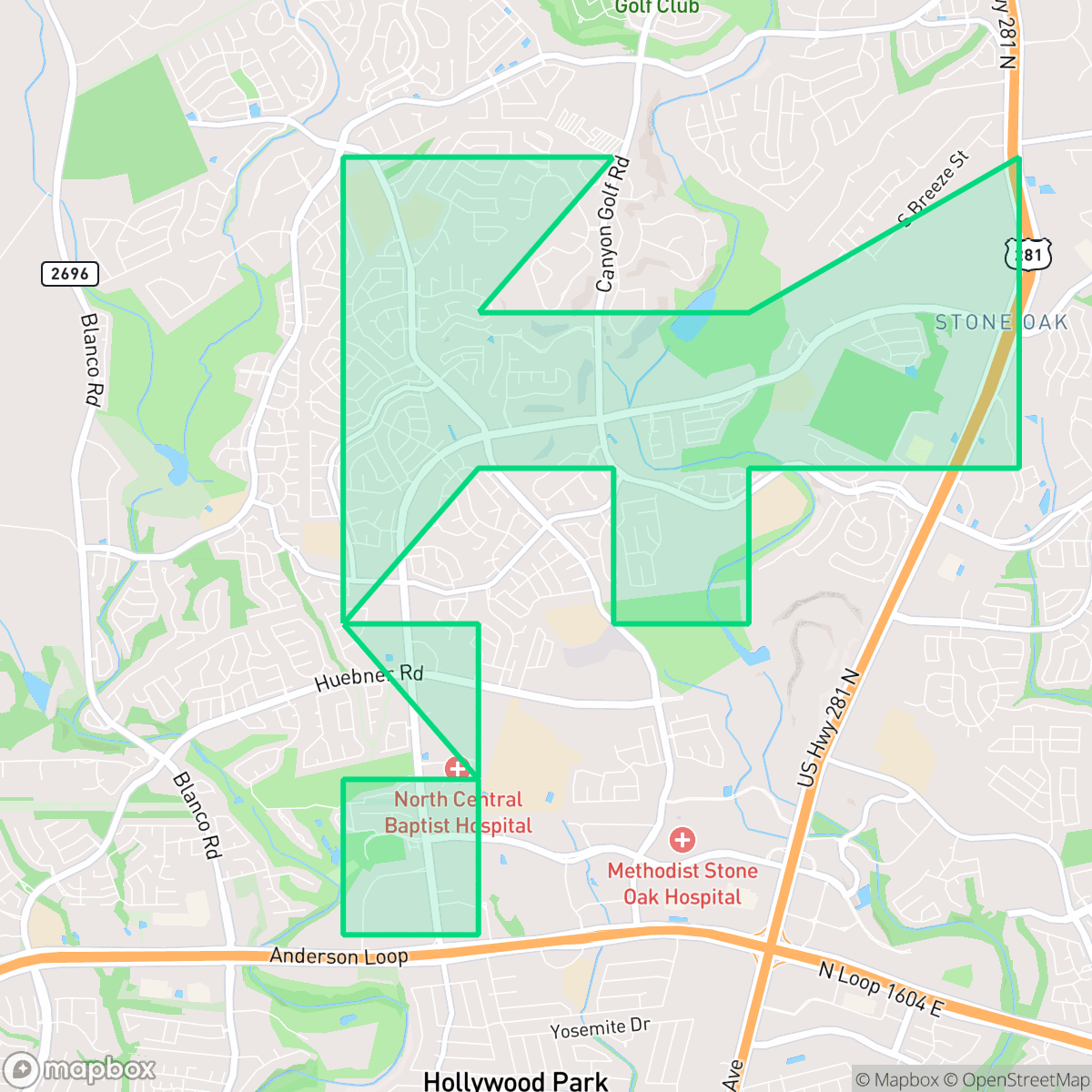
About Stone Oak
Established in 1985, Stone Oak was the first master-planned community in Bexar County, Texas. Envisioned by developer Dan Parman and his partners, the neighborhood was created by assembling roughly 5,000 acres of active ranchland north of Loop 1604, a purchase that was the largest in county history at the time. Parman designed the community with strict zoning guidelines to balance residential subdivisions with commercial hubs. Though development slowed during the Savings and Loan Crisis of the late 1980s, the area rebounded and was annexed by San Antonio in 1997. Today, the neighborhood is known for its rolling Hill Country terrain, gated subdivisions, and local landmarks like the Sonterra Country Club, the Canyon Springs Golf Club, and the Parman Library, which honors the founder's philanthropic legacy.
The neighborhood functions as a prominent suburban hub in northern San Antonio, defined by its blend of gated residential enclaves and established commercial corridors. It is highly regarded for its visual appeal and access to quality education within the North East Independent School District, which maintains a strong reputation for academic performance. According to iHuus data, the area provides a consistent level of privacy and maintains significant green spaces, making it a popular choice for families and professionals seeking a structured living environment outside the city center. Residents have access to a variety of local services, ranging from diverse dining options to wellness businesses, all integrated into the master-planned design.
Living in this area involves certain trade-offs, primarily regarding transportation and environmental factors. The community is largely car-dependent, as most businesses are not within comfortable walking distance for daily errands. While the neighborhood is free from industrial hazards, residents may experience moderate noise levels due to its proximity to major road arteries. Additionally, those prioritizing air quality should note that the area reports lower scores compared to some other parts of the city. Overall, the neighborhood is best suited for those who value organized suburban planning, access to top-tier schools, and a scenic landscape over urban walkability.
Neighborhood Scores Across 15 Qualities
Detached homes feature moderate setbacks and mature tree buffers that provide slightly more separation between neighbors than the San Antonio average. Most properties include private fenced yards with consistent spacing between adjacent structures.
Continuous sidewalks and safe crossings are common throughout the area, making it more walkable than the San Antonio average. While residential cul-de-sacs are well-connected, some parts of the neighborhood remain car-centric with limited walking access to commercial hubs.
Large homes with complex rooflines, private pools, and well-manicured landscaping characterize the area. This level of visual polish and architectural scale is notably higher than the San Antonio average, according to iHuus data.
Wide grass verges and a large central wooded greenway provide safe, continuous walking space for pets. This area offers significantly more accessible green space for pet owners than the San Antonio average.
Residential areas feature a blend of dense suburban layouts and low-density pockets characterized by significant tree canopy and open land. This balance of developed housing and natural greenery is slightly more prevalent here than the San Antonio average, according to iHuus data.
A variety of dining and social spots provide a higher level of activity than the San Antonio average. While some pockets near water offer walkable paths, much of the neighborhood's commercial energy is concentrated near major highways and requires a car for easy access.
Steady traffic sounds from nearby busy streets are present, though levels are roughly consistent with the San Antonio average according to iHuus data.
Frequent unhealthy air quality levels pose a significant risk to sensitive groups, appearing slightly worse than the San Antonio average according to iHuus data.
Industrial presence is virtually nonexistent throughout most of the area, offering a much cleaner environment than the San Antonio average. While a large limestone quarry exists in the center of the neighborhood, the surrounding landscape remains predominantly residential and free from warehouses or heavy industrial facilities.
Health insurance enrollment rates in this area are notably higher than the San Antonio average, according to iHuus data.
Conservative residents form the majority in this area, representing a notable departure from the more liberal-leaning trend seen across San Antonio. According to iHuus data, the local political landscape is predominantly conservative with a small opposing presence.
A balanced mix of young adults, families, and older residents characterizes the area. This age distribution is consistent with the broader San Antonio population, according to iHuus data.
Flood safety in this area is notably higher than the San Antonio average, though some properties remain within areas subject to occasional residual risk.
Address-Level Insights for Stone Oak


iHuus Neighborhood Intelligence Insights
Get address-level neighborhood insights for Stone Oak
- Street-level scores — see how individual blocks compare, not just neighborhood averages
- Micro-zone boundaries — identify quiet pockets, flood boundaries, and walkable clusters before you visit
- 15 dimensions in full — walkability, noise, air quality, school quality, insurance coverage, population age profile, urban/rural index, and more
- Boundary risk alerts — know if your address sits near a block boundary where scores drop, the kind of detail no listing will ever mention
- School insights — individual school ratings and insights, not just district-level data
- Compare before you commit — side-by-side data across neighborhoods, down to block precision
No credit card required
Compare with Any Neighborhood
| Dimension | Stone Oak | 145 Association |
|---|---|---|
| 🚶 Walkabilityavg 6.44 | ||
| 🔊 Acoustic Comfortavg 4.07 | ||
| 🤫 Privacy Indexavg 5.75 | ||
| 🎨 Visual Appealavg 6.11 | ||
| 🐕 Dog Friendlinessavg 5.91 | ||
| 🗺️ Urban-Rural Indexavg 6.87 | ||
| ✨ Neighborhood Vibeavg 4.35 | ||
| 🏥 Health Insurance Coverageavg 5.94 | ||
| 🌿 Air Qualityavg 2.27 | ||
| 🏭 Industrial Proximityavg 8.31 | ||
| 🌊 Flood Safetyavg 4.2 | ||
| 🗳️ Ideological Leanavg 7.37 | ||
| 👥 Population Age Profileavg 4.68 | ||
| 🔥 Fire Safety | ||
| 🏫 School Quality |
Stone Oak Rankings
School Districts Serving Stone Oak
School Insights for Stone Oak
Below average outcomes; significant attendance and academic challenges.
School Insights
See what's really behind every school rating near Stone Oak
- Individual school ratings — each school's own score with outcome context, not just a district average
- Enrollment & class size data — student-to-teacher ratio and how it compares to the state average
- Full demographics breakdown — ethnicity and gender composition for every school in the enrollment zone
- Every school in the district — all schools within the enrollment boundary ranked by rating, not just the closest one
- Grade levels & benchmarks — elementary through high school, with below/above state-average flags
No credit card required