Stone Mountain-Stone Oak, San Antonio
Updated · 1,200 residents
Stone Mountain-Stone Oak is a quiet, residential enclave in far north San Antonio known for its high-quality homes and abundant natural beauty. Residents enjoy excellent walkability and access to extensive green spaces, though the area experiences noticeable noise from nearby road traffic.
Key Highlights
About Stone Mountain-Stone Oak
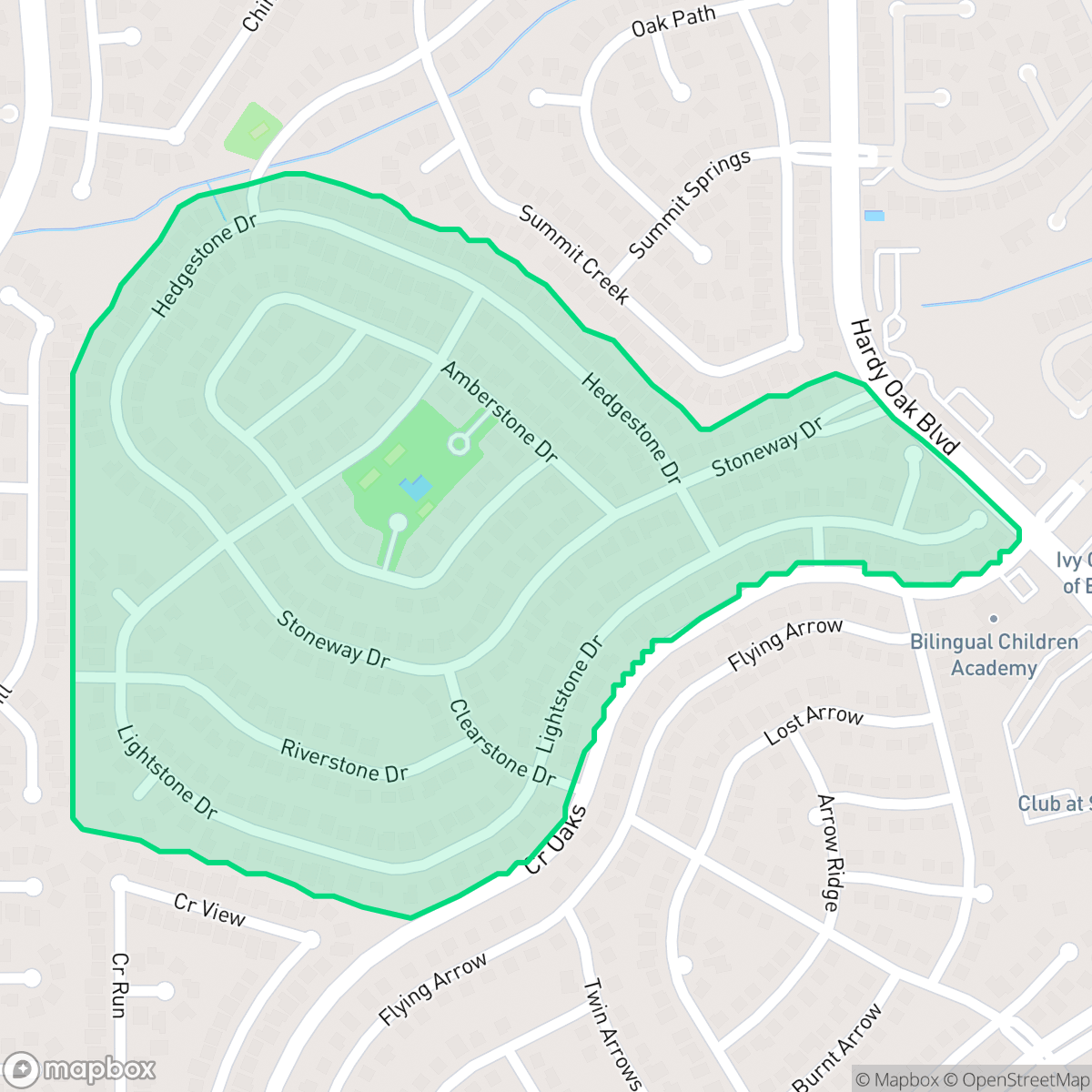
Stone Mountain is a residential subdivision of 380 homes within the larger Stone Oak master-planned community in far north San Antonio. The area originally consisted of several ranches before developer Dan Parman led private efforts to craft the boundaries of Stone Oak in 1985, establishing the first master-planned community in Bexar County. Development of the Stone Mountain subdivision specifically began in the early 1990s, with homes constructed starting around 1992. Designed to transition the outlying countryside into a cohesive suburban environment, the neighborhood’s growth slowed during the Savings and Loan Crisis of the late 1980s and early 1990s before expanding rapidly. Today, the neighborhood is known for its rolling hills, mature oak trees, and proximity to local landmarks like the Parman Library and the Canyon Springs Golf Club.
The neighborhood is defined by its low-density, suburban character, featuring large homes with complex rooflines and well-manicured yards. With a high urban-rural index, the area offers a serene atmosphere characterized by significant tree canopy coverage and a complete absence of industrial activity. It serves as a peaceful retreat for those who value privacy and a connection to nature, while maintaining a strong sense of community through its well-maintained sidewalks and pedestrian-friendly layout.
While the area is highly rated for its dog friendliness and aesthetic appeal, prospective residents should note that acoustic comfort is lower than the city average due to road traffic noise. The community is well-served by the North East Independent School District, which maintains high academic standards. It is an ideal location for families and professionals seeking a stable, high-amenity environment with excellent health insurance coverage and proximity to local lifestyle services.
Neighborhood Scores Across 15 Qualities
Detached homes feature moderate setbacks and mature tree buffers that provide a sense of separation between neighbors. This level of spacing is slightly higher than the San Antonio average, according to iHuus data.
Sidewalks are available along main arteries and within residential cul-de-sacs, making the area more walkable than the San Antonio average. While pedestrian infrastructure is present, the suburban layout remains car-centric and lacks direct walking access to commercial hubs.
Manicured yards, private pools, and large homes with complex architecture define the local landscape. This level of visual quality and architectural detail is significantly higher than the San Antonio average, according to iHuus data.
Wide green verges and large wooded areas on the western edge offer safe, traffic-free walking spaces for pets. According to iHuus data, these connected natural spaces make the area more dog-friendly than much of San Antonio.
Low-density housing and significant tree canopy coverage provide a more open, wooded environment than the typical San Antonio urban layout. This area features a mix of scattered homes and larger institutional buildings, offering more greenery than the city average.
Low density residential blocks and significant green space create a tranquil atmosphere, though activity levels are slightly below the San Antonio average. While local dining and wellness services provide essential amenities, most businesses require a drive as they are not within walking distance.
Frequent noise from nearby freeways and railroad tracks is a notable feature of this area. According to iHuus data, the level of acoustic disturbance here is higher than the San Antonio average.
Frequent unhealthy air quality levels pose a significant risk to sensitive groups. According to iHuus data, the pollution levels in this area are slightly worse than the San Antonio average.
Industrial facilities, warehouses, and hazardous sites are entirely absent from this area. According to iHuus data, this neighborhood maintains a higher level of separation from industrial activity than the San Antonio average.
Health insurance accessibility is significantly higher than the San Antonio average, according to iHuus data. Residents in this area benefit from a much greater proportion of covered individuals compared to the rest of the city.
Political leanings in this area lean significantly more conservative than the San Antonio city average. According to iHuus data, the community maintains a conservative majority with a smaller presence of opposing viewpoints.
A balanced mix of young adults, families, and older residents characterizes the area, reflecting a demographic spread very similar to the San Antonio average.
Flood risk in this area is significantly lower than the San Antonio average, though some residual risk remains within specific zones. According to iHuus data, most of the neighborhood sits outside the primary flood hazard areas.
Address-Level Insights for Stone Mountain-Stone Oak


iHuus Neighborhood Intelligence Insights
Get address-level neighborhood insights for Stone Mountain-Stone Oak
- Street-level scores — see how individual blocks compare, not just neighborhood averages
- Micro-zone boundaries — identify quiet pockets, flood boundaries, and walkable clusters before you visit
- 15 dimensions in full — walkability, noise, air quality, school quality, insurance coverage, population age profile, urban/rural index, and more
- Boundary risk alerts — know if your address sits near a block boundary where scores drop, the kind of detail no listing will ever mention
- School insights — individual school ratings and insights, not just district-level data
- Compare before you commit — side-by-side data across neighborhoods, down to block precision
No credit card required
Compare with Any Neighborhood
| Dimension | Stone Mountain-Stone Oak | 145 Association |
|---|---|---|
| 🚶 Walkabilityavg 6.44 | ||
| 🔊 Acoustic Comfortavg 4.07 | ||
| 🤫 Privacy Indexavg 5.75 | ||
| 🎨 Visual Appealavg 6.11 | ||
| 🐕 Dog Friendlinessavg 5.91 | ||
| 🗺️ Urban-Rural Indexavg 6.87 | ||
| ✨ Neighborhood Vibeavg 4.35 | ||
| 🏥 Health Insurance Coverageavg 5.94 | ||
| 🌿 Air Qualityavg 2.27 | ||
| 🏭 Industrial Proximityavg 8.31 | ||
| 🌊 Flood Safetyavg 4.2 | ||
| 🗳️ Ideological Leanavg 7.37 | ||
| 👥 Population Age Profileavg 4.68 | ||
| 🔥 Fire Safety | ||
| 🏫 School Quality |
Stone Mountain-Stone Oak Rankings
School Districts Serving Stone Mountain-Stone Oak
School Insights for Stone Mountain-Stone Oak
Below average outcomes; significant attendance and academic challenges.
School Insights
See what's really behind every school rating near Stone Mountain-Stone Oak
- Individual school ratings — each school's own score with outcome context, not just a district average
- Enrollment & class size data — student-to-teacher ratio and how it compares to the state average
- Full demographics breakdown — ethnicity and gender composition for every school in the enrollment zone
- Every school in the district — all schools within the enrollment boundary ranked by rating, not just the closest one
- Grade levels & benchmarks — elementary through high school, with below/above state-average flags
No credit card required