Southeast Citizens Committee-Highland Park, San Antonio
Updated · 1,804 residents
Southeast Citizens Committee-Highland Park is a quiet, residential enclave in San Antonio defined by its grid layout and absence of industrial activity. Residents benefit from low noise levels, though the area faces notable challenges regarding flood safety and limited access to local commercial services.
Key Highlights
About Southeast Citizens Committee-Highland Park
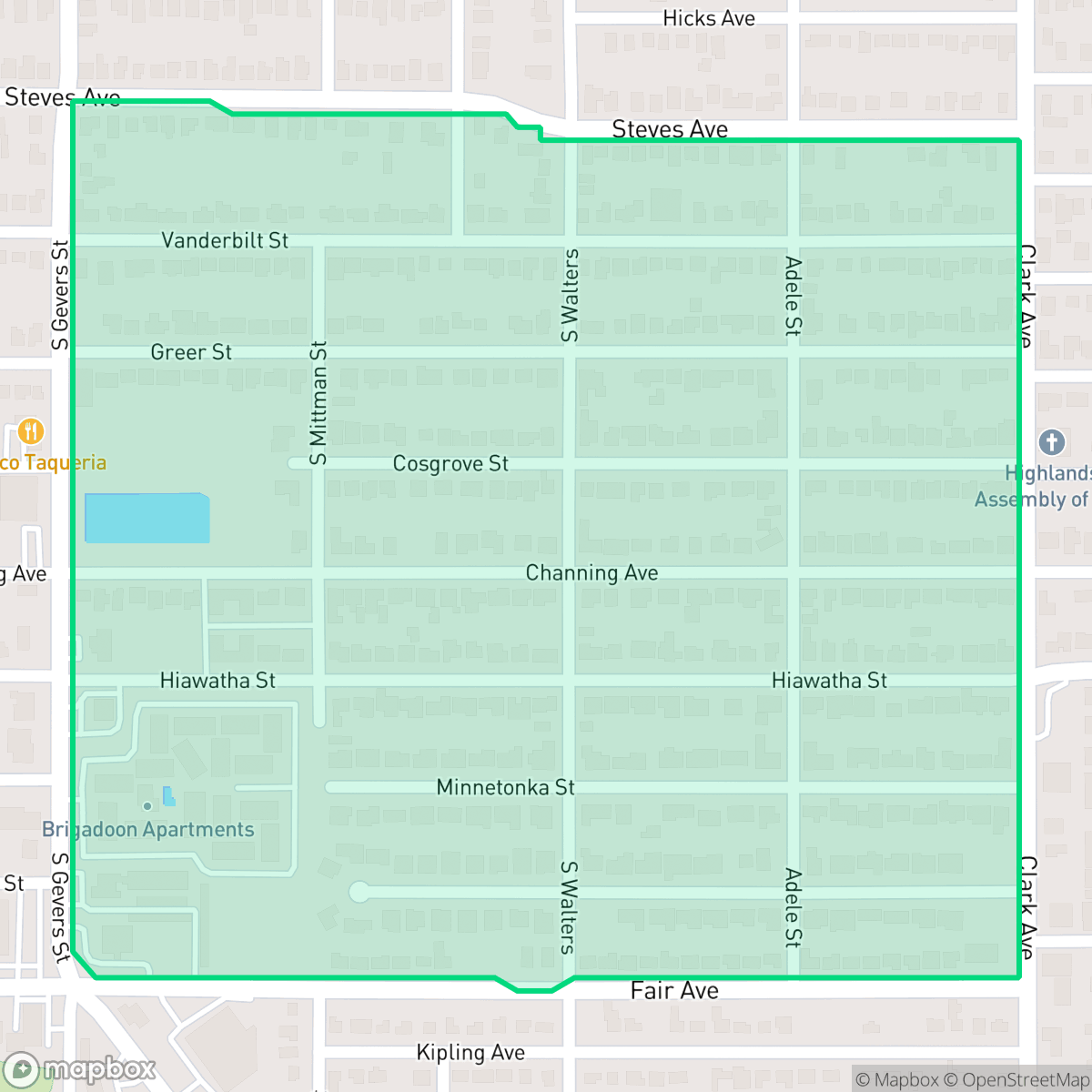
Developed starting in 1909 by the Highland Park Improvement Company on former dairy land known as "Steves Pasture," Highland Park grew into one of San Antonio's largest streetcar suburbs, anchored by the No. 10 trolley line. The neighborhood is characterized by a diverse mix of Craftsman bungalows, Victorian homes, and Spanish Revival cottages. A key community landmark is the 1914 Highland Park Elementary School, built on one of the area's highest elevations. Historically, the neighborhood is noted as the home of pioneering panoramic photographer E.O. Goldbeck, who lived and worked on Drexel Avenue. In the late 1950s and early 1960s, strong community advocacy successfully diverted the construction of Interstate 37 to the neighborhood's outer edge, preserving its historic architectural fabric and tight-knit layout.
According to iHuus data, the neighborhood maintains a consistent, low-density residential rhythm, characterized by a grid street layout that prioritizes quiet living over commercial activity. With an acoustic comfort level that ranks well above the city average, the area functions as a peaceful retreat from urban noise, free from the presence of heavy industry or warehouses. Its landscape is defined by ample green space, including local athletic fields and grass verges that provide suitable areas for pet owners to navigate.
Prospective residents should consider the trade-offs associated with this location, including significant flood safety risks and air quality concerns. The neighborhood is served by the San Antonio Independent School District, which is currently navigating a period of academic restructuring and facility consolidation. While the street grid offers a traditional suburban feel, the walkability is inconsistent due to canopy-covered sidewalks, and the scarcity of local businesses requires residents to travel outside the immediate area for most daily errands.
Neighborhood Scores Across 15 Qualities
Standard suburban spacing provides a moderate level of separation between homes. According to iHuus data, this density is slightly higher than the San Antonio average, offering a balance of community proximity and small private yard buffers.
Residential streets follow a consistent grid and offer a peaceful environment for walking, although sidewalk availability is inconsistent due to dense tree canopy. According to iHuus data, walkability in this area is slightly below the San Antonio average.
Standard tract housing with small yards and simple roof geometries defines the local landscape. This visual character is slightly below the San Antonio average due to a lack of expansive landscaping or luxury amenities.
Limited access to public parks and narrow street verges make pet walking more difficult here than in most parts of San Antonio. While some areas feature continuous grass along streets, much of the neighborhood greenery is contained within private yards.
Open land and scattered homes amid woodland provide a more rural feel than the typical San Antonio landscape. According to iHuus data, this area features a mix of dense suburban grids and larger residential clusters alongside more dispersed properties.
Local dining and services are available, though the area is more active than the San Antonio average. Most activities require a vehicle because many businesses are not within walking distance.
Acoustic levels remain low, with noise primarily limited to infrequent distant trains or sporadic vehicle traffic. According to iHuus data, this area is significantly quieter than the San Antonio average.
Frequent unhealthy air quality levels present a significant health risk to sensitive groups. According to iHuus data, these conditions are worse than the average seen throughout San Antonio.
Industrial facilities and warehouses are entirely absent from this area, offering a cleaner environment than the San Antonio average. According to iHuus data, the neighborhood consists solely of residential, institutional, and light commercial uses.
Health insurance access is more prevalent here than the San Antonio average, according to iHuus data. Residents benefit from a higher rate of coverage compared to the rest of the city.
Voting patterns and census indicators show a significantly more liberal leaning than the San Antonio average, according to iHuus data.
Residents live among a balanced mix of young adults, families, and older individuals. According to iHuus data, this demographic spread is slightly more varied than the San Antonio average.
Address-Level Insights for Southeast Citizens Committee-Highland Park


iHuus Neighborhood Intelligence Insights
Get address-level neighborhood insights for Southeast Citizens Committee-Highland Park
- Street-level scores — see how individual blocks compare, not just neighborhood averages
- Micro-zone boundaries — identify quiet pockets, flood boundaries, and walkable clusters before you visit
- 15 dimensions in full — walkability, noise, air quality, school quality, insurance coverage, population age profile, urban/rural index, and more
- Boundary risk alerts — know if your address sits near a block boundary where scores drop, the kind of detail no listing will ever mention
- School insights — individual school ratings and insights, not just district-level data
- Compare before you commit — side-by-side data across neighborhoods, down to block precision
No credit card required
Compare with Any Neighborhood
| Dimension | Southeast Citizens Committee-Highland Park | 145 Association |
|---|---|---|
| 🚶 Walkabilityavg 6.44 | ||
| 🔊 Acoustic Comfortavg 4.07 | ||
| 🤫 Privacy Indexavg 5.75 | ||
| 🎨 Visual Appealavg 6.11 | ||
| 🐕 Dog Friendlinessavg 5.91 | ||
| 🗺️ Urban-Rural Indexavg 6.87 | ||
| ✨ Neighborhood Vibeavg 4.35 | ||
| 🏥 Health Insurance Coverageavg 5.94 | ||
| 🌿 Air Qualityavg 2.27 | ||
| 🏭 Industrial Proximityavg 8.31 | ||
| 🌊 Flood Safetyavg 4.2 | ||
| 🗳️ Ideological Leanavg 7.37 | ||
| 👥 Population Age Profileavg 4.68 | ||
| 🔥 Fire Safety | ||
| 🏫 School Quality |
Southeast Citizens Committee-Highland Park Rankings
School Districts Serving Southeast Citizens Committee-Highland Park
School Insights for Southeast Citizens Committee-Highland Park
Below average outcomes; significant attendance and academic challenges.
School Insights
See what's really behind every school rating near Southeast Citizens Committee-Highland Park
- Individual school ratings — each school's own score with outcome context, not just a district average
- Enrollment & class size data — student-to-teacher ratio and how it compares to the state average
- Full demographics breakdown — ethnicity and gender composition for every school in the enrollment zone
- Every school in the district — all schools within the enrollment boundary ranked by rating, not just the closest one
- Grade levels & benchmarks — elementary through high school, with below/above state-average flags
No credit card required